

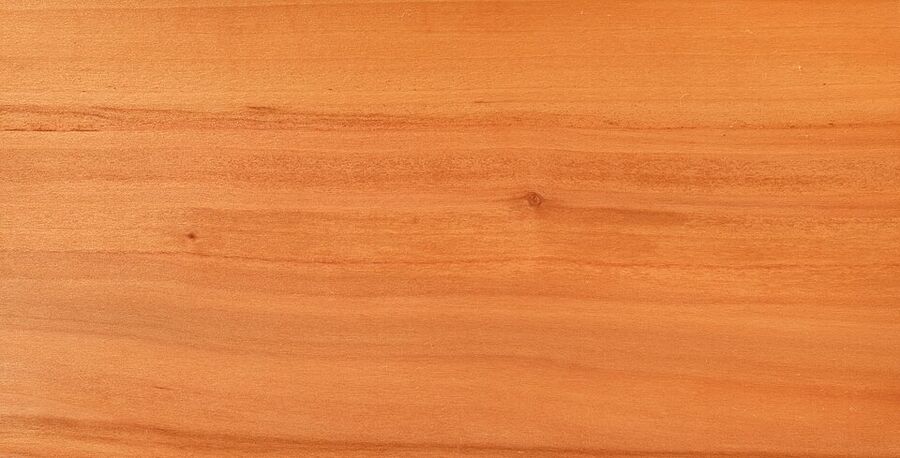

Overview
Apple is a hard, dense, fine-grained fruitwood in light pinkish brown, produced mainly from old orchard trees that have been removed. Boards are rarely wide or long, and Wood Database notes it is seldom available as lumber. Choose it for turned work, handles, carving and small, hard-wearing parts, not for large panels.
Pros
- Very hard and dense (Janka 1,730 lbf, about 830 kg/m3), so it wears and polishes well.
- Fine, even texture suits turning and carving.
- Fine, uniform texture closely resembling cherry, but significantly heavier and harder (Wood Database).
- Glues, stains, finishes and turns well; Wood Database calls it excellent for turning.
Cons
- Wood Database calls it hard to work, and notes it can burn when cut with dull tools.
- High shrinkage (5.6% radial, 10.1% tangential) and a large amount of seasonal movement in service (Wood Database).
- Non-durable: indoor use only.
- Seldom available as lumber, and usually only in very small sizes; Hearne lists it at $22-25 per bf.
Variants and subspecies
- Cultivated apple (Malus domestica): the orchard tree and the usual source of the timber.
- European crab apple (Malus sylvestris): the wild species, a small tree; Wikipedia gives it a data deficient status.
- Fruit variety is not distinguished in the timber trade.
Working and finishing
Wood Database: somewhat difficult to work because of its high density, and it burns easily when machined, so keep cutters sharp and feed steadily. It glues, stains, finishes and turns well, and has a faint sweet scent while being worked.
Staining and finishing colour
Wood Database says apple stains and finishes well. The fine, uniform grain resembles cherry, and a clear finish shows the reddish-brown colour and any darker banding.
Sustainability and handling
Wood Database reports apple is neither CITES-listed nor on the IUCN Red List (checked 2026-09-30). For the wild Malus sylvestris, the Wikipedia taxobox gives data deficient, so the conservation field is n/a. Wood Database reports no health effects specific to apple, though any wood dust is an irritant. EU traders should note the EU Deforestation Regulation (30 December 2026 for large and medium operators). US imports need a Lacey Act plant declaration (16 USC 3372(f)).
Popular projects
Wood Database lists fine furniture, tool handles, carving, mallet heads, turned items and other small specialty objects.
Buying notes
Expect short, narrow boards and turning blanks. Wood Database says it is likely to be rather expensive and meant for small projects. Ask for dry stock.
Typical projects
- turned objects
- tool handles
- carving
- mallet heads
- fine furniture
- small specialty objects
Sources
Researched 2026-09-30. Prices, conservation status and CITES listings on this page are indicative and were checked on that date. They change: confirm them with your supplier, and with the relevant authority before importing or exporting.