


Overview
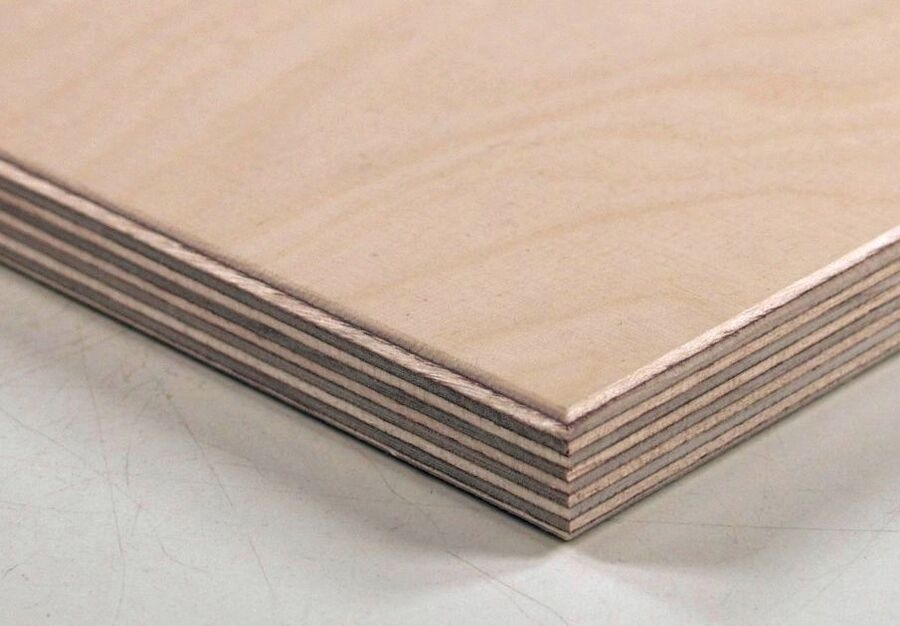
Baltic birch is plywood made entirely of thin birch veneers, with no softwood or filler plies, so every layer is the same hard, pale wood. It comes in many more plies than ordinary plywood (Popular Woodworking counts 13 in a 3/4 in sheet), which gives a dense, void-free core and a clean striped edge that people leave exposed on purpose. It is the default shop plywood for drawer boxes, jigs, CNC and laser work. Birch-faced "CNC plywood" and cheaper imported birch ply are covered here too, because they are sold as the same idea with fewer plies or poorer faces.
Pros
- Many plies of equal thickness. In Popular Woodworking's measurements, Baltic birch was the most consistent plywood tested: all 18 samples were within 0.003 in of each other.
- The core has no softwood gaps to hide, so edges cut, rout and sand clean, and the edge can be left as a design feature.
- More plies mean better resistance to splitting when you screw into an edge, which is why it suits drawer sides and box joints.
- Takes a clear finish and laser engraving well, and flat 5x5 sheets fit small CNC beds and car boots.
Cons
- Real Baltic sheets are 5x5 ft, so a 4x8 sheet is often a different product, and 4x8 can cost a lot more than the same thickness of cabinet-grade birch (Baker's list price for 3/4 4x8 B/BB is $136.00 against $84.95 at Toledo).
- The common "BB" face allows patches. Toledo says BB allows an average of 3 to 6 colour-matched patches per face, so for a showpiece look at B/BB or better.
- Metric thicknesses (18 mm sold as "3/4 in", 12 mm as "1/2 in") do not match imperial router bits and dado stacks exactly. Measure before cutting joints.
- Birch faces are thin and sand through quickly.
- Provenance is hard to verify (see sustainability).
Variants and subspecies
- BB/BB: BB faces both sides, patches allowed. The usual shop grade.
- B/BB: a better face on one side, priced higher. Toledo's no-patch B/BB 3/4 4x8 was $114.95.
- Finnish aircraft birch: a different product at much higher prices; see Aircraft plywood.
- Turkish or other birch: Toledo lists a Turkish 1/2 in sheet at $49.95 against $59.95 for its standard BB/BB.
- Birch-faced CNC ply with softwood or poplar core: cheaper and lighter, sold for cutting parts. Faces are birch but the core is not all birch; read the label. See Domestic birch plywood for domestic cabinet-grade and Appleply.
- Film-faced Baltic birch for concrete forms, which Toledo lists at $94.95 for 3/4 in; see Formply (concrete form plywood).
Working and finishing
Cut with a sharp, fine-tooth blade and score or tape the cut line to limit face tear-out; the many plies cut cleanly without the voids that ruin edges on cheaper plywood. Edges sand to a good finish; many woodworkers leave them bare under oil or lacquer, and others band them. Screw into edges with pilot holes; the multi-ply edge holds better than a veneer-core edge with fewer plies. For laser cutting, Toledo says its 5x5 sheets use interior glue, which it describes as laser-friendly, while its 4x8 sheets use exterior glue, so check before buying for a laser.
Staining and finishing colour
Birch is a blotch-prone wood under penetrating stain. Use a pre-stain conditioner or a gel stain on faces, or choose clear finish to keep the pale colour. Veneers are thin, so heavy sanding with coarse grits will go through the face. The edge stripes accept stain slightly differently from the face, so stained work shows the glue lines clearly.
Sustainability and handling
Sourcing is the main concern. Wood Central (February 2026) reports the US still imports at least 10,000 m3 a month of Russian birch plywood (11,300 m3 in November 2025). The US put a 50 percent tariff on Russian and Belarusian plywood (NBC, February 2023). Earthsight reports US Treasury sanctions on a Segezha-linked supplier in November 2023 and notes there is no total US ban. The EU has banned Russian birch plywood since July 2022 and extended anti-dumping measures to Kazakhstan and Turkiye on 14 May 2024. Legal status checked 2026-09-30. Ask a supplier for the mill and country of origin, and for an FSC chain-of-custody number you can check. Earthsight found FSC labels misused on Russian birch ply.
Glue and formaldehyde: composite wood sold in the US must meet EPA TSCA Title VI limits (0.05 ppm for hardwood plywood). A 3/4 in 4x8 sheet is heavy, so use two people. Sanding dust is irritating.
Popular projects
Drawer boxes and tool-chest trays, shop jigs and sleds, router templates, CNC-cut furniture, toys, puzzles, speaker boxes, and modern furniture with exposed laminated edges.
Buying notes
Ask for BB/BB or B/BB, the thickness in both inch and mm, and 4x8 or 5x5. Indicative US prices (September 2026): Toledo 5x5 BB/BB 1/4 in $26.95, 1/2 in $41.95, 3/4 in $62.95, 1 in $84.95; Toledo 4x8 BB/BB 1/4 in $34.95, 1/2 in $59.95, 3/4 in $84.95; Berta 4x8 BB/BB 3/4 in $99.90, with discounts of 10, 15 and 20 percent at 10, 20 and 50 sheets. Check each sheet for flatness and face patches before paying list price at specialty yards.
Typical projects
- drawer boxes
- jigs and shop fixtures
- CNC and laser-cut parts
- toys and puzzles
- speaker enclosures
- exposed-edge furniture
Hardware that suits this
Sources
- www.toledoplywood.com/product-category/categories/hardwoods/baltic-...
- www.toledoplywood.com/product/3-4-5-x-5-g2s-baltic-birch-13-ply-bb-bb
- www.bakerlumber.net/products/plywood/baltic-birch.html
- bertastore.com/products/baltic-birch-plywood-bb-bb
- makerstock.com/products/baltic-birch-plywood
- www.popularwoodworking.com/wood/choose_the_right_plywood
- www.aircraftspruce.com/catalog/wppages/finnishbirch.php
- en.wikipedia.org/wiki/Plywood
- woodcentral.com.au/four-years-into-ukraine-war-u-s-is-still-hungry-...
- www.nbcnews.com/news/world/us-tariffs-russian-plywood-ukraine-invas...
- www.earthsight.org.uk/news/US-sanctions-Russian-timber
- policy.trade.ec.europa.eu/news/eu-tackles-circumvention-anti-dumpin...
- www.epa.gov/formaldehyde/formaldehyde-emission-standards-composite-...
Researched 2026-09-30. Prices, conservation status and CITES listings on this page are indicative and were checked on that date. They change: confirm them with your supplier, and with the relevant authority before importing or exporting.