


Overview
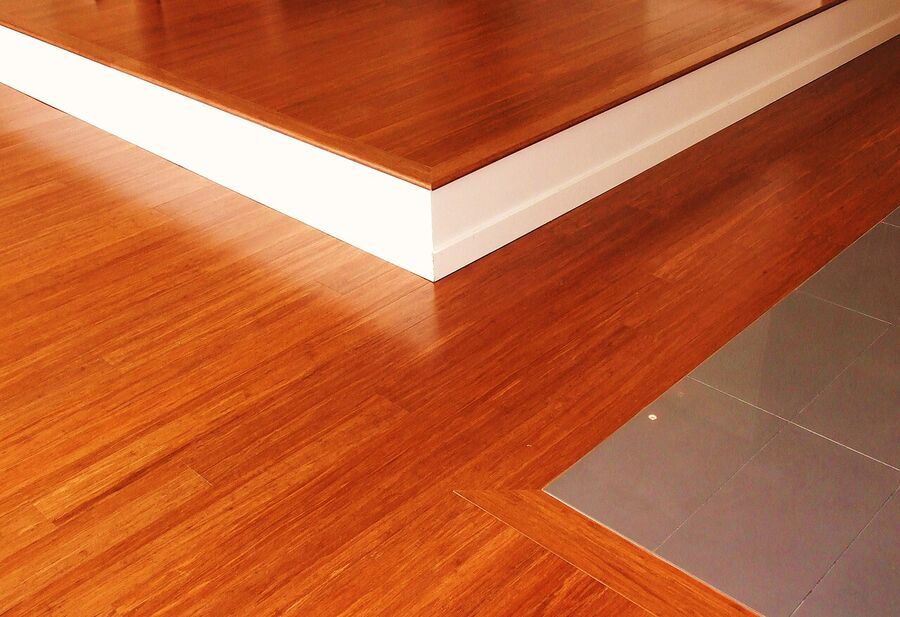
Strand-woven bamboo is made by shredding bamboo into fibre strands, coating them in resin and compressing them into dense blocks, which are then sawn into boards. The result is far harder than ordinary laminated bamboo and is sold as flooring and as thick slabs for counters and tabletops. It is a grass, so there are no growth rings; the look is a streaky, interwoven pattern. Pick it when you need a hard, stable surface at a moderate price.
Pros
- Very hard. Wikipedia puts strand-woven flooring at 3,000 to over 5,000 lbf on the Janka scale, against 1,360 for white oak and 2,350 for jatoba. Sources and makers disagree, so treat the number as a range, not a spec.
- Cheaper than most hardwoods of similar hardness: Angi gives $5-10 per sq ft of material.
- Can be sawn, planed and routed with woodworking tools, as the Wikipedia page shows with a mitred ramp.
- Refinishes with clear coat readily.
Cons
- Extremely tough on tooling; silica in bamboo (0.5 to 4.0% in the outer layers per the Wood Database) adds to the wear.
- Resin-heavy. Most bamboo flooring uses urea-formaldehyde adhesive (Wikipedia), though UF-free products exist; ask.
- Floating installation is not suitable for strand-woven, per Angi.
- Staining is difficult (Wikipedia) and results are unpredictable.
- Perishable outdoors and not covered by agreed structural standards (Wikipedia).
- Brands vary widely in density and resin content.
Variants and subspecies
- Natural: tan, lightest and hardest.
- Carbonized: heat-darkened to caramel or brown; Wikipedia notes carbonizing significantly reduces hardness.
- Pre-coloured / stained at the factory: the practical way to get dark tones.
- Thick butcher-block slabs: for tops, sold by specialist dealers.
- For the softer strip-laminated board see Laminated bamboo (vertical and horizontal).
Working and finishing
Use carbide-tipped blades and cutters, slow feeds and a good dust collector; high-speed steel dulls fast. Predrill for screws. Tape the line of a crosscut and cut with the show face up to limit tear-out. The Wood Database says bamboo glues well; test your adhesive on an offcut, since the dense resin-bonded surface differs from raw bamboo.
Staining and finishing colour
Wikipedia calls on-site staining challenging; the resin-dense strands refuse stain in patches. If you want a particular colour, buy factory-coloured stock, or use dye or a pigmented clear coat tested on offcuts. Clear coats go on well and renew easily.
Sustainability and handling
Bamboo is not on CITES or the IUCN list (Wood Database). It matures quickly, quoted as two to three years by the Wood Database and three to five by Wikipedia; Teragren harvests moso at 5.5 to 6 years, and the Wood Database says strength keeps increasing for a few years, so harvest age matters. Strand-woven is dense and resin-rich, so shipping and processing add energy (the Wood Database calls processed imports energy-intensive; Wikipedia notes shipping from China). We have not verified an embodied-carbon figure. Ask for a formaldehyde statement and FSC certification.
Popular projects
Flooring dominates. In furniture it appears as counters, desktops, stair treads, butcher-block-style tops and shelves, where hardness resists dents.
Buying notes
Floors are sold by the square foot (Angi: $5-10 for materials, with brands from about $3.50 to $10). Specialist dealers sell slabs and boards at higher per-sq-ft prices. Check thickness, density or Janka claims against the brand's test data, resin type and warranty, and avoid unbranded stock with no formaldehyde documentation.
Typical projects
- flooring
- countertops
- stair treads
- butcher-block tops
- desks
- shelving
Sources
Researched 2026-09-30. Prices, conservation status and CITES listings on this page are indicative and were checked on that date. They change: confirm them with your supplier, and with the relevant authority before importing or exporting.