


Overview
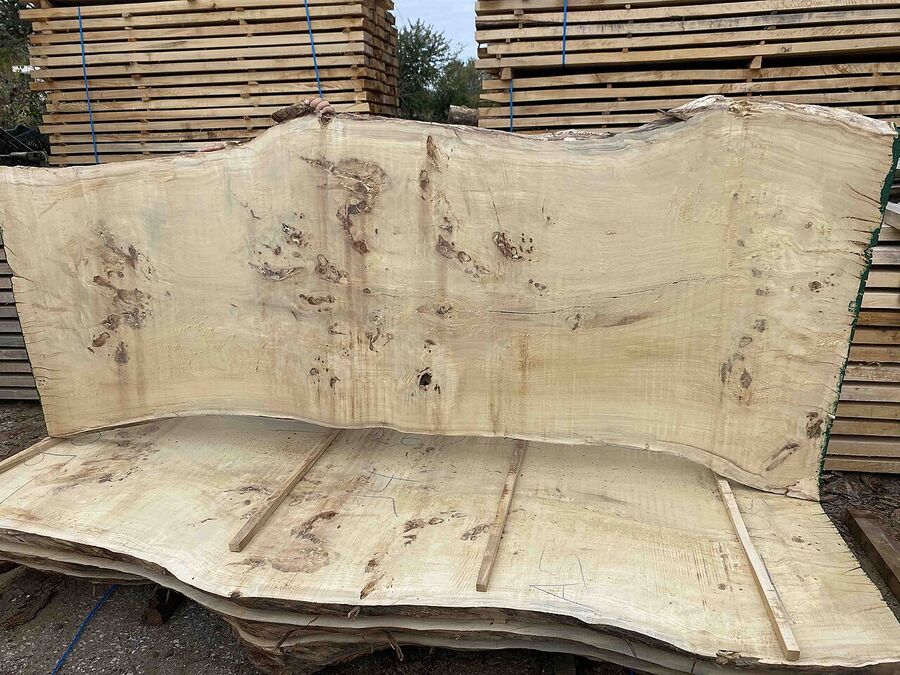
A burl (burr in British English) is a rounded outgrowth on a tree where the grain is deformed and filled with small knots from dormant buds, per Wikipedia. Cut open, it shows swirls, eyes and tight curls that no straight board has. It is chosen as decoration: veneer, inlay, instrument parts, turned bowls and focal-point panels, not as structural wood. This entry covers burls in general; the price is for one example, thuya burl.
Pros
- The most dramatic figure in wood, with each piece unique.
- The twisted, interlocked grain resists splitting. Wikipedia notes burls were used for mallets and bowls for that reason.
- Sliced into veneer, a small burl goes a long way. Wikipedia lists furniture veneer, inlay, instruments and turning among its uses.
- Burls grow on many species, including maple (called burr maple) and coast redwood.
Cons
- Very expensive per board foot in solid form: the thuya burl pieces I priced were about $182-280 per board foot.
- Hard to work. Wikipedia says the twisted, interlocked grain chips unpredictably and is very hard to work with hand tools or on a lathe.
- Irregular, often voided and cracked, so yield is low and every piece needs inspection.
- Supply has an ethical dimension: poaching (see Sustainability).
- No hardness number: I did not find a Janka for burl, and it varies with the host species.
Variants and subspecies
- By host tree. Burl is a growth pattern, not a species. Maple burl is called burr maple, and coast redwood burls can reach up to 26 ft (8 m), per Wikipedia. Thuya burl is the example priced here.
- Not the same as birdseye. Wikipedia treats birdseye as a different phenomenon, of unknown cause; see Figured wood.
- Cause. Wikipedia attributes burls to stress, such as injury, virus, fungus or Agrobacterium tumefaciens, and the USDA Forest Service describes the growth as hyperplasia of the xylem. Most burls grow underground on roots.
- Cuts. Slab, turning blank or veneer.
Working and finishing
Expect the grain to tear out in unexpected directions. Wikipedia says burl is difficult by hand and on the lathe. Sharp tools, light cuts and sanding rather than planing are my suggestions; no source is attached to them. Veneer is the practical way to cover a large surface, and a solid block suits turning and small boxes. Expect cracks and voids in raw slabs, and plan for filling them (my inference).
Staining and finishing colour
Take a conservative approach: the wood's swirl is the figure, and a stain can flatten or exaggerate it unpredictably. I found no sourced staining advice for burls, so test on an offcut and favour clear finishes.
Sustainability and handling
Wikipedia reports poaching of redwood burls in national parks and advises buyers to ask for provenance, with legal sources including private land clearing and salvage permits. I found no certification scheme for burls. Wear a respirator when sanding; I did not find a burl-specific health source.
Popular projects
Veneered furniture panels and tabletops, inlay, instrument parts, turned bowls and pens, and mallets (Wikipedia).
Buying notes
Sold as slabs, turning blanks, individual pieces and veneer. Rare Woods USA's thuya burl pieces came to about $182-208 per bf for six of the eight pieces and $266 and $280 for the other two, computed from price and dimensions; veneer prices are a different basis. Ask for provenance, check for cracks, and buy by the piece after viewing photos of the actual piece.
Typical projects
- veneer for furniture
- inlay
- instrument parts
- turned bowls
- mallets
Sources
Researched 2026-09-30. Prices, conservation status and CITES listings on this page are indicative and were checked on that date. They change: confirm them with your supplier, and with the relevant authority before importing or exporting.