

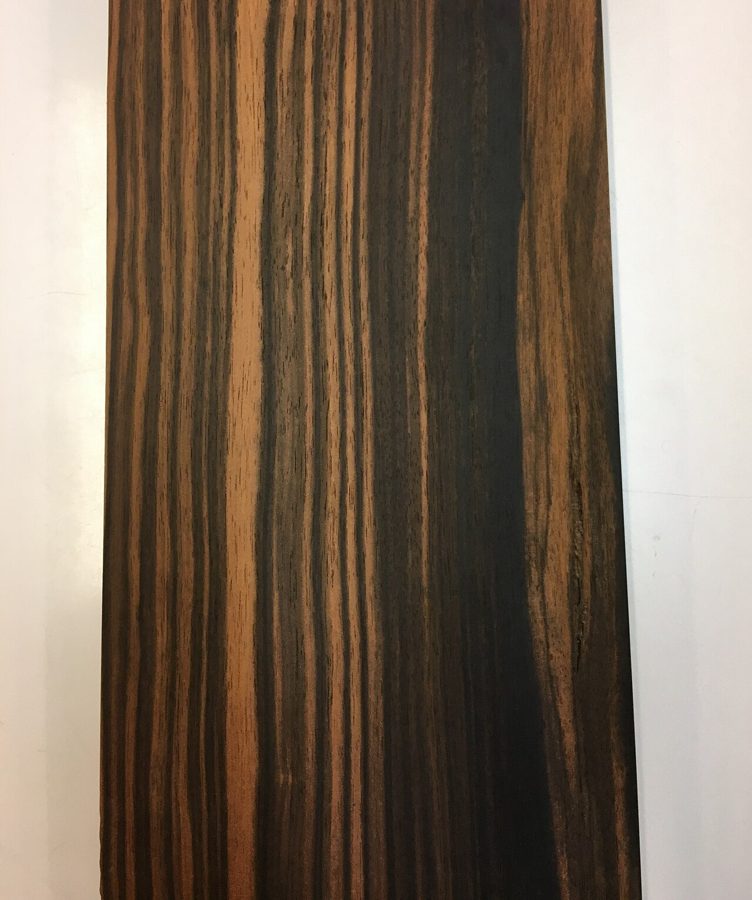

Overview
Macassar ebony is the striped ebony: a yellow to reddish-brown ground with dark brown or black stripes, a fine uniform texture and high natural lustre. The Wood Database compares the look to zebrawood, and says it takes its name from the Indonesian port of Makassar, a main exporting point. It is hard, dense and costly. People pick it for statement veneers, small high-end cabinet details and turnings.
Pros
- Janka 3,220 lbf and 1,120 kg/m3 (Wood Database).
- Dramatic striping with fine, even texture.
- Excellent for turned objects (Wood Database); the heartwood is rated very durable.
- Not subject to a CITES listing.
Cons
- Very expensive: $82.50 to $135 per board foot at the two yards checked.
- Rather difficult to work: density, a blunting effect on cutters and occasional interlocked grain.
- Prone to checking and splitting during drying, so drying defects are not uncommon.
- Poor insect and borer resistance, despite durable heartwood (Wood Database).
- Reported sensitizer and a specific report of skin irritation.
- IUCN Vulnerable, with a slow-growing tree and a limited habitat.
Variants and subspecies
- Macassar vs Gaboon ebony: different species. Gaboon (Diospyros crassiflora) is the solid black African ebony, and Bell Forest lists it in shorts at $180.00 per bf, so don't price one from the other.
- Macassar vs Ceylon ebony: see Ceylon ebony, which is jet black with a very different supply story.
- Malaysian blackwood (D. ebonasea), also on Bell's price list, is yet another species.
Working and finishing
Expect slow, cautious machining: carbide tooling, light passes, and attention to tear-out on interlocked grain. Drying defects are not uncommon, so buy well-dried stock. The Wood Database says it is excellent for turning. Wear a mask and use dust extraction, because of the sensitizer report and the skin irritation reported specifically for Macassar.
Staining and finishing colour
Not normally stained: the stripes are the point. Polish, oil or a thin clear finish are the usual routes. No source was found on its stain behaviour; test on offcuts if you must change colour.
Sustainability and handling
IUCN Red List: Vulnerable (1998 assessment; checked 2026-09), with a population reduction of over 20% in three generations according to the Wood Database. Not listed in the CITES Appendices: the Diospyros annotation #5 applies only to Madagascar populations (CITES Appendices text valid from 5 March 2026; checked 2026-09). The US Lacey Act (16 U.S.C. 3372) makes trade in illegally taken plants unlawful, and EU deforestation rules cover wood and furniture from 30 December 2026 for large and medium operators (EC, checked 2026-09). Wikipedia describes it as endemic to Sulawesi. The tree grows slowly with a very limited natural habitat (Wood Database). Treat it as a luxury, use sparingly (veneer, inlay, small parts) and ask for the origin.
Popular projects
Veneer, high-end cabinetry, billiard cues, musical instruments and small specialty items (Wood Database). Wikipedia notes its use for Japanese tokobashira alcove posts.
Buying notes
Stock is sold in small, expensive pieces: $82.50-110.00 per bf (Bell Forest, by quantity) and $135.00 for 4/4 rough (Goosebay). Check the botanical name, since "ebony" covers several species with different properties and prices.
Typical projects
- veneer
- high-end cabinetry
- billiard cues
- musical instruments
- inlay and small specialty items
- turned objects
Sources
- www.wood-database.com/macassar-ebony
- en.wikipedia.org/wiki/Diospyros_celebica
- cites.org/eng/app/appendices.php
- www.law.cornell.edu/uscode/text/16/3372
- environment.ec.europa.eu/topics/forests/deforestation/regulation-de...
- www.bellforestproducts.com/exotic-lumber/prices
- goosebaylumber.net/wood/ebony-macassar
Researched 2026-09-30. Prices, conservation status and CITES listings on this page are indicative and were checked on that date. They change: confirm them with your supplier, and with the relevant authority before importing or exporting.