


Overview
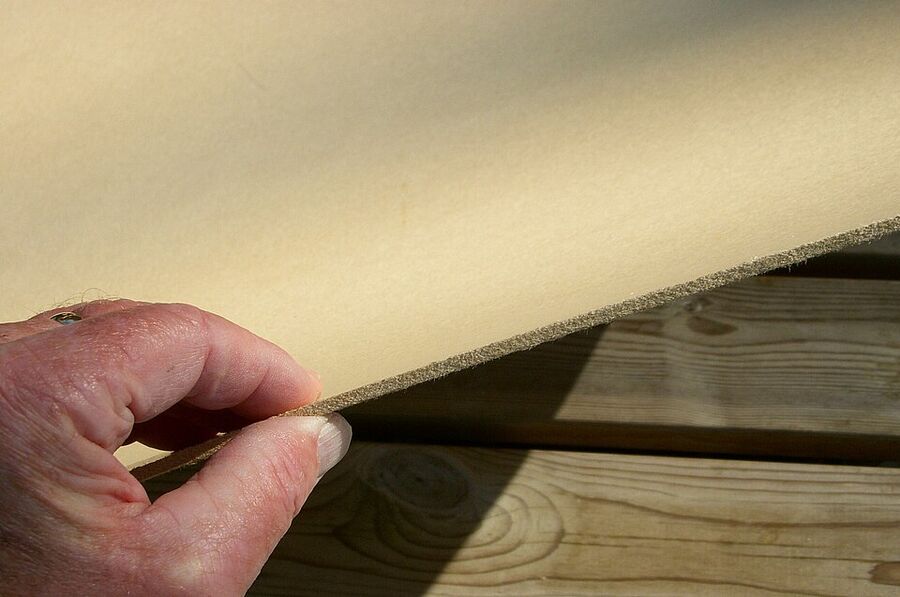
Hardboard is a thin, dense fibreboard made from exploded wood fibres that are highly compressed. Wikipedia says it is similar to particleboard and MDF but denser, stronger and harder, and that the fibres are bonded by their own lignin without added adhesive, although resin is often added. It is sold in 1/8 to 1/4 in sheets. In the shop it is the thin skin: drawer bottoms, cabinet backs, workbench tops, templates.
Pros
- Very cheap. McCoy's lists 1/8 in 4x8 Masonite at $23.99.
- Dense, smooth and hard; Wikipedia gives density of about 800 to 1,040 kg/m3, against 500 to 1,000 kg/m3 for MDF.
- Tempered hardboard is coated with linseed oil and baked, giving more water resistance, impact resistance, hardness and rigidity (Wikipedia).
- Flat and stable for thin panels; good as a sacrificial or skin layer.
- Does not use added adhesive in the basic process, per Wikipedia.
Cons
- Poor screw and nail holding in thin sheets; use glue and backing.
- Absorbs moisture and swells at edges unless tempered and sealed.
- Weak across unsupported spans; it sags and flexes, so it is a skin, not a structure.
- Wet-process boards have a smooth face and a textured back, so look for a side you want visible (Wikipedia).
- Dust is fine and irritating.
Variants and subspecies
- Standard hardboard: smooth one side (S1S) or both sides.
- Tempered hardboard: linseed-oil baked, harder and more water resistant (Wikipedia).
- Perforated hardboard (pegboard): McCoy's lists 4.8 mm perforated at $32.99.
- Underlayment: 4.8 mm surfaced one side at $22.99 at McCoy's.
- Wet vs dry process: the wet "Mason method" leaves one smooth side and one textured side; dry-processed hardboard is smooth on both sides, and Masonite is made by the wet process only (Wikipedia).
- Dunnage/pallet grade at Toledo is a separate cheap category.
- MDO and overlay panels: see MDO and HDO plywood.
Working and finishing
Cuts with a fine-tooth or carbide blade; support the sheet fully to avoid cracking, and use a zero-clearance cut. Glue and pin or brad into a rabbet for cabinet backs and drawer bottoms. Sand edges and prime before painting; the smooth side takes paint well. Back it with MDF or plywood if screws must hold, and seal the edges if it might get damp.
Staining and finishing colour
The face is dark brown and uniform; stains sit unevenly and look muddy. Paint it, laminate it, or leave the natural brown under clear finish. A coat of sealer or primer controls absorption. Tempered boards resist finishes a little because of the baked oil; test before committing.
Sustainability and handling
Hardboard is among the product types the EPA excludes from the TSCA Title VI composite wood formaldehyde rule (EPA FAQ, checked 2026-09-30). Resin may still be added, per Wikipedia. Sanding and cutting generate fine dust; use a mask. Sheets are thin and can crack or bow if stored unsupported, so keep flat and dry.
Popular projects
Drawer bottoms, cabinet and furniture backs, thin workbench and jig skins, router templates, puzzles and game boards (Wikipedia), and floor underlayment.
Buying notes
Sold 4x8 in 1/8 in and 4.8 mm. Indicative McCoy's prices (September 2026): 1/8 in $23.99, 4.8 mm $29.99, 4.8 mm underlayment $22.99, perforated $32.99. Choose tempered for anywhere damp.
Typical projects
- drawer bottoms
- cabinet backs
- workbench skins
- jigs and templates
- puzzle and game boards
- underlayment
Sources
Researched 2026-09-30. Prices, conservation status and CITES listings on this page are indicative and were checked on that date. They change: confirm them with your supplier, and with the relevant authority before importing or exporting.