


Overview
Okoume is a light, pinkish African timber used to make the most popular marine plywood in the world outside North America. Wikipedia describes the tree as a weak wood with low decay resistance and moderate dimensional stability, and says the major use of "gaboon" is plywood. As a plywood face it is smooth and pale, and it is a favourite for lightweight boats and furniture, usually sold to BS 1088 standard.
Pros
- Light. Wikipedia says okoume plywood is about 8 to 12 percent lighter than meranti marine ply.
- Flexible, which helps for tight-radius bends such as near a bow (Wikipedia).
- Clean, even face that takes clear coat or paint.
- BS 1088 stock is graded and often Lloyd's approved. Timber BoatWorks lists BS 1088:2018.
- Available in thin sheets (3, 4 and 6 mm) in 4x8 sizes.
Cons
- Less stiff than meranti, and less resistant to impact (Wikipedia); boatbuilders often sheathe it in epoxy and fibreglass.
- The wood itself has low decay resistance (Wikipedia), so the coating is doing the work.
- Expensive. Fiberglass Supply's 4 mm sheet is $138.98, and Island Water World's 18 mm sheet is $321.65.
- Edge screw holding is limited in thin sheets.
- Vulnerable timber (IUCN).
Variants and subspecies
- BS 1088 okoume: made to the British Standard for marine plywood; a Lloyd's of London stamp certifies compliance (Wikipedia).
- Non-certified okoume ("gaboon"): cheaper furniture and underlayment grade, sometimes sold as "marine" without a certificate.
- Meranti marine: heavier and stiffer; see Marine plywood and Meranti.
- Aircraft and thin ply: see Aircraft plywood.
- Bendy ply: see Bending plywood.
Working and finishing
Okoume is soft and easy to cut; use a fine blade and support the thin sheets. Scarf and epoxy-glue for hull panels. Sand lightly because the face veneer is thin. Seal edges with epoxy before painting. Fiberglass Supply quotes weight at 14 lb for a 4 mm 4x8 sheet and 24 lb for 6 mm.
Staining and finishing colour
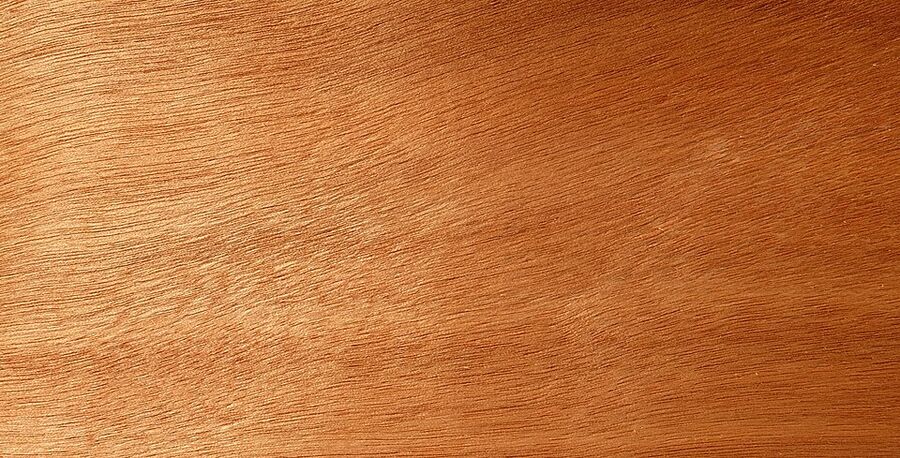
The pale, even face accepts clear epoxy, varnish or paint. Natural colour is pink to tan and warms under varnish. It is not a blotchy wood, but the face is thin, so sand through is a risk. Do not rely on stain; use clear coats with UV filters outdoors.
Sustainability and handling
Wikipedia lists Aucoumea klaineana as Vulnerable (IUCN 2.3). Whether the particular sheet is legal depends on the mill and the exporter, so ask for an FSC chain-of-custody record and a species and origin statement. The Lacey Act (US) bars trade in plants taken in violation of law; legal status checked 2026-09-30. Imported composite wood is also subject to EPA TSCA Title VI documentation requirements. Wear a mask when sanding.
Popular projects
Stitch-and-glue boats, kayaks and canoes, light cabinets in boats, speaker enclosures and models.
Buying notes
Specify BS 1088 or equivalent, the face grade and thickness. Indicative September 2026 prices for 4x8: Fiberglass Supply 3 mm $139.75, 4 mm $138.98, 6 mm $180.60, 9 mm $216.72; Island Water World 18 mm $321.65; Timber BoatWorks $97 to $273 across 4, 6, 9, 12 and 18 mm. Price jumps with thickness, so buy the minimum that carries the load.
Typical projects
- boat hulls and decks
- kayaks and canoes
- light furniture
- speaker enclosures
- model and drone parts
Finishes that suit this
Sources
- en.wikipedia.org/wiki/Aucoumea_klaineana
- en.wikipedia.org/wiki/Marine_plywood
- fiberglasssupply.com/4mm-okoume-marine-plywood-bs1088
- fiberglasssupply.com/6mm-okoume-marine-plywood-bs1088
- www.islandwaterworld.com/marine-plywood-okoume-bs1088-18-mm-4-ft-x-...
- www.timberboatworks.com/en-us/products/okoume-1088
- www.epa.gov/formaldehyde/formaldehyde-emission-standards-composite-...
Researched 2026-09-30. Prices, conservation status and CITES listings on this page are indicative and were checked on that date. They change: confirm them with your supplier, and with the relevant authority before importing or exporting.