


Overview
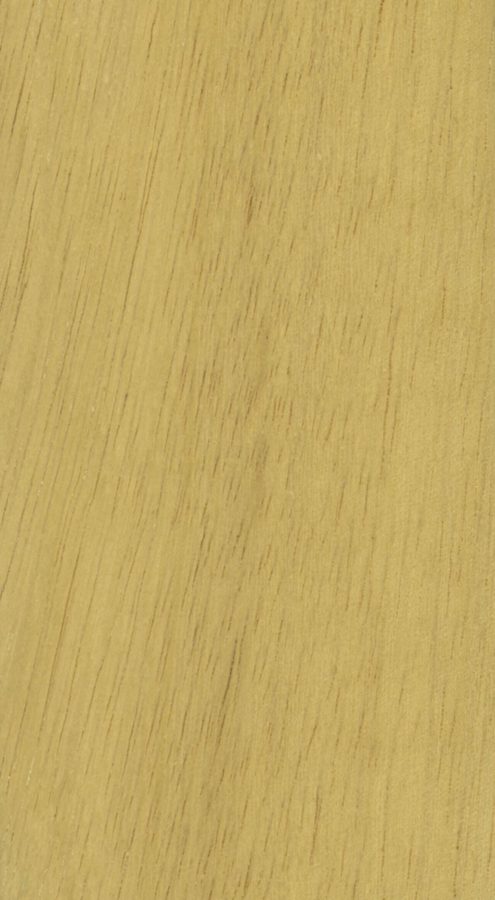
The wood of the Para rubber tree after its latex-producing life is over. It is pale, plain and cheap, and it is the quiet workhorse behind a great deal of imported "hardwood" furniture and kitchen worktops. Pick it when you want a stable, light-coloured, paintable or stainable wood at a modest price and do not need it to live outdoors or show dramatic grain.
Pros
- Easy to work with hand and machine tools, and it glues, stains and finishes well (Wood Database).
- Straight grain, fairly stable in service once properly seasoned.
- A plantation by-product, so it does not come from old-growth forest.
- Strength is comparable to oak per the Timber Development UK profile, at a far lower price.
Cons
- Perishable: very little decay resistance and prone to fungal stain and insect attack. Keep it indoors and dry.
- Warps and twists in drying; poorly dried stock is the commonest complaint.
- Sour smell while being worked, strongest when green; it fades as the wood dries.
- Bland, coarse-textured appearance with low natural lustre.
- People with a natural latex or rubber allergy may react to it (Wood Database).
Variants and subspecies
- Solid rubberwood: kiln-dried boards, usually 4/4 to 8/4; rarely exported as raw lumber.
- Finger-jointed and edge-glued panels: the most common form, sold for tabletops and cabinet parts.
- Colour-matched (stained) stock: furniture makers often dye it to read as oak, cherry or walnut.
Working and finishing
Planes, routs and sands cleanly. Tear-out is slight. It tends to split when nailed, so pre-drill. Glues reliably with standard PVA. Dry it with weights on the stack and end-seal boards; the Timber Development UK profile recommends an anti-stain dip immediately after conversion, which is a reminder to buy kiln-dried, stickered stock and to check it for blue-stain.
Staining and finishing colour
Its pale tone takes dye and pigment stain easily, and it is regularly coloured in production furniture. Because the pores are open and the texture coarse, apply a sealer or conditioner and test on an offcut. The finished colour darkens slightly with age.
Sustainability and handling
Rubberwood is a by-product: the trees are grown for latex and the timber is a second harvest. Wood Database reports it as not listed in the CITES Appendices or on the IUCN Red List, and Cirad's Tropix sheet likewise gives no CITES listing (statuses checked 2026-09). I could not verify a certified (FSC) US supply, so ask a supplier for chain-of-custody documents if that matters. Natural-latex allergy is the one specific health flag; use dust extraction as for any hardwood. Treat it as perishable in storage: keep it dry and ventilated.
Popular projects
Dining tables and chairs, children's furniture, kitchen worktops and butcher-block counters, painted cabinet doors and shelving. It is a sensible choice wherever the finish will cover the wood.
Buying notes
Very little is sold by the board foot in the US; look for finger-jointed panels, edge-glued tabletop blanks or ready-made furniture. I found no US retail list price, so none is stated here. Check moisture content and look for blue-stain and warp before buying. Avoid it for anything exposed to damp.
Typical projects
- dining and kitchen furniture
- children's furniture
- butcher-block counters
- kitchen cabinet doors
- painted shelving
- finger-jointed panels
Sources
Researched 2026-09-30. Prices, conservation status and CITES listings on this page are indicative and were checked on that date. They change: confirm them with your supplier, and with the relevant authority before importing or exporting.