


Overview
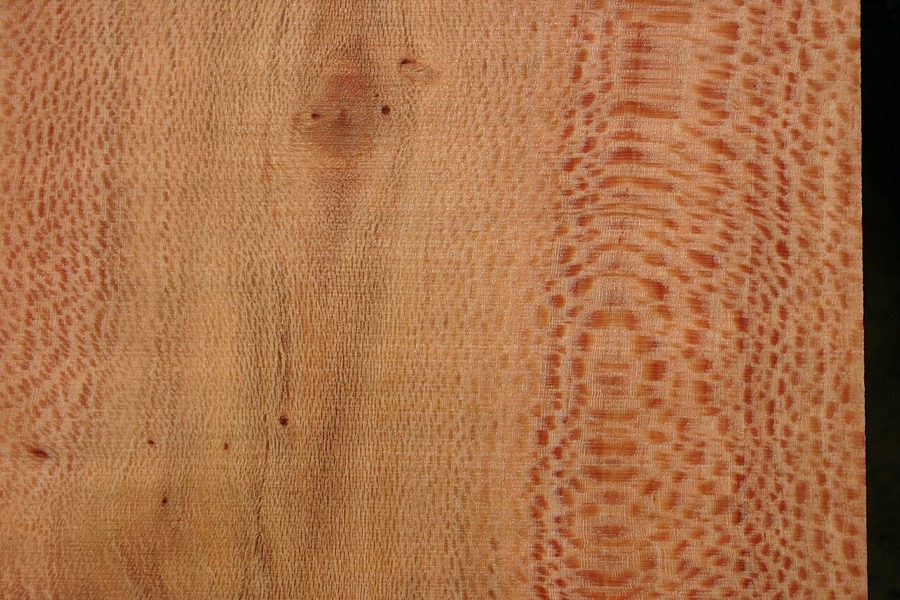
Silky oak is an Australian rainforest tree, not an oak: it belongs to the Proteaceae, the family that gives it wide rays and the lace-like fleck on quartersawn faces. The light reddish-brown timber was once a staple of Australian furniture and window joinery. It is chosen for that figure, which looks dramatic in cabinets, guitars and veneer.
Pros
- Quartersawn boards show a large, lace-like ray fleck that is rare in temperate woods.
- Overall fairly easy to work with (Wood Database).
- Moderately durable to durable against decay, and moderately resistant to most insects.
- Historically used for external window joinery because it resists rot (Wikipedia).
- Plantation-grown stock exists outside Australia.
Cons
- Planing can tear out on the fleck.
- Wood Database reports eye and skin irritation, and Wikipedia says the plant's tridecylresorcinol causes contact dermatitis.
- Not commonly available in the US; prices run mid to high for an imported hardwood, and it is often confused with other "lacewood" species.
- The figure is strongest on carefully quartersawn boards (Wood Database); plainsawn faces show less.
Variants and subspecies
- Grevillea robusta: this entry; Australian "silky oak" and plantation South African timber.
- Other "silky oaks" from Australian rainforest genera are sold under the same name; check the botanical name.
- Lacewood (e.g. Panopsis): other Proteaceae timbers sold as "lacewood". They are different species, so do not assume the same hardness, colour or price.
Working and finishing
Fairly easy to work, with a moderate blunting effect on edges. Planing can tear out on the rays, so keep blades sharp and take light passes. Glues and finishes well. Wear gloves and a dust mask because of the skin-irritation reports.
Staining and finishing colour
The fleck is the point, so most work uses clear shellac, oil or lacquer, which warms the reddish colour. Dye can enhance contrast between rays and ground, but heavy pigment stain muddies it. Test on the same board.
Sustainability and handling
Not in the CITES Appendices (checked 2026-09 against the Appendices in force from 5 March 2026). GBIF reports the species as Least Concern on the IUCN Red List (checked 2026-09), although Wood Database states it is not listed. Wikipedia notes felling of declining natural stands is restricted, and the tree is regarded as a weed in parts of New South Wales and Victoria and invasive in Hawaii and South Africa, so plantation-grown or salvaged timber is the right source. Its flowers and fruit contain hydrogen cyanide, and the plant causes contact dermatitis (Wikipedia). The Lacey Act's 2008 amendment covers timber products (Wikipedia, Lacey Act), and the EU deforestation regulation applies to wood products from 30 December 2026 for large and medium operators.
Popular projects
Cabinet doors and veneered panels, guitar and instrument backs and sides, fine furniture, window joinery and turned objects.
Buying notes
Sold in small quantities by exotic-lumber sellers, usually as quartersawn boards. I found no direct US listing for Grevillea robusta, so the frontmatter price is a proxy based on lacewood at about $16.50 to $22 per board foot in 2026-09; confirm with the seller. Ask for botanical name and the sawing method before paying a premium.
Typical projects
- cabinet doors and veneer
- guitar backs and sides
- fine furniture
- window joinery
- turned objects
Sources
Researched 2026-09-30. Prices, conservation status and CITES listings on this page are indicative and were checked on that date. They change: confirm them with your supplier, and with the relevant authority before importing or exporting.