

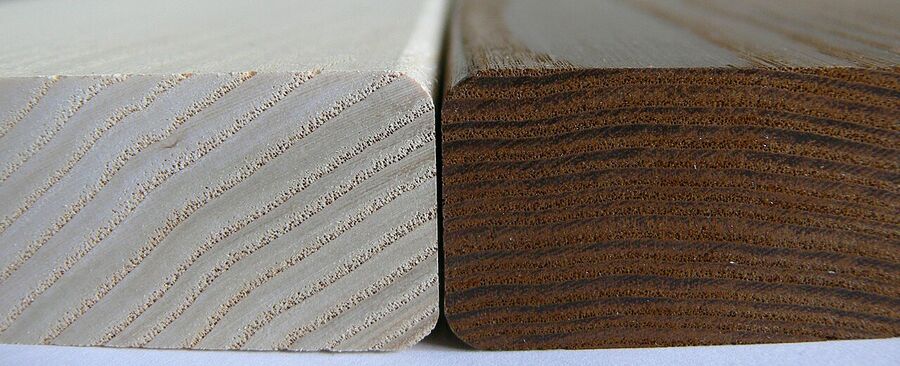

Overview
Thermally modified wood is ordinary timber baked in a low-oxygen kiln until its chemistry changes. Wikipedia describes the process as pyrolysis above 180 °C, which lowers hygroscopicity (how much water the wood takes up) and raises dimensional stability. The result is a uniformly dark, stable board with no added chemicals, usually sold as cladding and decking. People choose it when they want the look of a dark hardwood from a cheaper species, or a stable exterior wood without a preservative.
Pros
- Much less swelling and shrinking. Wikipedia gives a reduction of up to 50-90%; one distributor of poplar quotes up to 70%. Treat both as vendor-style claims that vary by species and process.
- Better decay resistance. Wikipedia says durability class 1-3 (EN 350-2) can be reached from a class 5, non-durable softwood. Stora Enso rates its Thermo-D at class 2.
- Colour goes right through the board, so planing or sanding does not expose pale wood.
- No leaching, and resin is driven off so knots do not bleed (Stora Enso).
- Thermal conductivity falls by 20-25% (Stora Enso).
Cons
- Weaker. Wikipedia reports bending strength reduced by up to 30%; the McIlvain distributor blog says 10-20% in modulus of rupture. Do not use it for load-bearing parts such as thin chair legs without testing.
- Not for ground contact and not termite-proof (Stora Enso rates Thermo-D for use class 3, above ground, and says it is not termite-resistant).
- Unfinished exterior boards go grey quickly (Stora Enso).
- Fire class D (Stora Enso).
- The treatment cannot be done at home, and the colour and properties depend on the temperature and the maker.
Variants and subspecies
- ThermoWood is a trademark of the International ThermoWood Association (Finland, 1990s). Its two classes, per Stora Enso: Thermo-S (about 190 °C, light brown, interior use, stability) and Thermo-D (about 212 °C, dark brown, durability class 2).
- Other processes named by Wikipedia: Plato, Retification, oil-heat treatment and Westwood (US, 2007).
- By base species: ash is the dearer hardwood, with the distributor listing it as class 1. Poplar and aspen are sold as cheaper alternatives. Pine and spruce are listed at class 2-3.
- Hardness varies by species and I found no single figure. A Wood and Fiber Science study measured treated black ash at 200 °C at about 5,700 N, 43% above controls; Cambia quotes 507 lbf for its thermally modified yellow poplar. Different woods; do not average them.
Working and finishing
Expect the reduced bending strength reported above to show up as easier breakage at thin sections and short grain, so keep sections generous (this is my inference, not a sourced tooling rule). Check fasteners and glues with the supplier: I did not find a reliable source on fastener corrosion for thermally modified wood itself, so I make no claim here. The equilibrium moisture content is lower than untreated wood, below 40-50% of it per Stora Enso, so it holds its dimensions through humidity swings.
Staining and finishing colour
The brown colour is deep, so a stain would sit on already-dark wood. SWST researchers described thermally treated ash as a walnut-like brown, suitable for flooring and fine furniture. Under UV, exposed cladding greys quickly.
Sustainability and handling
Wikipedia describes the process as heat in low oxygen, and Stora Enso reports no leaching. Wikipedia notes antimicrobial volatile compounds in the wood may decrease. Sustainability otherwise follows the base species and its FSC/PEFC status; ask the supplier, since none of my sources certify the product. The dust is wood dust: use extraction and a respirator.
Popular projects
Exterior cladding, decking, fence and screen boards, garden furniture, and interior flooring. Wikipedia also records its use for "roasted" guitar fretboards and soundboards, where the stability is the draw.
Buying notes
Sold by the square foot in profiles (cladding, decking). The one US price list I opened ran $5.00-9.00 per sq ft by species, with ash dearest. Ask which process, temperature class and base species you are buying, and whether the durability class comes from an independent test.
Typical projects
- exterior cladding
- decking
- garden furniture
- flooring
- guitar tops and fretboards
Sources
Researched 2026-09-30. Prices, conservation status and CITES listings on this page are indicative and were checked on that date. They change: confirm them with your supplier, and with the relevant authority before importing or exporting.