

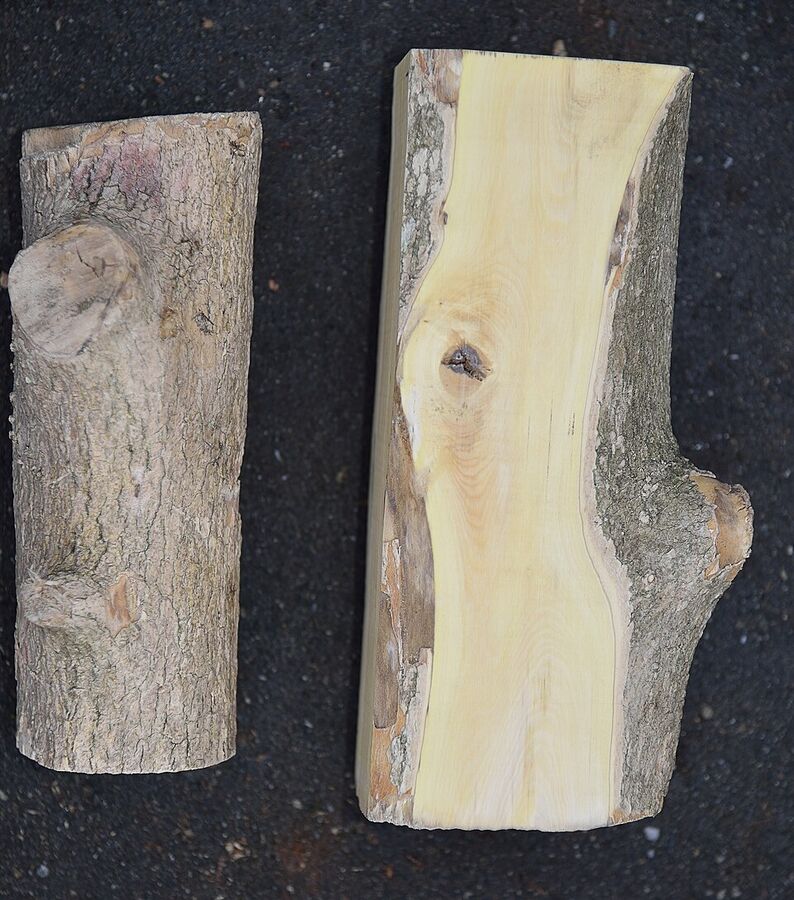

Overview
Boxwood is the benchmark for very fine, dense, even-textured wood: pale yellow, almost featureless and very hard (Janka 2,940 lbf, about 965 kg/m3). The tree stays small, so the timber comes in short, narrow pieces. It is the classic wood for wood-engraving blocks, and is also used for turned objects, game pieces and small carvings.
Pros
- Extremely fine, uniform texture; holds very sharp detail.
- Very hard and dense; wears and polishes beautifully.
- Superb turning wood (Wood Database).
- The heartwood is rated durable by Wood Database.
- The traditional material for end-grain wood engraving: Wikipedia records Thomas Bewick developing the technique with boxwood blocks.
Cons
- Only small quantities and sizes; the tree is small (Wood Database).
- Wood Database calls it somewhat difficult to work in flat dimensions; tear-out can occur on irregular grain, and it has a slight blunting effect on cutters.
- High shrinkage (7.3% radial, 11.2% tangential).
- Very expensive: about $192-204 per bf from one retailer's turning squares.
- Reported as a sensitizer.
Variants and subspecies
- Common box (Buxus sempervirens): the European species covered here.
- Wood Database says the name "boxwood" has become convoluted and confused; Buxus sempervirens is the original, genuine boxwood.
- A reader comment on the Wood Database page reports that of three samples sold as "Turkish boxwood", one was something quite different. Treat trade names as unreliable and check the botanical name.
Working and finishing
Wood Database: somewhat difficult in flat dimensions, but superbly suited to turning and carving, where it holds very fine detail. Expect a slight blunting effect on cutters, and tear-out on irregular grain when planing. Heartwood can become stained with dark streaks from fungal attack.
Staining and finishing colour
Boxwood is rarely stained; its very fine, even texture and natural luster show best under a clear finish.
Sustainability and handling
Wood Database reports boxwood is not CITES-listed (checked 2026-09-30) and gives IUCN Least Concern; the Wikipedia taxobox I opened gives no status, so treat that as a single-source figure. The box tree moth (Cydalima perspectalis) and boxwood blight are serious pests of box in Europe, which may restrict future supply. Boxwood is reported as a sensitizer (eye and skin irritation); use dust extraction. EU traders should note the EU Deforestation Regulation (30 December 2026 for large and medium operators). US imports need a Lacey Act plant declaration (16 USC 3372(f)).
Popular projects
Wood Database lists carvings, chess pieces, musical instruments (flutes, recorders, woodwinds), rulers, handles and turned objects. Wikipedia records boxwood as the classic material for wood-engraving blocks.
Buying notes
Wood Database says boxwood is usually available only in small quantities and sizes, and tends to be very expensive. Buy turning squares or small blanks from a specialist and be wary of "boxwood" labels on other species.
Typical projects
- wood engraving blocks
- turned objects
- chess pieces
- carving
- rulers
- woodwind instruments
- handles
Sources
- www.wood-database.com/boxwood
- en.wikipedia.org/wiki/Buxus_sempervirens
- en.wikipedia.org/wiki/Box_tree_moth
- en.wikipedia.org/wiki/Boxwood_blight
- en.wikipedia.org/wiki/Wood_engraving
- www.rarewoodsusa.com/product/turning-squares-boxwood
- environment.ec.europa.eu/topics/forests/deforestation/regulation-de...
- www.law.cornell.edu/uscode/text/16/3372
Researched 2026-09-30. Prices, conservation status and CITES listings on this page are indicative and were checked on that date. They change: confirm them with your supplier, and with the relevant authority before importing or exporting.