


Overview
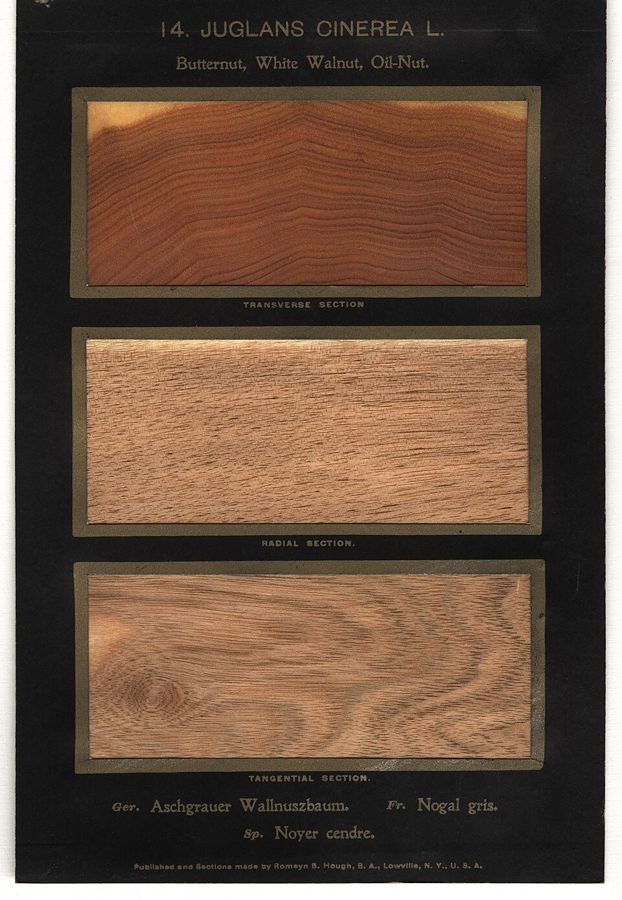
Butternut (Juglans cinerea), also called white walnut, is a close relative of Black walnut with a much lighter, silkier look: tan heartwood with distinct darker growth rings. It is soft and light and easy to carve and plane, which is why it has long been a wood for carved work, boxes and trim. Choose it for a warm pale-brown piece that can be worked almost like pine but looks like a fine hardwood.
Pros
- Easily worked with hand and machine tools; very soft (490 lbf) and lightweight (about 435 kg/m3).
- Takes glue, stain and finish well, per the Wood Database, with a silky natural lustre.
- No characteristic odour while working, and no health reactions reported beyond the general risks of wood dust.
- Low shrinkage movement for a hardwood: 3.4% radial and 6.4% tangential.
- Distinct growth-ring pattern gives a handsome plain-sawn face.
Cons
- Soft: dents easily and is a poor choice for tabletops that will take wear.
- Tends to leave fuzzy surfaces when planed or sanded, so sharp cutters and fine grit are advised.
- Decay resistance is only moderate to non-durable, and it can be attacked by insects.
- Supply is shrinking because of butternut canker; boards are not always in stock.
- Mid-range price despite being soft.
Variants and subspecies
- Butternut itself is the only species sold; the wood is sometimes marketed as "white walnut".
- It is not related to butternut squash, as the Wood Database points out.
- Trunks are fluted, so end grain can look faceted rather than circular.
- For the true dark walnuts see Black walnut and Claro walnut. Butternut is the one Juglans the Wood Database says has virtually no odour while worked, a way to distinguish it from walnut.
Working and finishing
The Wood Database says butternut is easily worked by hand or machine, but because it is so soft it tends to leave fuzzy surfaces after planing or sanding, so use sharp cutters and fine-grit paper. It glues, stains and finishes well.
Staining and finishing colour
Heartwood is a light to medium tan, sometimes reddish, with darker growth rings that form fairly distinct grain patterns. The Wood Database says it stains well. As with any stain, test on a scrap first. A clear finish keeps the silky, warm colour.
Sustainability and handling
The Wood Database reports butternut as not listed in the CITES Appendices (checked 2026-09-30) or on the IUCN Red List, but notes that many trees are afflicted by butternut canker (Sirococcus clavigigenti-juglandacearum), which has led the US Fish and Wildlife Service to list it as a species of federal concern; it is also protected in Canada. Wikipedia, citing a 2019 IUCN assessment, lists the species as Endangered, so the sources conflict. Ask about provenance. US-grown timber is still covered by the Lacey Act, which as amended in 2008 prohibits trade in plants and timber taken, possessed, transported or sold in violation of law (Wikipedia's summary of the Act); buy from dealers who can name the source. The Wood Database reports no health effects specific to butternut beyond general dust risk. The Wood Database's wood-dust article treats wood dust in general as an irritant or sensitizer and notes that fine dust can cause cumulative lung damage, so extract at the source and wear a respirator when sanding or machining.
Popular projects
Carvings, boxes, interior trim, furniture where a soft, pale walnut-like look is wanted, and veneer. The Wood Database lists veneer, carving, furniture, interior trim, boxes and crates as typical uses.
Buying notes
Sold as lumber and carving blanks. List prices run from about $4.00 to $7.65 per board foot (various grades and thicknesses). Availability is patchy, so check with a local sawmill or specialist yard.
Typical projects
- carvings
- boxes
- interior trim
- furniture
- veneer
Finishes that suit this
Sources
Researched 2026-09-30. Prices, conservation status and CITES listings on this page are indicative and were checked on that date. They change: confirm them with your supplier, and with the relevant authority before importing or exporting.