

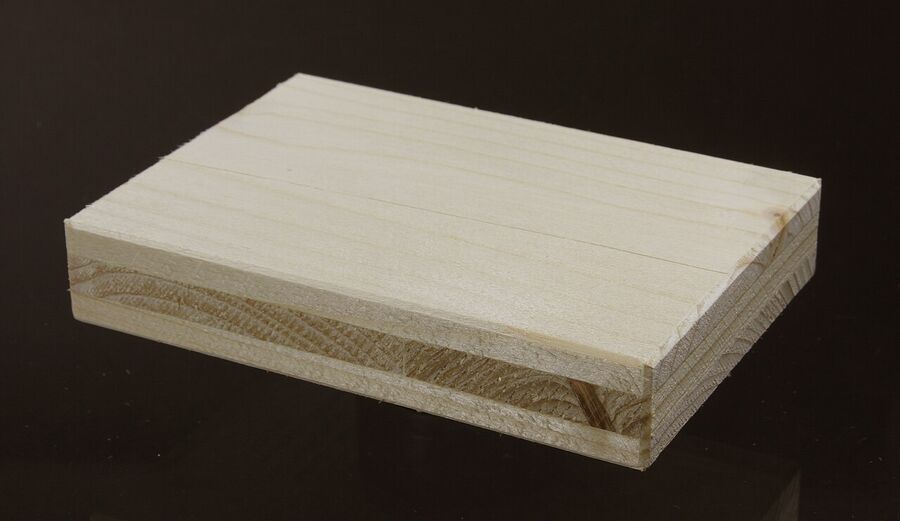

Overview
Cross-laminated timber is a large engineered wood panel made by gluing at least three layers of solid-sawn lumber at angles to each other, usually 90 degrees and usually an odd number of layers (Wikipedia). It resembles plywood but with distinctly thicker laminations, and it is not the same thing as glulam. CLT is a building material: APA describes it as a prefabricated solid panel for walls, floors and roofs. It is in this guide because furniture makers sometimes meet it as offcuts or panels for monumental pieces, but honestly it is not a furniture-grade stock.
Pros
- Strong and dimensionally stable, because the cross layers distribute loads in all directions (APA).
- Large flat panels in one piece, precision cut at the mill with CNC machines for openings and joints (Wikipedia and APA).
- Solid wood throughout, with visible laminations that suit a modern, raw look.
- Modelled price of about $3.5-3.7 per board foot is cheap by volume next to hardwood.
Cons
- Sold per project as a custom component rather than a commodity; the Mass Timber Performance Index says CLT pricing is project-specific, and my price is a modelled figure, not a retail one.
- Panels are made and sold as large building components, which is the wrong scale for most furniture shops (my inference).
- The faces are structural-grade lumber, not furniture-grade: APA lamination rules call for at least visually graded No. 2 or 1200f-1.2E MSR lumber in the longitudinal layers and No. 3 in the transverse layers.
- Cross-grain layers and visible glue lines are a poor fit for traditional furniture joinery (my inference).
Variants and subspecies
- Grades. ANSI/APA PRG 320-2025 defines 15 basic grades: five E grades (E-rated or MSR laminations in the longitudinal layers), seven V grades (visually graded) and three S grades (structural composite lumber in both directions). Custom grades and layups are allowed.
- Species. Wikipedia's example of a 10-storey CLT building used panels made in Austria from European spruce. In North America the lamination rules require a minimum specific gravity of 0.35.
- Circular-CLT uses demolition wood and pallets (Netherlands, 2024; Wikipedia).
- Related products: glulam (different construction) and plywood (thinner veneer layers). The cross-layer idea is the same as plywood's.
Working and finishing
CLT is cut and shaped with large multi-axis CNC machines at the factory, then sanded to thickness with a tolerance of 1 mm or less (Wikipedia). A woodworker would normally buy cut-to-size pieces from a mill. Sealing the edges and keeping the panel dry are for the builder's guidance; I did not find a source on bench-scale finishing.
Staining and finishing colour
The outer layer is softwood, so colour and stain behaviour follow the species of lamination. I found no source specific to CLT, so test on a scrap from the same panel.
Sustainability and handling
APA describes the panels as lightweight, with minimal jobsite waste; Wikipedia points to the circular-CLT product made from demolition wood. Adhesives must meet ANSI 405 and a full-scale fire test in ANSI/APA PRG 320 (APA). The 2021 International Building Code added mass-timber construction types IV-A, IV-B and IV-C (Wikipedia). I did not find a sourced formaldehyde figure.
Popular projects
Buildings: walls, floors, roofs and elevator shafts, from mid-rise multifamily to industrial (APA). In a small shop, offcuts can become benches, thick tabletops or plinths, but that use is uncommon and is my inference, not something the sources document.
Buying notes
CLT is bought from a fabricator, quoted per project. The Mass Timber Performance Index models North American CLT at roughly $42-44 per cubic foot and notes the price is custom, not commodity. If you only want a thick laminated slab for a bench, glulam or a laminated slab you glue up yourself will be easier to find. Ask a mill about offcuts, and state the species and grade.
Typical projects
- floors
- walls and roofs in buildings
- elevator shafts
- benches and large tabletops (rare)
Sources
Researched 2026-09-30. Prices, conservation status and CITES listings on this page are indicative and were checked on that date. They change: confirm them with your supplier, and with the relevant authority before importing or exporting.