


Overview
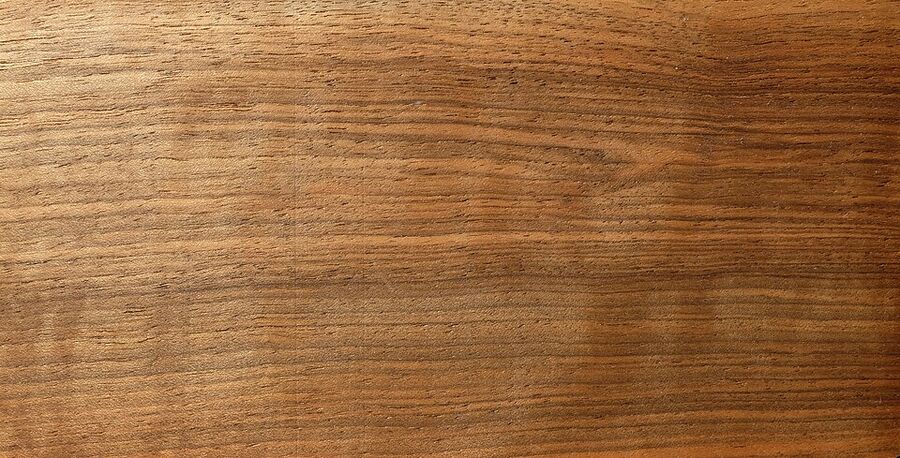
European walnut (Juglans regia) is the walnut of European fine furniture, gunstocks and veneer: pale to dark chocolate brown with dark streaks, often more varied and lighter than American Black walnut. It works easily and carries oil beautifully. It is the same tree that bears the edible walnuts, and the best figured wood (burr, crotch, curl) is mostly turned into veneer.
Pros
- Easy to work provided the grain is straight and regular; moderately durable heartwood (Wood Database).
- A wide colour range, from pale brown to dark chocolate, with attractive streaking.
- Takes oil, wax and clear finishes superbly.
- Strong figure options: burr, crotch and curl, widely sold as veneer.
Cons
- Wood Database says it is likely to be rather expensive, and sometimes only seen as veneer. Hearne lists plain European walnut at $15-18 per bf and figured at $18-35 and up.
- Susceptible to insect attack despite moderate decay resistance.
- Reported as a sensitizer (eye and skin irritation).
- Colour varies a great deal between boards, so matching takes work.
- Only medium hard (Janka 1,220 lbf), about the same as European oak, so it dents like oak does.
Variants and subspecies
- Plain European walnut: pale to chocolate brown, the main lumber product.
- Figured walnut: burr (burl), crotch and curl; Hearne lists a separate "figured" price of $18-35 and up per bf. "Circassian walnut" is a trade name for J. regia, listed by Wood Database among its common names.
- English walnut: another name for the same species; Hearne lists it separately at $15 and up.
- For the American species, which is darker and more uniform, see Black walnut.
Working and finishing
Wood Database reports easy working with straight, regular grain. Wild or figured boards may tear out, so use a sharp, finely set plane or a scraper. Stable enough for fine cabinetry (5.5% radial and 7.5% tangential shrinkage). Glues and finishes well; fill pores if you want a glassy surface.
Staining and finishing colour
Usually finished with oil, shellac or lacquer rather than stain, because the natural colour is the point. Blotchy colour variation is better dealt with by toning or bleaching than by heavy stain.
Sustainability and handling
Wood Database reports European walnut as not CITES-listed and gives its IUCN status as near threatened, but notes it technically does not meet the vulnerable criteria. Wikipedia's IUCN-based taxobox gives Least Concern (Rivers and Allen, 2017). The sources disagree, so check the current Red List (checked 2026-09-30). EU traders should note the EU Deforestation Regulation (30 December 2026 for large and medium operators). US imports need a Lacey Act plant declaration (16 USC 3372(f)). Wood Database reports walnut as a sensitizer; use extraction.
Popular projects
Fine furniture and cabinetry, gunstocks, panelling, turned items, and veneered panels. Wood Database lists furniture, cabinetry, gunstocks, interior paneling, veneer and turned items.
Buying notes
Flitch-cut (sawn through-and-through from one log) boards come from specialty importers; they are priced per bf, with figured boards individually priced. Walnut sold in the US is generally kiln-dried with the bark removed. UK yards price English walnut on request (Sutton Timber: POA).
Typical projects
- fine furniture
- cabinetry
- gunstocks
- interior panelling
- veneered panels
- turned items
Finishes that suit this
Sources
Researched 2026-09-30. Prices, conservation status and CITES listings on this page are indicative and were checked on that date. They change: confirm them with your supplier, and with the relevant authority before importing or exporting.