


Overview
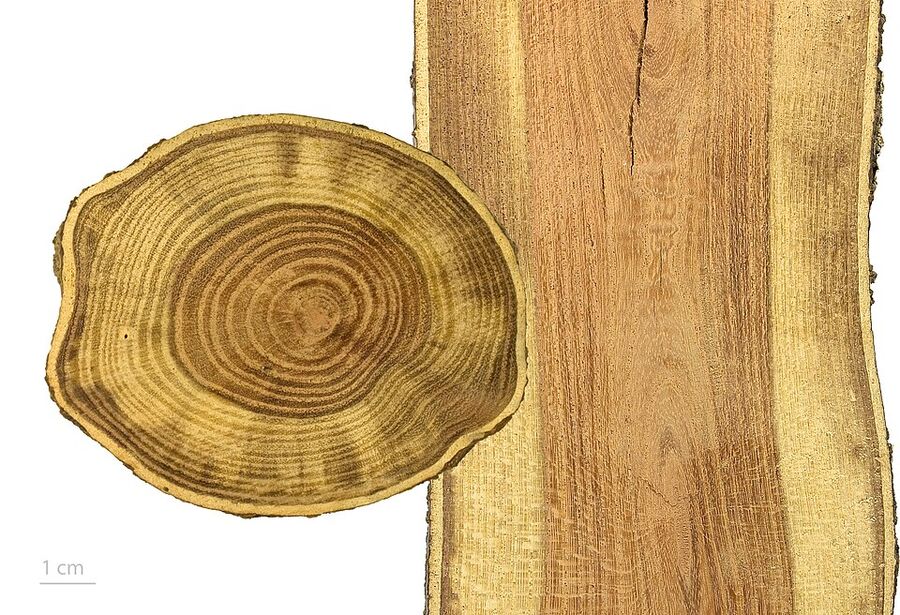
Honey locust is a hard, reddish-brown wood with a contrasting light yellow sapwood, and it makes attractive furniture despite being little known. It looks like Black locust but is a different genus, and it resembles Kentucky coffeetree even more closely. Supply is limited and mostly local.
Pros
- Hard (1,580 lbf) and dense (about 755 kg/m3), with straight or slightly irregular grain and moderate natural luster.
- Rated moderately durable to durable.
- Turns, glues, stains and finishes well.
- Relatively low shrinkage for a hard wood: 4.2% radial and 6.6% tangential.
- No health reactions beyond standard wood dust have been associated with it, per Wood Database.
Cons
- Can be difficult to work with hand and machine tools because of its density, though it generally gives good results.
- Susceptible to insect attack.
- Not widely or commonly available; Wood Database says only limited quantities appear within its natural range.
- Medium, uneven texture, and sapwood is wide and light.
Variants and subspecies
- Honey locust (Gleditsia triacanthos) is the wood described here.
- Black locust is Robinia pseudoacacia, a separate genus. Wood Database says telling the two apart is like separating white and red oak: black locust pores are packed with tyloses, honey locust pores lack them. See Black locust.
- Kentucky coffeetree is very similar in colour, grain and anatomy. Its latewood pores tend to be in circular clusters, whereas honey locust pores are usually in tangential bands.
Working and finishing
Use sharp tools and light cuts and pre-drill for fasteners. Results are generally good, and it turns and glues well. Separate sapwood and heartwood pieces if you want even colour.
Staining and finishing colour
It stains and finishes well. The heartwood is a medium to light reddish brown against a clear light-yellow sapwood. Use a clear finish to display the contrast, or stain or tone to even it up.
Sustainability and handling
Wood Database says it is not in the CITES Appendices or on the IUCN Red List; Wikipedia gives Least Concern for Gleditsia triacanthos (checked 2026-09-30). Wood Database says no health reactions beyond the usual risks of wood dust have been associated with it. The US National Cancer Institute reports strong and consistent associations between wood-dust exposure and nasal and sinus cancers, so use extraction and a respirator. US-grown timber falls under the Lacey Act.
Popular projects
Wood Database lists furniture, fence posts, utility lumber and turned objects.
Buying notes
Check local sawmills. We found 4/4 honey locust at $2.35-2.65 (1 Common, CR Muterspaw), $4.25-5.25 (Monk Creek) and $4.50-6.00 (Bell Forest Products). Wood Database expects mid to upper range prices for a domestic hardwood. Ask the dealer to confirm species, since it is sometimes confused with black locust.
Typical projects
- furniture
- fence posts
- turned objects
- utility lumber
Sources
Researched 2026-09-30. Prices, conservation status and CITES listings on this page are indicative and were checked on that date. They change: confirm them with your supplier, and with the relevant authority before importing or exporting.