

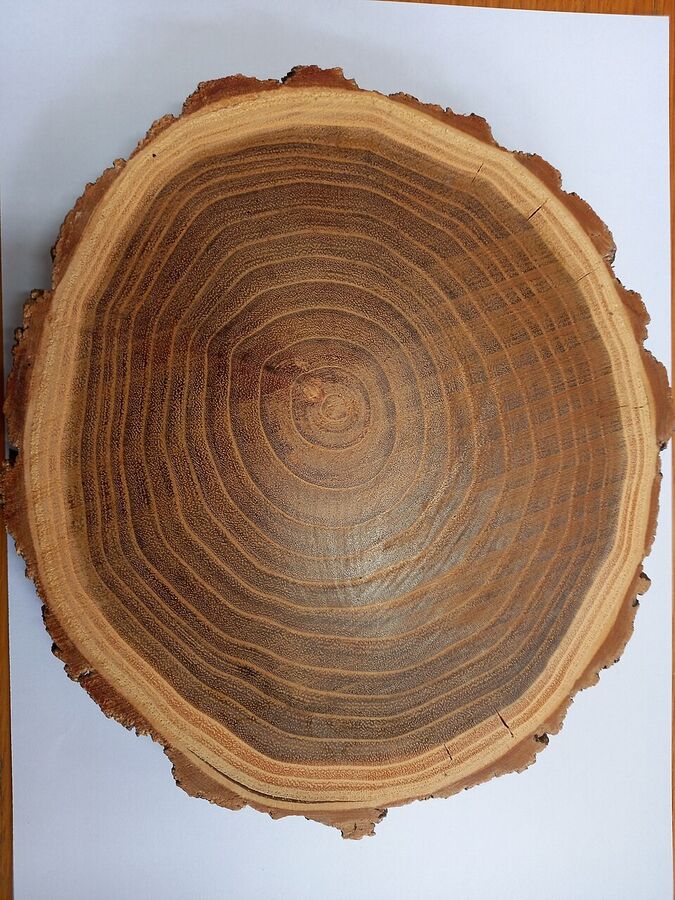

Overview
Black locust is among the hardest and most rot-resistant temperate hardwoods. Wood Database says it competes with hickory as the strongest and stiffest domestic timber, but with more stability and rot resistance. It is the traditional fence-post wood, and a reasonable pick for outdoor furniture and decks where untreated, durable timber is wanted.
Pros
- Rated very durable, with good weathering characteristics.
- Very hard (1,700 lbf) and dense (about 770 kg/m3), very strong and stiff.
- Responds very well to lathe turning and steam bending; glues and finishes well.
- Moderate price within its natural range, comparable to white oak in the eastern US per Wood Database.
- Widespread, so supply from invasive or planted stands can be a sustainable source.
Cons
- High density and hardness make it harder to machine than most domestic hardwoods; moderate blunting effect on cutting edges.
- Shrinkage of 4.6% radial and 7.2% tangential.
- Has been reported to cause eye and skin irritation, and less commonly nausea.
- Lumber is not widely stocked; prices can be much higher outside its range.
- Can be confused with osage orange and honey locust.
Variants and subspecies
- Black locust (Robinia pseudoacacia): colour ranges from pale greenish-yellow to darker brown.
- Honey locust (Gleditsia triacanthos) is a different genus with similar look; see Honey locust. Wood Database says black locust pores are packed with tyloses while honey locust pores lack them.
- Osage orange is another yellow, durable look-alike, heavier and with a water-soluble yellow dye; see Osage orange.
Working and finishing
Mixed. The grain is usually straight, but density makes machining harder; use sharp carbide tools and pre-drill for fasteners. It turns very well and steam-bends very well. Glues and finishes well. For outdoor use, it is traditionally left untreated.
Staining and finishing colour
It glues and finishes well. The pale greenish yellow darkens to a russet brown with age. For outdoor work it weathers on its own; for indoor work a clear oil or finish keeps the warm tone, and dye can level out board-to-board colour variation.
Sustainability and handling
Wood Database says it is not in the CITES Appendices and the IUCN lists it as Least Concern; it is very widespread and even invasive in some areas, so using it carries few conservation concerns. Wood Database says it has been reported to cause eye and skin irritation and, less commonly, nausea, though severe reactions are rare. The US National Cancer Institute reports strong and consistent associations between wood-dust exposure and nasal and sinus cancers, so extract dust and wear a respirator. US-grown timber falls under the Lacey Act.
Popular projects
Wood Database lists fence posts, boatbuilding, flooring, furniture, mine timbers, railroad ties, turned objects and veneer. It is a common durable choice for outdoor benches and posts.
Buying notes
Check local sawmills first, since national retailers often show it as out of stock; at Monk Creek, 4/4 was $3.75-4.75 a board foot. Prices can be much higher where it is imported, per Wood Database. Ask whether it is air- or kiln-dried, and pick straight stock for furniture.
Typical projects
- fence posts
- boatbuilding
- flooring
- outdoor furniture
- turned objects
Finishes that suit this
Sources
Researched 2026-09-30. Prices, conservation status and CITES listings on this page are indicative and were checked on that date. They change: confirm them with your supplier, and with the relevant authority before importing or exporting.