


Overview
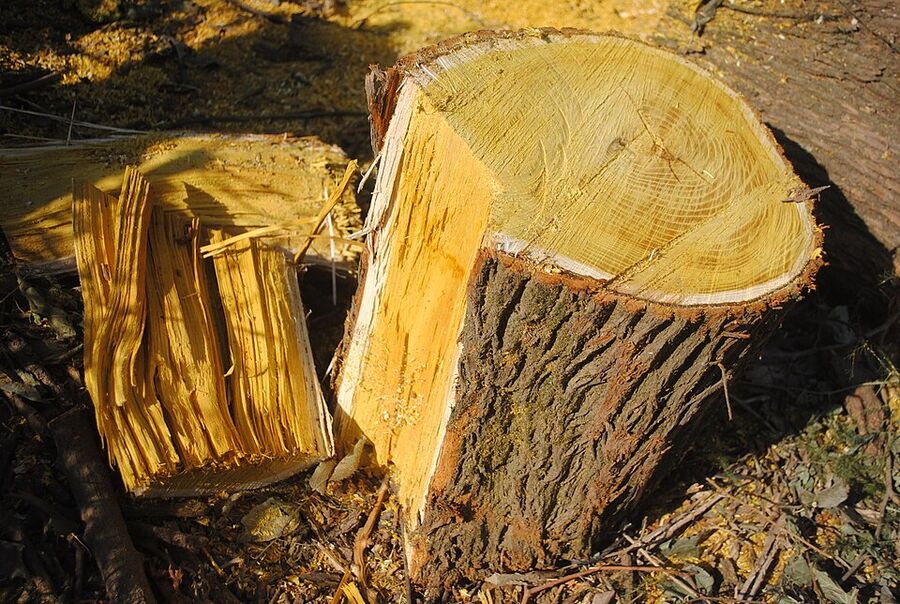
Osage orange is one of the hardest, most rot-resistant and most stable North American woods. The heartwood starts golden to bright yellow with a high natural luster, then ages toward brown. The trunks are small, crooked and knotty, so it is a specialty wood sold in short boards and turning blocks rather than wide planks.
Pros
- Extremely durable: Wood Database calls it one of the most decay-resistant woods in North America.
- Very hard (2,620 lbf) and dense (about 855 kg/m3), yet little dulling of cutting edges is reported.
- Very stable, with little seasonal or environmental movement, per Wood Database; shrinkage is 3.8% radial and 5.6% tangential.
- Straight grain, fine to medium texture, and bright yellow colour.
- Turns well and takes stains, glue and finish well.
Cons
- Difficult to work because of hardness and density.
- Rarely harvested for lumber: small, crooked, knotty trunks mean short, narrow boards.
- Colour darkens to medium brown with UV exposure.
- Sap has been reported to cause dermatitis.
- Priced above most native hardwoods, though moderate overall.
Variants and subspecies
- Osage orange (Maclura pomifera) is the northern species described here.
- Argentine Osage orange (Maclura tinctoria) is a related South American species; Wood Database says it is imported as "Argentine Osage orange" and is available in larger, cleaner boards than the smaller domestic species.
- Lookalikes include mulberry and black locust; Wood Database says Osage orange is heavier and contains a water-soluble yellow dye, so shavings in water turn the water yellow. See Black locust.
Working and finishing
Pre-drill for fasteners, use sharp carbide tools and take light cuts. It has little dulling effect on edges despite its hardness, per Wood Database. Turns well. Because the wood is very stable, it suits handles, small boxes and turned goods where movement matters.
Staining and finishing colour
It takes stains, glues and finishes well. The natural yellow ages to brown under UV light, so use a UV-inhibiting finish if you want to keep the colour, or accept the brown patina. Wood Database points to its article on preventing colour changes in exotic woods.
Sustainability and handling
Wood Database states it is not in the CITES Appendices or on the IUCN Red List; Wikipedia lists it Least Concern (checked 2026-09-30). Wood Database says the sap has been reported to cause dermatitis, so wear gloves with fresh stock. The US National Cancer Institute reports strong and consistent associations between wood-dust exposure and nasal and sinus cancers, so use extraction and a respirator. US-grown timber falls under the Lacey Act.
Popular projects
Wood Database lists fence posts, dye, archery bows, musical instruments, turnings and small specialty items. Its name "bois d'arc" means "bow wood".
Buying notes
Expect short, narrow boards and turning blocks. At the time we checked, 4/4 Osage orange was $5.45-7.50 a board foot at two dealers. Ask for kiln-dried stock, check for knots and cracks, and avoid sunlight if you want to keep the yellow.
Typical projects
- fence posts
- archery bows
- turnings
- musical instruments
- small specialty items
Sources
Researched 2026-09-30. Prices, conservation status and CITES listings on this page are indicative and were checked on that date. They change: confirm them with your supplier, and with the relevant authority before importing or exporting.