


Overview
Jarrah is the red hardwood of south-west Western Australia: a dense, deep red-brown eucalypt used for flooring, bridges, wharf piles and, in smaller quantities, furniture and bar tops. It is very durable, takes a high polish and darkens attractively with age. Pick it for a hard-wearing piece with real presence, and read the sustainability section before you commit.
Pros
- Rated very durable by the Wood Database, so suitable outdoors.
- Deep, warm colour and occasional pommele or mottled figure.
- Hard enough for floors and benchtops (see the hardness range below).
- Polishes to a deep lustre.
Cons
- Difficult to machine: dense, with interlocked grain and a blunting effect on tooling; pilot-drill everything.
- Supply is tightening (see below), and the US price is not published by the stockists we checked.
- Dust irritates eyes and airways (Wood Database).
- Dense and heavy, so it is tiring to handle in long boards.
Variants and subspecies
- Plain jarrah: the standard dark red-brown board.
- Figured jarrah: pommele, mottled and burl, sold as flitch, slab or burl (Hearne lists quartersawn, flitch and burl).
- Salvaged jarrah: reclaimed beams and old mill stock, a likely source now that native logging has ended (ask the seller).
Working and finishing
Wood Database rates it difficult to work. Use sharp carbide, slow feeds and pilot holes. Glue soon after surfacing and test glue and finish on offcuts first. Oil and hardwax finishes suit it.
Staining and finishing colour
It is already deep red, so stain is rarely the point; clear or tinted oils deepen it. The colour darkens with light and age. Test on an offcut, especially on figured boards.
Sustainability and handling
Hardness sources disagree: Wood Database gives 1860 lbf, Hurford's Outback Hardwoods lists 1910, one US dealer gives 2200, and WoodSolutions gives 8.5 kN (about 1910 lbf with 1 kN taken as 224.8 lbf). Treat it as roughly 1900 lbf.
The IUCN status is Near Threatened (2019 assessment, via Wikipedia, which cites IUCN). Not listed in the CITES Appendices according to the Wood Database; checked 2026-09, but I could not query CITES/Species+ directly, so confirm at Species+ before shipping across borders. Per the WA Government and ABC News (both 1 Jan 2024), commercial native-forest logging in Western Australia ended on that date; the 2024-2033 Forest Management Plan allows timber only from ecological thinning and approved mining and infrastructure clearing, and ABC reported that jarrah floors and furniture would get harder to source and dearer. Ask your supplier for provenance (salvage, thinning or approved clearing), because accredited-source claims are not the same as FSC certification. Eye and respiratory irritation are the documented dust effects (Wood Database); use extraction.
Popular projects
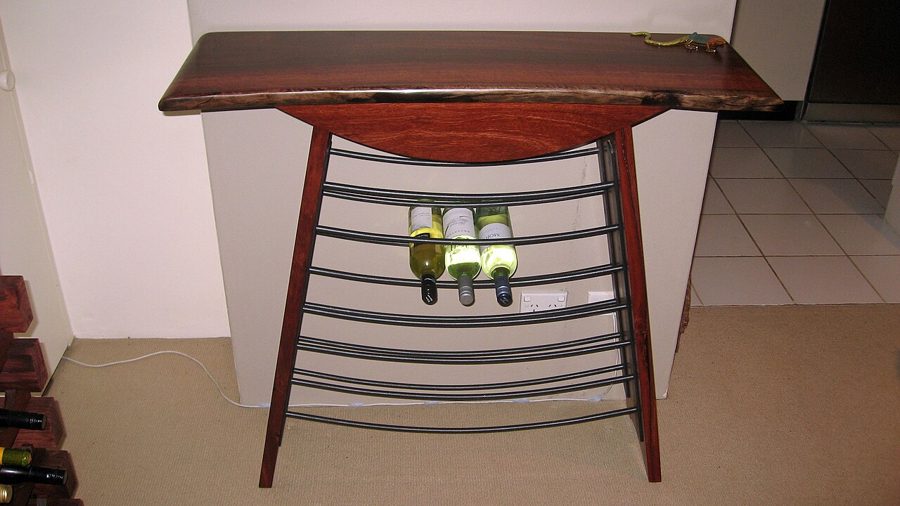
Flooring, outdoor tables and decking, bar and bench tops, wine racks, stair treads, and accent pieces where its colour carries the design.
Buying notes
Sold as flooring and lumber in 4/4 to 8/4. The only price found is derived from an Australian "from" flooring price, which will understate US retail: compare spotted gum, which sells at US$12.85 to 17.59 per sq ft in the US versus about US$3.60 per sq ft in Australia on the same basis. Ask for provenance and moisture content; also consider Spotted gum or Blackbutt if you want an Australian hardwood with easier supply.
Typical projects
- flooring
- outdoor furniture and decking
- bar tops
- wine racks
- benchtops
- boat parts
Sources
Researched 2026-09-30. Prices, conservation status and CITES listings on this page are indicative and were checked on that date. They change: confirm them with your supplier, and with the relevant authority before importing or exporting.