

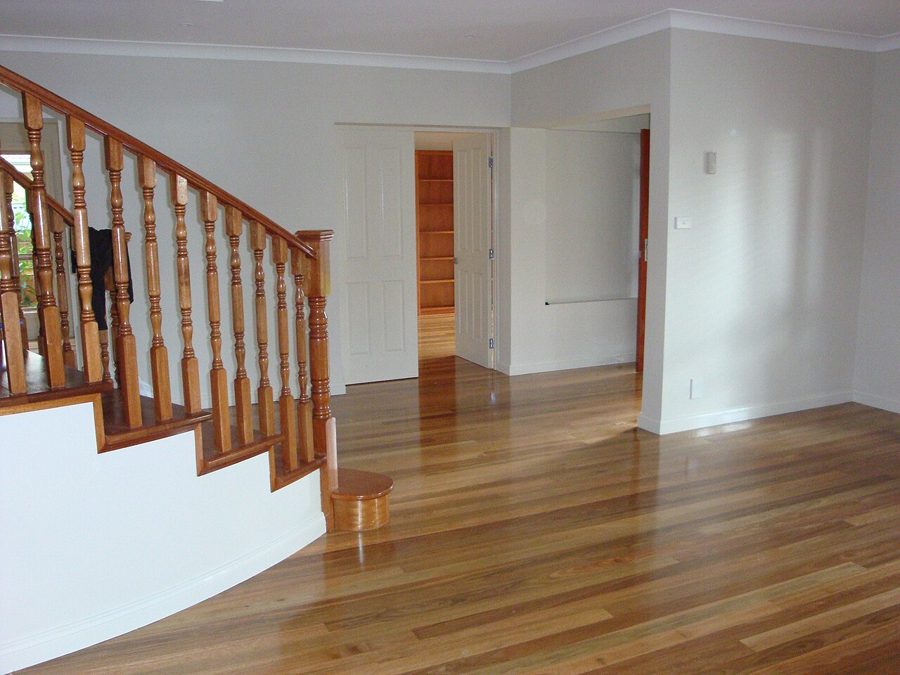

Overview
Spotted gum is the best-known hardwood of Australia's east coast: a hard, durable, warmly coloured Corymbia that is cheaper and easier to source than the red WA timbers. WoodSolutions treats the name as covering C. maculata, C. citriodora and C. henryi. Pick it for flooring, tabletops and outdoor pieces where hardness and wavy grain are wanted.
Pros
- Very hard and dense (see the range below) and durable outdoors.
- Attractive wavy grain, sometimes fiddleback.
- Plantation supply in Queensland: more than 10,000 ha planted in subtropical Queensland since the 1990s (Queensland DPI and business.qld.gov.au).
- Available in the US as flooring.
Cons
- Hard to cut and fasten; pre-drill and use carbide.
- Skin irritation and rashes are reported (Wood Database).
- Interlocked or wavy grain can tear out when planed.
- US prices are high compared with Australian retail.
Variants and subspecies
- Corymbia maculata and C. citriodora (lemon-scented gum): both assessed Least Concern.
- C. henryi: large-leaved spotted gum. All three are covered by WoodSolutions' single spotted gum entry; the Wood Database page lists C. maculata.
Working and finishing
Planes and sands to a good surface with sharp tools but resists nails and screws; use pilot holes. Take light cuts across wavy grain. Test glue and finish on offcuts.
Staining and finishing colour
The dark, rich natural colour needs no stain. Clear finishes enhance the wavy figure; the wood mellows and darkens slowly with light.
Sustainability and handling
Hardness sources disagree: Wood Database 2330 lbf, Fantastic Floor (Hurford) 2473 lbf, and WoodSolutions 10.1 kN (about 2270 lbf at 224.8 lbf per kN). IUCN: Corymbia maculata and C. citriodora are Least Concern (2019, via Wikipedia). Not listed in the CITES Appendices according to the Wood Database; checked 2026-09, but I could not query CITES/Species+ directly, so verify before export. It is the highest-volume native hardwood harvested in Queensland (business.qld.gov.au), and Forestry Corporation NSW says its hardwood plantations are only on previously cleared land. I found no certification evidence for US stock, so ask the seller. Skin irritation is the documented health issue (Wood Database); wear gloves and a mask.
Popular projects
Flooring, kitchen benchtops, dining tables, stairs, decking and outdoor furniture.
Buying notes
In the US it is sold mainly as flooring: $12.85 per sq ft (Reserve Hardwood Flooring) and a $17.59 suggested retail (Fantastic Floor). Australian retail from AUD 55 per square metre is roughly US$3.60 per sq ft, which shows how much the import costs. Look for kiln-dried stock with a species and origin label. Compare Blackbutt and Sydney blue gum for lighter colours.
Typical projects
- flooring
- tabletops
- decking
- staircases
- benchtops
- outdoor furniture
Sources
Researched 2026-09-30. Prices, conservation status and CITES listings on this page are indicative and were checked on that date. They change: confirm them with your supplier, and with the relevant authority before importing or exporting.