


Overview
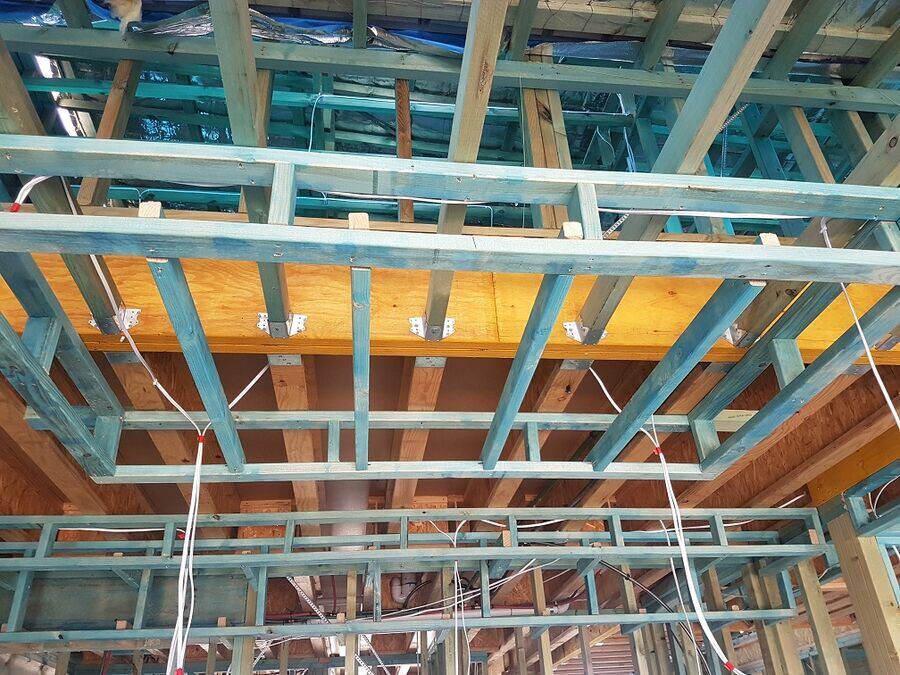
Laminated veneer lumber is made by gluing thin wood veneers together with all grain running in the same direction, unlike plywood, which alternates direction (Wikipedia). The result is a uniform, straight beam with predictable strength, made in billets up to 4 ft wide and 80 ft long (Wikipedia). It is a structural building product, rarely a finished-furniture material. Woodworkers use it where they need a long, stiff, stable member: beams, bench and desk frames, workbench tops.
Pros
- Comparable to glulam but with higher allowable stress (Wikipedia).
- Made with exterior-grade adhesives, according to APA, and listed for headers, beams, columns, rim boards, concrete formwork and "furniture frames".
- Consistent and straight, with defects spread through the veneers.
- Available in long lengths: 24-44 ft, and up to 60 ft on special order (civilsir.com).
- Composition per cubic metre in North America is 97.54% wood, 2.41% phenol-formaldehyde resin, 0.02% phenol-resorcinol-formaldehyde and 0.03% fillers (Wikipedia).
Cons
- Edges show veneer lines; the face is not decorative.
- Not weather-proof for unprotected exposure; use it dry or protect it.
- Heavy, hard on cutting edges because of the resin, and awkward to buy in small amounts.
- Pricing is hard to find: the only published guide we opened gives $3-12 per linear foot and is low quality.
Variants and subspecies
- LVL: parallel veneers, the product described here.
- PSL (parallel strand lumber) and LSL (laminated strand lumber): related products; APA lists LSL and OSL for "furniture substrate and millwork".
- Ply counts: 1-3/4 in per ply; 2-ply is 3-1/2 in, 3-ply 5-1/4 in, 4-ply 7 in (civilsir.com).
- Standard depths: 5-1/2 to 24 in, commonly 7-1/4, 9-1/4, 11-7/8 and 14 in.
- Glulam: a comparable product made from sawn boards; see Glued laminated timber (glulam).
Working and finishing
Cut and drill with carbide-tipped tools, because of the resin content. Nailing and screwing follow the manufacturer's rules; do not notch or drill beams without their guidance, since LVL is engineered to carry load. For furniture, plane or sand the faces and paint or clear-coat; the veneer lines on the edge can be left as a feature.
Staining and finishing colour
It is not made for stain. The faces are plain, and the edge shows layer lines, so people paint it or leave a clear coat to show the stripes. Test any stain on an offcut first.
Sustainability and handling
LVL uses about 97.5% wood by volume (Wikipedia) and makes straight long beams from smaller timber. The glue is phenol-formaldehyde, an exterior-grade adhesive. We have not verified an embodied-carbon figure or an Environmental Product Declaration, so we make no carbon claim. Store it flat, dry and covered. It is heavy; plan lifting.
Popular projects
Beams and headers in buildings, and for woodworkers, workbench and desk frames, long shelves, and stair stringers. APA lists furniture frames among its uses.
Buying notes
Sold by the linear foot at lumber yards and specialist suppliers, in plies 1-3/4 in thick and standard depths. A contractor guide gives $3-5 per linear foot for 1-3/4 in thickness and $10-12 for 3-1/2 in, but the same range is given regardless of depth, so get a quote. Specify load requirements and use only products with a manufacturer listing.
Typical projects
- beams and headers
- desk and bench frames
- workbench tops
- rim boards
- stair stringers
- concrete formwork
Sources
Researched 2026-09-30. Prices, conservation status and CITES listings on this page are indicative and were checked on that date. They change: confirm them with your supplier, and with the relevant authority before importing or exporting.