


Overview
Glulam is built from layers of kiln-dried dimension lumber glued face to face with the grain running the same way. Its principles date to the 1860s (Southampton), and today it is made to ANSI A190.1 (APA). It can be made into beams, columns and curved or arched members far bigger than any sawn timber. For woodworkers it is a way to buy a long, stable, structural beam, and a look: exposed laminations in a finished surface.
Pros
- Large sections in standard widths of 3-1/8, 3-1/2, 5-1/8, 5-1/2 and 6-3/4 in, depths 6 to 36 in, with custom curved, tapered and arched members (APA).
- Four appearance classes (Framing, Industrial, Architectural, Premium) let you pay for a finished face; appearance does not change structural design values (APA).
- Made from kiln-dried lumber with finger-jointed ends, giving a joint "capable of carrying high loads comparable to natural wood" (Wikipedia).
- Fire behaviour is predictable: APA notes a predictable char rate.
Cons
- Expensive and heavy: $6-34 per linear foot depending on size, species, grade and appearance class (one retailer guide).
- Stock beams have zero camber or a 5,000-ft radius; camber needs to be ordered (APA).
- Needs protection from moisture unless made for exterior use.
- Hard to buy small quantities; orders are typically by the linear foot with lead times.
Variants and subspecies
- Framing: for hidden structure; appearance is not controlled.
- Industrial: lightly sanded, for exposed industrial use.
- Architectural: sealed and sanded, for exposed finished beams.
- Premium: highest finish.
- Layups: designated e.g. 24F-V4 for Douglas-fir (APA).
- LVL: a comparable product with higher allowable stress; see Laminated veneer lumber (LVL).
Working and finishing
Cut with carbide-tipped blades; the laminations cut like the species they are made of. Do not cut, notch or drill structural members without the maker's guidance. Plane or sand to the grade of finish you need. Finger joints and face glue lines are strong, but check them for open seams before machining.
Staining and finishing colour
It stains like the softwood it is made from, and blotchiness can show. Architectural and Premium grades are sanded and sealed for a clean face. Test a sample first; glue lines can resist stain and show as light lines.
Sustainability and handling
Glulam turns small softwood boards into big members. Adhesives are phenol-resorcinol-formaldehyde, PF or MUF on the faces and melamine formaldehyde or PF in the finger joints (Wikipedia). We have not verified an embodied-carbon figure, so we make no carbon claim. Stored dry and covered, it is stable; protect it from standing water. It is heavy; plan lifting.
Popular projects
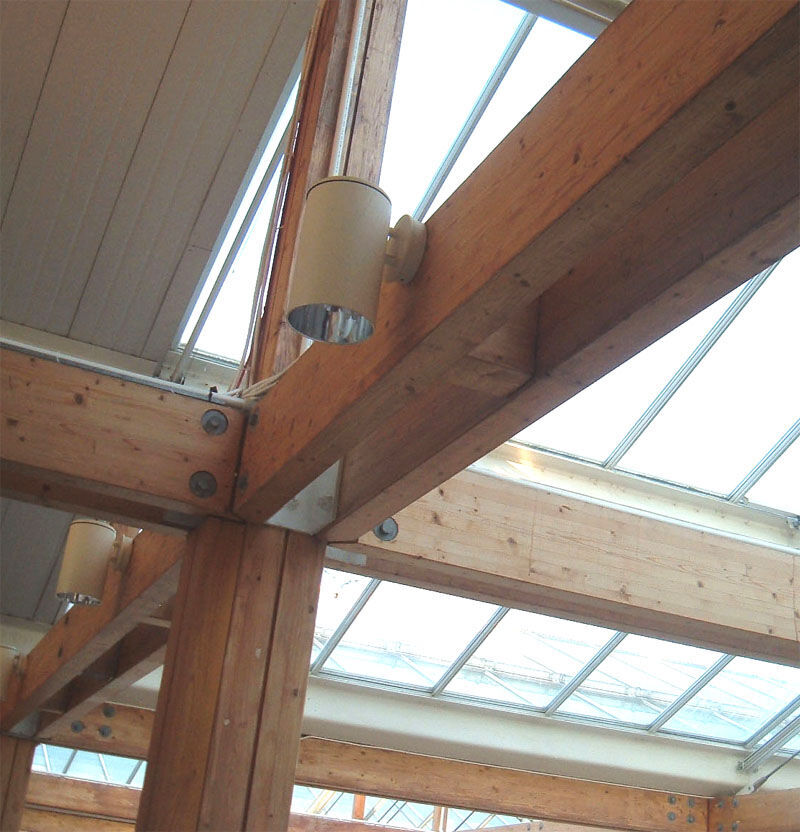
Exposed beams, arches, post-and-beam frames and roof and floor frames in buildings (as in the Portsmouth School of Architecture frame shown here), and for woodworkers, heavy table bases, pergola members and large beams.
Buying notes
Ordered by size, grade and length from a supplier. One retailer guide gives $6-34 per linear foot. Specify the appearance class, species and layup (e.g. 24F-V4), and request camber if needed.
Typical projects
- exposed beams
- arched and curved members
- roof and floor frames
- post-and-beam structures
- large table bases
- pergolas
Sources
Researched 2026-09-30. Prices, conservation status and CITES listings on this page are indicative and were checked on that date. They change: confirm them with your supplier, and with the relevant authority before importing or exporting.