


Overview
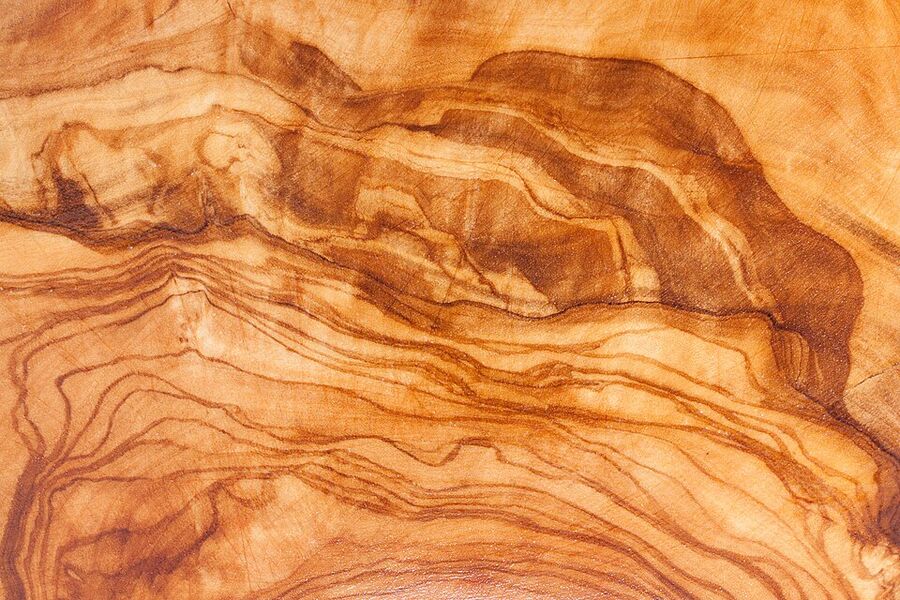
Olive wood is a very hard, very dense and strikingly figured Mediterranean timber, with swirling dark brown to black streaks on a yellow to light reddish-brown ground. The tree's fruit is too valuable for orchards to be felled for lumber, so it comes as short lengths, slabs, turning squares and burls. Choose it for small, special pieces and turned work.
Pros
- Dramatic figure and colour contrast.
- Extremely hard (Janka 2,710 lbf, about 980 kg/m3), so it wears well and polishes well.
- Turns superbly (Wood Database), and glues and finishes well.
Cons
- Wood Database says it can be somewhat difficult to work, because of its density and sometimes wild or interlocked grain, causing tear-out during surfacing.
- High movement in service and poor stability, especially where branch wood is used; drying checks and warpage can occur.
- Expensive: $42-60 per bf at one US specialty importer, and only in short, narrow pieces.
- Decay resistance is reported inconsistently, from perishable to moderately durable (Wood Database).
- Reported as a sensitizer (eye and skin irritation).
Variants and subspecies
- Cultivated olive (Olea europaea): hundreds of cultivars; Wood Database says each variety makes different fruit, but they are not distinguished in the timber trade.
- Wild or African olive (O. europaea subsp. cuspidata): formerly treated as a separate species and now usually a subspecies, per Wood Database; the wild trees are the likely source of some lumber.
- Burls, short lumber, natural-edge slabs and turning squares are the forms occasionally available (Wood Database).
Working and finishing
Wood Database: the density and sometimes wild or interlocked grain cause tear-out when surfacing, and drying checks and warpage can occur. It turns superbly, and glues and finishes well.
Staining and finishing colour
Not a stain wood: the dark and light bands are already high in contrast. Wood Database says olive finishes well, and a clear finish is the natural choice.
Sustainability and handling
Wood Database reports olive is neither CITES-listed nor on the IUCN Red List (checked 2026-09-30); the Wikipedia taxobox cites a data deficient assessment (Magos Brehm and others, 2011), so the field here is n/a. Wood Database says healthy cultivated trees are not felled for lumber, so supply is mostly pruned branches, trimmings and diseased or storm-damaged orchard trees. EU traders should note the EU Deforestation Regulation (30 December 2026 for large and medium operators). US imports need a Lacey Act plant declaration (16 USC 3372(f)). Wood Database reports olive as a sensitizer; use dust extraction.
Popular projects
Wood Database lists high-end furniture, veneer, turned objects and small specialty items.
Buying notes
Expect short lumber, natural-edge slabs, turning squares and burls rather than long boards. Prices are high for an imported hardwood (Wood Database).
Typical projects
- high-end furniture
- veneer
- turned objects
- small specialty items
Sources
Researched 2026-09-30. Prices, conservation status and CITES listings on this page are indicative and were checked on that date. They change: confirm them with your supplier, and with the relevant authority before importing or exporting.