

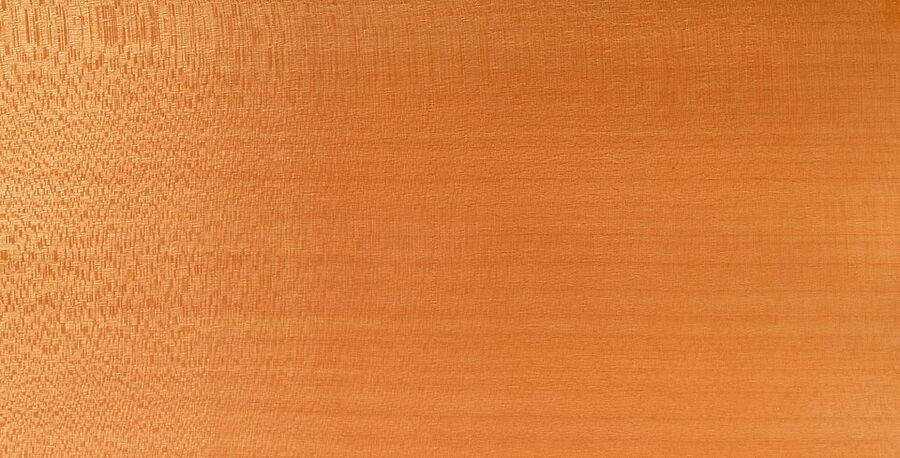

Overview
Pear is the finest-grained of the European fruitwoods: pale pink-brown, uniform in colour, easy to cut and carve, and one of the traditional woods for veneer, marquetry and fine instruments. Wood Database calls it a popular and premium hardwood in Europe, available only in limited quantities in the US. Choose it for small, detailed work, or for a smooth, quiet furniture surface.
Pros
- Overall easy to work with hand and machine tools; turns, glues and finishes well (Wood Database).
- Very fine, even texture with little visible figure; carves crisply.
- Hard (Janka 1,660 lbf, about 690 kg/m3).
- Often steamed to even out colour; also dyed black as an ebony substitute.
Cons
- Non-durable: indoor use only.
- Limited size and availability in the US; larger logs are usually turned into veneer (Wood Database). Hearne lists it at $12-22 per bf.
- High tangential shrinkage (11.3% against 3.9% radial; a T/R ratio of 2.9), so boards can warp.
- Plain figure may be too quiet for some tastes.
Variants and subspecies
- Steamed pear: colour deepened and evened by steaming, the usual form of the veneer.
- Dyed (ebonised) pear: a traditional black substitute for ebony; Wood Database notes pear is dyed black this way.
- Wild and cultivated pear are both Pyrus communis in the trade; I did not find a separate cut sold under another name.
Working and finishing
Wood Database: easy to work with hand and machine tools; it turns, glues and finishes well. Fine, straight grain gives a smooth surface off the plane; keep edges sharp for carving. Dry it slowly: shrinkage is high tangentially.
Staining and finishing colour
The even texture takes dye and stain evenly, which is why it was dyed black. Clear oil or shellac gives a warm pink-brown. Wood Database says it finishes well.
Sustainability and handling
Wood Database reports pear is not CITES-listed and not on the IUCN Red List (checked 2026-09-30); Wikipedia's taxobox gives Least Concern (Barstow, 2017). Wood Database notes no health effects beyond the usual risks of any wood dust. EU traders should note the EU Deforestation Regulation (30 December 2026 for large and medium operators). US imports need a Lacey Act plant declaration (16 USC 3372(f)).
Popular projects
Veneer, marquetry and inlay, carving, drawing and measuring instruments, musical instruments and turned objects. Wood Database lists veneer, architectural millwork, marquetry, inlay, carving, musical instruments, furniture and cabinetry.
Buying notes
Wood Database says larger logs are usually turned into veneer and that lumber and veneer prices are high for an imported European hardwood. Decide up front whether you want it steamed (a deeper pink) or not.
Typical projects
- veneer and marquetry
- inlay
- carving
- drawing instruments
- musical instruments
- fine furniture details
- turned objects
Sources
Researched 2026-09-30. Prices, conservation status and CITES listings on this page are indicative and were checked on that date. They change: confirm them with your supplier, and with the relevant authority before importing or exporting.