

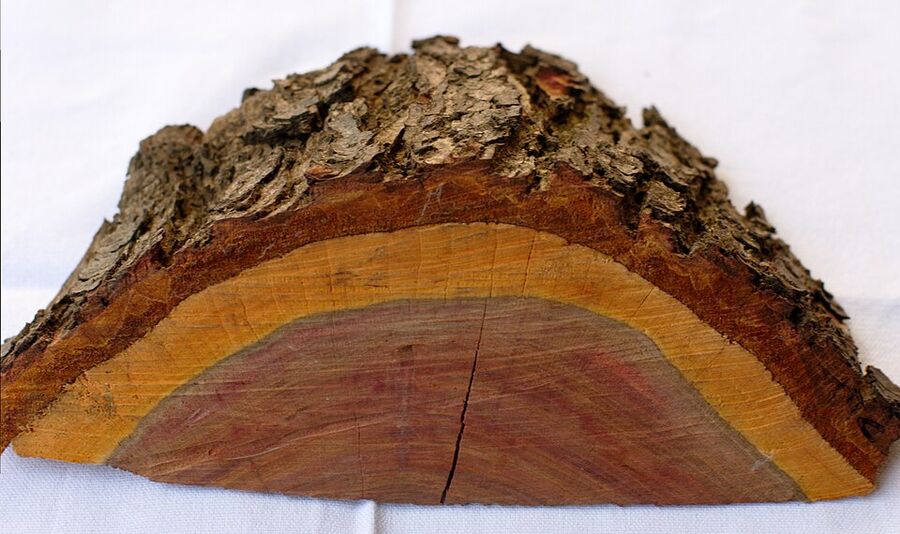

Overview
Plum is a dense, fine-grained fruitwood with striking colour: yellowish-brown heartwood streaked with pink, orange, red, purple, olive or grey. The trees are small, so it is sold as turning blanks and small sections rather than lumber. Choose it for turning, instrument parts, knife handles and inlay, where its colour is the feature.
Pros
- Distinctive, variegated colour.
- Hard and dense (Janka 1,550 lbf, about 795 kg/m3; an estimate from specific gravity), heavier and harder than cherry (Wood Database).
- Fine texture with close grain and a slight natural luster; glues, turns and finishes well.
- Distinct scent while being worked, reminiscent of pumpkin or squash (Wood Database).
Cons
- Not commercially available as lumber because the trees are small (Wood Database); sizes are very limited.
- Swirled or irregular grain, knots and other defects are common, and can tear out when surfacing.
- No published decay-resistance or shrinkage data (Wood Database), so treat it as unproven outdoors.
- Priced at $20 per bf at the one US importer I found; Wood Database says prices are likely to be high for a domestic wood.
Variants and subspecies
- European plum (Prunus domestica): the species Wood Database describes.
- Wood Database lists apricot (Prunus armeniaca), sweet cherry and black cherry as related species; plum is heavier and harder than cherry.
- No named plum varieties are distinguished in the timber trade that I found.
Working and finishing
Wood Database: areas with straight, clear grain are easy to work by hand or machine; take care around irregular grain and knots to avoid tear-out. Plum glues, turns and finishes well.
Staining and finishing colour
Wood Database says plum finishes well. The colour is the point, so a clear finish is the natural choice; stain would hide the pink, purple and olive streaks.
Sustainability and handling
Wood Database reports plum is not CITES-listed (checked 2026-09-30). Wood Database says plum is also not on the IUCN Red List, so the field is n/a. No adverse health effects are reported for plum, though Wood Database notes the closely related black cherry has been reported to cause respiratory effects, so control any wood dust. EU traders should note the EU Deforestation Regulation (30 December 2026 for large and medium operators). US imports need a Lacey Act plant declaration (16 USC 3372(f)).
Popular projects
Turned objects, musical instruments, inlay and knife handles (Wood Database).
Buying notes
Buy turning blanks or small sections from a specialist retailer, and ask for dry stock. Colour varies from tree to tree, so choose from photographs of the actual piece.
Typical projects
- turned objects
- musical instruments
- inlay
- knife handles
Sources
Researched 2026-09-30. Prices, conservation status and CITES listings on this page are indicative and were checked on that date. They change: confirm them with your supplier, and with the relevant authority before importing or exporting.