


Overview
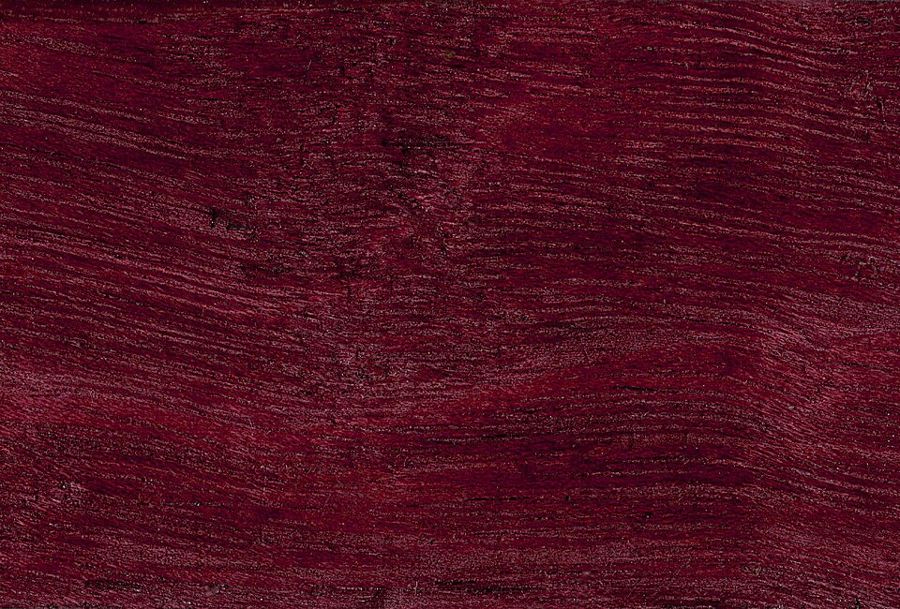
Purpleheart (Peltogyne spp.), also sold as amaranth, is a dull greyish-purple brown when freshly cut that turns a deep eggplant purple within days, then fades back toward brown with light. It is strong, durable and widely stocked. People pick it for the colour alone, in accents, stripes and whole pieces.
Pros
- The only widely sold wood with a natural purple, and it is cheap for what it is.
- Janka 2,520 lbf and about 905 kg/m3, with excellent strength.
- Rated very durable, resisting decay and most insects, per Wood Database.
- Available in good widths and thicknesses.
- Not CITES-listed.
Cons
- Gums up cutters if heated: dull tools or high speeds make it exude resin.
- Can be hard to plane without tear-out, and dulls cutters moderately.
- Fades toward brown with UV light unless protected.
- Reported as a sensitizer; eye and skin irritation and nausea are the usual reactions.
- Some Peltogyne species are Endangered, and a board seldom carries a species name.
Variants and subspecies
- Peltogyne is a genus of many species. The commonly harvested P. mexicana, P. paniculata and P. venosa are not on the IUCN Red List, per Wood Database, while P. chrysopis and P. gracilipes are Endangered.
- Amaranth is an older trade name for the same wood.
- Look-alike: none close; for a purple tone from a different tree, see Katalox (Mexican ebony) (darker, near black with purple tints).
Working and finishing
Keep cutters sharp and feed steadily; slow, dull passes heat the wood and gum the tool. Take light cuts to avoid tear-out. Sanding at a slightly higher grit gives a clean surface. It turns well and glues acceptably; wipe with solvent first if the surface is resinous.
Staining and finishing colour
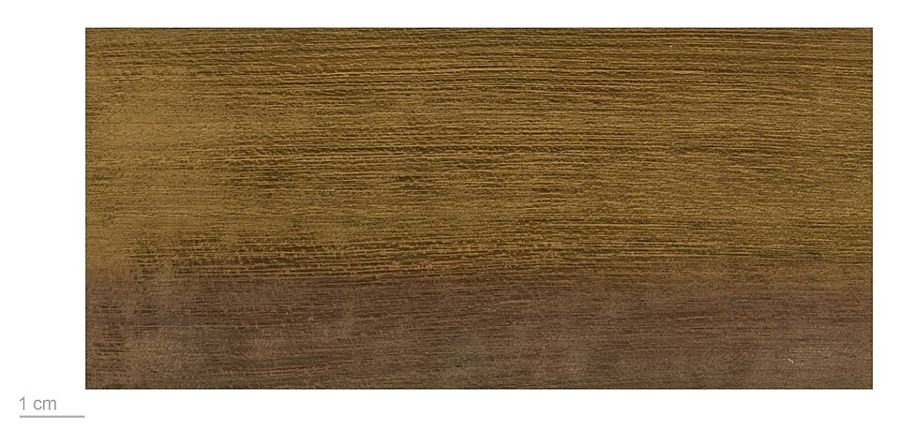
Stain is pointless; the colour is the feature. Freshly sanded wood looks drab and develops the purple in a few days, then slowly browns. A UV-inhibiting clear finish slows the shift, per Wood Database. Wood Database shows a sanded sample moving noticeably in three weeks.
Sustainability and handling
CITES: not listed (Wood Database; APHIS CITES Timber Manual, checked 2026-09-30). IUCN: not assessed as a group; because purpleheart is a collection of species it is unclear for any given board, although P. chrysopis and P. gracilipes are Endangered. FSC availability is not verified here. The US Lacey Act makes it unlawful to trade wood taken or exported in breach of the source country's laws (fws.gov/law/lacey-act), so buy from dealers who can name the country and species. If a piece will be exported to or sold in the EU, Regulation (EU) 2023/1115 (the EUDR) requires due-diligence evidence that wood products are deforestation-free and legally produced; check its current application date with your buyer.
Ethical call: reasonable if you can get an origin and species from the dealer; otherwise treat it as medium-risk. Health: reported as a sensitizer (eye and skin irritation, nausea). The US National Cancer Institute reports strong, consistent associations between wood-dust exposure and cancers of the nasal cavity and sinuses, so use extraction and a respirator when sanding.
Popular projects
Inlays and stripes in cutting boards and tabletops, accent drawer fronts, small furniture, flooring, boatbuilding, and turned pieces such as pens and bowls.
Buying notes
Common in 4/4 to 8/4 and turning squares. Two retailers list 4/4 at $14.50 and $14.99 a board foot (September 2026). Ask for freshly milled stock if you want the brightest colour, and expect the first-week colour to look disappointing.
Typical projects
- inlays and accent strips
- furniture
- flooring
- boat building
- turned objects
- heavy construction
More pictures

Sources
Researched 2026-09-30. Prices, conservation status and CITES listings on this page are indicative and were checked on that date. They change: confirm them with your supplier, and with the relevant authority before importing or exporting.