


Overview
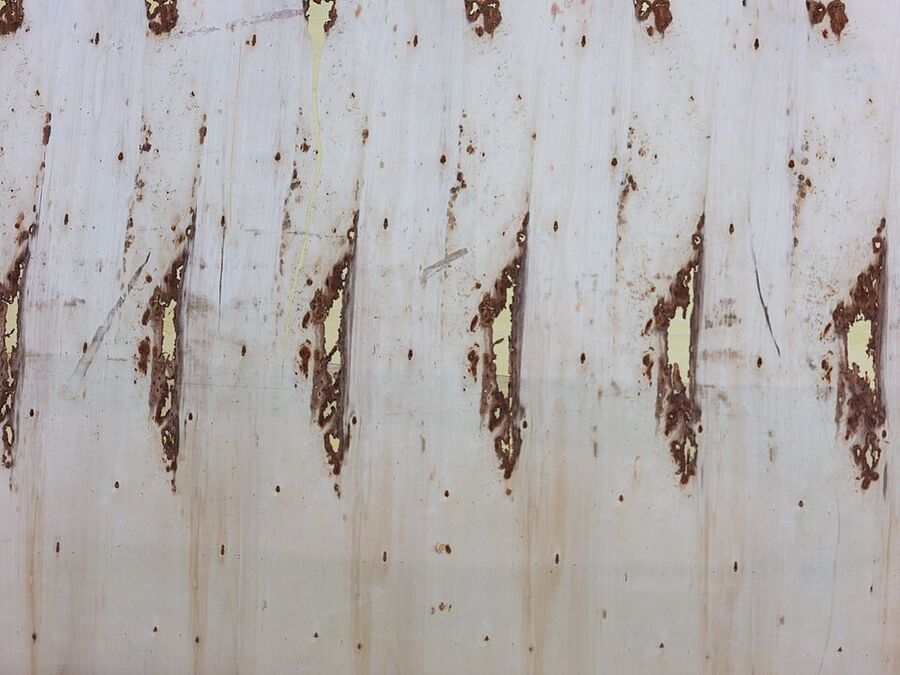
Wood veneer is a thin slice of wood, sometimes bark, that is glued onto a core panel such as wood, particleboard or MDF to make flat panels like doors, tops and cabinet sides (Wikipedia). It is how a small amount of costly timber covers a lot of surface. Veneer is sold raw, paper-backed (a sheet bonded to paper so it can be cut and glued like a laminate) or as edge banding.
Pros
- A real-wood face on a stable substrate: the best of the cross-grained panel and the solid-wood look.
- Wikipedia says veneers can be cut as thin as 0.64 mm (1/40 in), and very little wood is wasted in the cutting.
- Slices stay in the order cut, so book-matching gives mirror-image grain across a panel.
- Paper-backed sheets are easy for a hobbyist to apply with contact cement.
- Cheaper per square foot than solid for exotic species.
Cons
- Very thin: it sands through easily and cannot be refinished heavily.
- Veneering is a skill. Poor glue-up gives bubbles and edge lifting.
- Raw veneer's two faces differ: the "loose" side has opened cell structure and the "tight" side does not, so the two sides finish differently (Wikipedia).
- Veneered panels need a balanced back, or they cup.
- Moisture can lift glue lines.
- Raw edges need banding.
Variants and subspecies
- Cuts (Wikipedia): rotary-cut, mainly for plywood and not attractive on its own because it follows the growth rings; sliced veneer from a flitch (a block of wood) for furniture faces. The grain and figure you see depend on the angle at which the wood is sliced.
- Raw veneer: no backing, usable with either side facing up (Wikipedia).
- Paper-backed: a sheet backed with 10-mil paper. Rockler sells 4x8 10-mil sheets in red oak plain-sliced ($117.99), maple plain-sliced ($129.99), rotary birch ($115.99), cherry ($114.99), mahogany ($115.99) and white oak ($149.99).
- Flat-cut sheets by species: Woodworkers Source maple $99.00 and walnut $231.00 for 4x8.
- Edgeband: veneer in tape form; Toledo carries it. See Cabinet-grade hardwood plywood for how bands match plywood faces.
- Veneer-core plywood uses thick rotary veneers inside; see Lumber-core plywood for solid cores.
Working and finishing
Glue to a flat, sanded substrate such as MDF (medium-density fibreboard) or Particleboard. Cut with a sharp blade or veneer saw, use a straightedge, and let it acclimatise first. Contact cement is the fast hobbyist route; vacuum press with PVA or urea glue is the careful one. Veneer both faces of a panel, or use a balancing veneer, to prevent cupping. Sand lightly with a block and stop at 180 to 220 grit.
Staining and finishing colour
It behaves like the species it is cut from. Maple and birch blotch under stain; oak, walnut and mahogany usually take it well. Stain and dye soak in quickly, so test on a scrap. Thin veneer leaves no room to sand out a mistake. Paper-backed veneer may show backing at edges.
Sustainability and handling
Veneering spreads a log over a large area, but the veneer inherits the species' conservation status and trade rules: check CITES and Lacey Act exposure for tropical species before buying. Legal status of any particular veneer species varies; I did not verify per-species rules (checked 2026-09-30). Substrates drive the formaldehyde profile: see MDF (medium-density fibreboard) and Particleboard. Cut with a mask or extraction.
Popular projects
Veneered tables and desktops, cabinet carcasses, marquetry, restoration of antique furniture, speaker cabinets, and edge-banding plywood so the raw edge disappears.
Buying notes
Paper-backed 4x8 sheets are the common hobby buy: Rockler's 10-mil range runs $114.99 to $149.99; Woodworkers Source lists maple at $99.00 and walnut at $231.00. Toledo also lists veneer sheets and edgeband. Ask for sheet size, species, cut (plain-sliced or quartered) and backing thickness, and whether the veneer is bookmatched. Popular Woodworking notes that big-box plywood veneers can be as thin as 1/100 in, so thicker sliced veneer gives more sanding room.
Typical projects
- veneered tabletops and carcasses
- marquetry
- edge banding
- restoration
- speaker cabinets
Sources
- en.wikipedia.org/wiki/Wood_veneer
- www.rockler.com/4-x-8-veneer-sheet-10-mil-paper-backing
- www.woodworkerssource.com/hard-white-maple/maple-flat-cut-paper-bac...
- www.woodworkerssource.com/walnut/walnut-flat-cut-paper-back-veneer-...
- www.veneersupplies.com/categories/Paper-Backed__Veneer/Paper-Backed...
- www.toledoplywood.com/product-category/categories/veneers/veneer-sh...
- www.toledoplywood.com/product-category/categories/veneers/edgeband
- www.popularwoodworking.com/wood/choose_the_right_plywood
Researched 2026-09-30. Prices, conservation status and CITES listings on this page are indicative and were checked on that date. They change: confirm them with your supplier, and with the relevant authority before importing or exporting.