

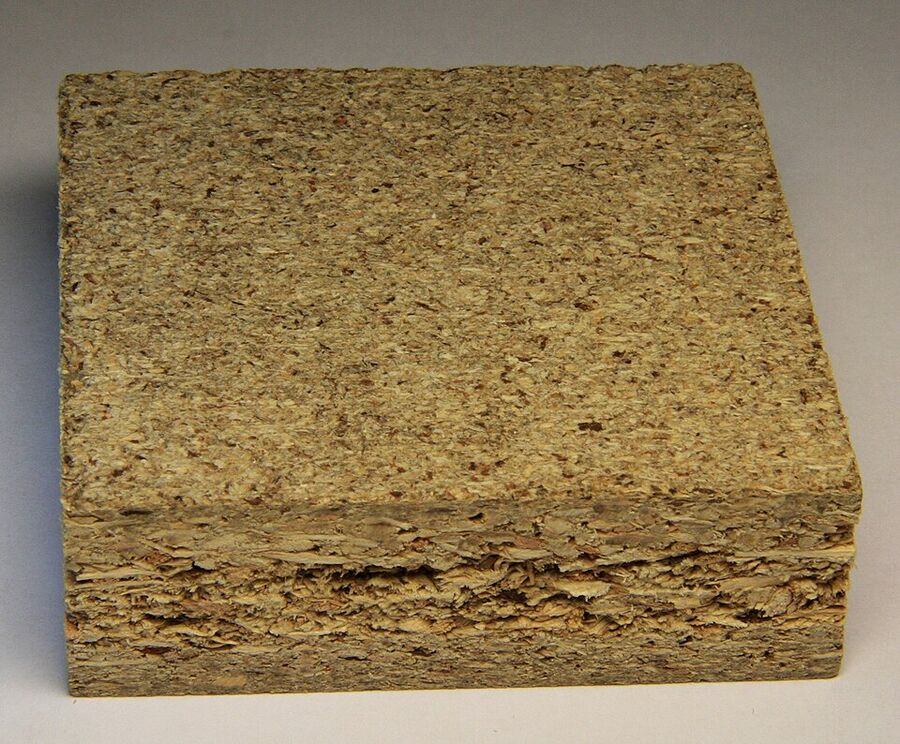

Overview
Particleboard is made from wood chips and particles bonded with a mostly formaldehyde-based resin and pressed into sheets. Wikipedia describes it as cheaper, denser and more uniform than conventional wood and plywood. It is the unglamorous substrate behind most flat-pack furniture and laminate countertops: it is a core, not a face. Use it where it will be covered, supported and kept dry.
Pros
- The cheapest of the common sheet goods. Toledo's 3/4 in sheet is $29.95, against $36.95 for 3/4 in MDF and about $90 for domestic birch plywood.
- Very flat. HPVA rates MDF and particleboard cores excellent for flatness (Fine Homebuilding).
- Uniform and consistent: no voids, no grain direction.
- A solid base for laminate and melamine; see Thermally fused laminate (TFL / melamine) and High-pressure laminate (HPL).
- Wikipedia notes veneered particleboard is preferred over veneered plywood in dry environments.
Cons
- Swells and discolours when exposed to moisture (Wikipedia). Once it swells it does not recover.
- Poor screw holding, especially in the edge; screws strip out when removed and reinserted. McIlvain notes wide-thread screws improve holding in MDF and particleboard cores.
- Edges are crumbly and need banding or a face frame.
- Heavy for its stiffness. Fine Homebuilding reports MDF-core sheets about 25 percent heavier than veneer core, and particleboard is in the same class.
- Sags over long shelf spans without a stiffener.
- Formaldehyde release is higher in engineered cores than veneer cores (Fine Homebuilding).
Variants and subspecies
- Industrial particleboard: the 5/8 and 3/4 in sheet sold for shelving, melamine and underlayment.
- Underlayment: thinner floor underlayment grades.
- Melamine-faced: see Thermally fused laminate (TFL / melamine).
- Veneered particleboard: a veneer face on a particleboard core; see Wood veneer.
- MDF: finer, denser, smoother; see MDF (medium-density fibreboard).
Working and finishing
Cut with carbide blades and dust extraction; chips tear out at the cut line, so score or tape for cabinet faces. Use confirmat screws, cam locks, dowels or glue rather than ordinary wood screws, and keep screws out of edges. Pre-drill. Edgeband the raw edges (iron-on banding works), and when banding, seal first so the glue grips. Do not use it for anything that touches water without sealing every face and edge.
Staining and finishing colour
It does not stain; the chip pattern shows through and soaks up finish unevenly. Paint over a primer, laminate it or veneer it. Raw edges drink paint. Seal all sides with the same coating so the panel does not take in moisture unevenly.
Sustainability and handling
Wikipedia describes the resin as mostly formaldehyde-based. EPA's TSCA Title VI rule (40 CFR 770, final 12 December 2016) limits particleboard to 0.09 ppm formaldehyde, with limited testing exemptions for no-added-formaldehyde and ultra-low-emitting resins; check for a TSCA Title VI compliance label (checked 2026-09-30). Sanding and cutting produce fine dust, so use extraction and a respirator. Store flat and dry, and off the floor.
Popular projects
Flat-pack cabinet carcasses, laminate-covered desks and countertop substrate, closet shelving, workbench tops under a hardboard skin, and veneered panels used in dry rooms.
Buying notes
Sold 4x8 (49x97 in at Toledo). Toledo's indicative September 2026 prices: 1/2 in $22.95, 5/8 in $28.95, 3/4 in $29.95, 1 in $40.95. Check corners and edges for damage and make sure the stock has not been rained on. For anything that will be handled or wet, step up to MDF (medium-density fibreboard), Moisture-resistant MDF or plywood.
Typical projects
- flat-pack furniture carcasses
- melamine shelving
- countertop substrate under laminate
- veneered panels in dry rooms
- underlayment
Hardware that suits this
Hardware to avoid
Sources
Researched 2026-09-30. Prices, conservation status and CITES listings on this page are indicative and were checked on that date. They change: confirm them with your supplier, and with the relevant authority before importing or exporting.