

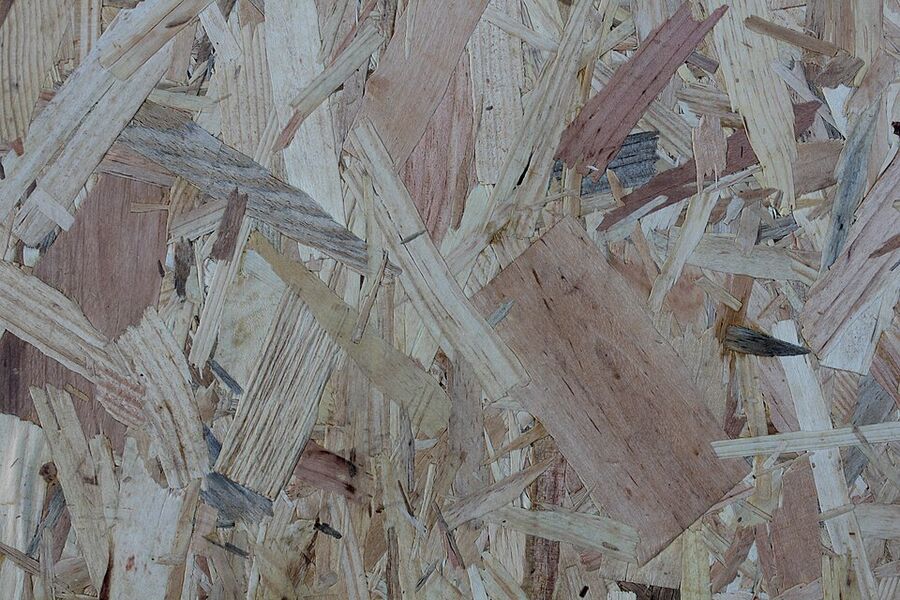

Overview
OSB is built from rectangular wooden strips compressed and bonded with wax and synthetic resin adhesives, in cross-oriented layers (Wikipedia). Its properties are similar to plywood, but it is uniform and cheaper. It is a construction material first and a shop material second: roof and wall sheathing and subfloors are its home, but it also makes cheap work surfaces, jigs and rough shop furniture.
Pros
- Cheapest structural sheet. Toledo's 3/4 in OSB is $22.95, against $37.95 for 3/4 in CDX plywood and about $90 for domestic birch plywood.
- No internal gaps or voids (Wikipedia).
- Wikipedia says it has greater load-bearing capacity than milled wood panels when tested to failure, and it has replaced plywood in much of the North American structural panel market.
- Cuts and fastens with the same tools as plywood (Wikipedia).
Cons
- Edges and surfaces swell when wet. Wikipedia says OSB can be water-resistant but needs additional membranes for impermeability and is not recommended for exterior use unprotected.
- Rough, flaky surface; it must be sanded and sealed to approach a finish look.
- Not a furniture material for visible parts: thickness varies, and the strands tear out at the edges.
- Heavier and less flat than good plywood, and poor at holding screws in the edge.
- Resins differ by type; type 1 uses urea-formaldehyde and is non-structural and non-waterproof (Wikipedia).
Variants and subspecies
- Type 1 (non-structural, UF-bonded) to type 2 (PMDI core with melamine-urea-formaldehyde or phenolic faces, water resistant on the face) to types 3 and 4 (phenolic throughout, structural, for damp and outside use), per Wikipedia's description of the EN classes.
- Sheathing grade in 7/16 and 5/8 in is the standard US stock.
- Plywood alternatives: see CDX sheathing plywood for softwood plywood, and Exterior and structural plywood (fir).
Working and finishing
Cut with a carbide blade; the resin and wax wear edges. Pre-drill near edges and use screws rather than nails when you want holding power. Seal all edges and any cut ends before it meets weather: raw edges wick water and swell. For furniture and shop surfaces, sand lightly to remove the loose flakes and finish with oil-based sealer, polyurethane or paint; some makers deliberately leave the strand pattern as the look.
Staining and finishing colour
OSB does not stain evenly: flakes and wax absorb differently, so stain looks blotchy and dark. Clear coat or a pigmented sealer gives an orange-brown industrial look; paint with a primer for a flat colour. Expect to sand between coats because raised strands.
Sustainability and handling
EPA's formaldehyde rule (TSCA Title VI, 40 CFR 770) explicitly excludes structural panels such as OSB, plus hardboard, structural plywood, structural composite lumber and other categories, so no TSCA Title VI label is required for them (EPA FAQ, checked 2026-09-30). Resin type nonetheless varies: Wikipedia lists UF for type 1, PMDI or melamine-urea-formaldehyde for type 2 and phenolic for types 3 and 4. A 4x8 sheet is heavy; two people and a sheet cart. Dust from sawing is irritating, so extract it.
Popular projects
Garage and workshop workbench tops, storage shelves, subfloors and sheathing, jigs and assembly tables, and loft and rough utility furniture where plywood is not needed.
Buying notes
Toledo's indicative September 2026 prices: 7/16 in $10.95, 5/8 in $18.95, 3/4 in $22.95. Buy dry and flat; panels left out in the rain show swollen edges. For furniture, buy plywood or MDF instead. Popular Woodworking's guide helps compare plywood alternatives.
Typical projects
- sheathing
- subfloors
- workbench tops
- shop cabinets
- utility shelving
- rough furniture
Sources
- en.wikipedia.org/wiki/Oriented_strand_board
- www.toledoplywood.com/product-category/categories/exterior-plywood/osb
- www.epa.gov/formaldehyde/formaldehyde-emission-standards-composite-...
- www.epa.gov/formaldehyde/frequent-questions-regulated-stakeholders-...
- www.popularwoodworking.com/wood/choose_the_right_plywood
Researched 2026-09-30. Prices, conservation status and CITES listings on this page are indicative and were checked on that date. They change: confirm them with your supplier, and with the relevant authority before importing or exporting.