


Overview
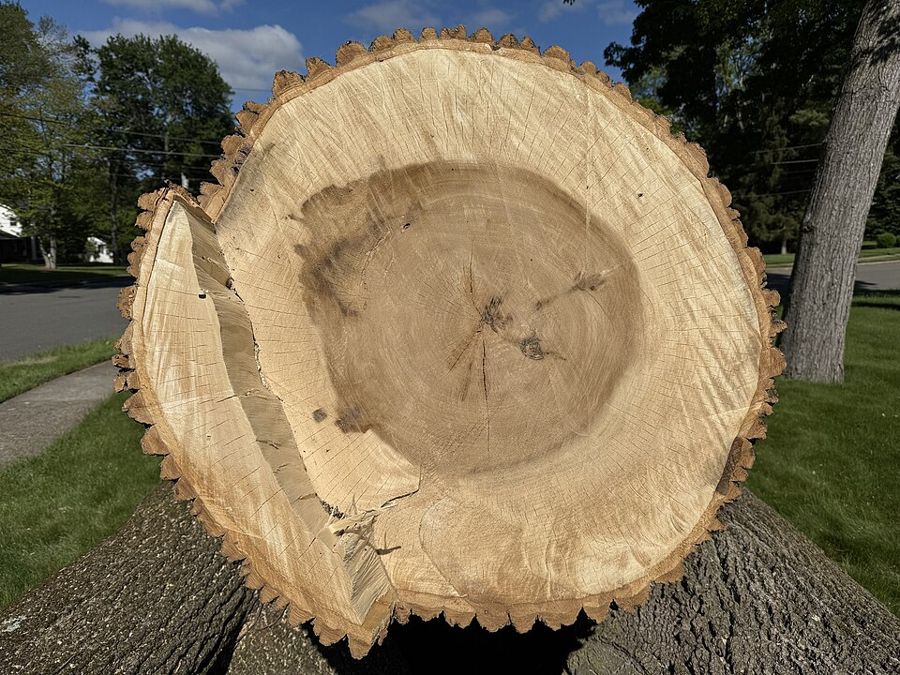
Yellow poplar (Liriodendron tulipifera) is the everyday cheap American hardwood: pale cream to greenish, straight-grained, soft and easy to cut. The Wood Database calls it one of the most common utility hardwoods in the United States. Pick it for painted furniture, hidden parts and prototypes, or for something affordable that is still a real hardwood; pick something else when you want a showy grain.
Pros
- Among the most economical domestic hardwoods; the Wood Database says it should be affordable, especially in the East.
- Very easy to work in almost all respects, with a straight, uniform grain.
- Light (about 455 kg/m3 dried) at 540 lbf Janka.
- Mineral-stained boards ("rainbow poplar") give unexpected purple, red, green and yellow streaking that some makers seek out.
Cons
- Soft: its low density leaves fuzzy surfaces and edges, especially when shaping or sanding, so finer grits may be needed.
- Dents easily and is not a wear-resistant top.
- Decay resistance is moderately durable to non-durable, and it is susceptible to insect attack.
- Colours tend to darken on exposure to light.
- Reported as an irritant (eye, skin and respiratory irritation, asthma-like symptoms).
- Shrinkage is 4.6% radial and 8.2% tangential (green to oven-dry), so plain-sawn boards move noticeably more than quartersawn.
Variants and subspecies
- Standard yellow poplar: cream to yellowish brown, often with green streaks.
- Rainbow poplar: mineral-stained wood in dark purple to red, green or yellow, sold for its colour.
- Not a true poplar: the Wood Database stresses it is not in Populus (the genus of Quaking aspen and Eastern cottonwood) but in Liriodendron, Latin for "lily tree". It is related to magnolias; see Southern magnolia.
- Poplar veneer is used dyed or on hidden faces to balance a veneered panel.
Working and finishing
The Wood Database says poplar is very easy to work in almost all regards; its main downside is softness, which can leave fuzzy surfaces and edges, especially when shaping or sanding. Sand to finer grits to get a smooth surface, use sharp cutters and expect dents. There is no characteristic odour.
Staining and finishing colour
The Wood Database gives no stain guidance for poplar, but its black cherry page notes that cherry's reddish patina is frequently imitated with stains on poplar. Heartwood runs cream to yellowish brown with grey or green streaks, which can show through a light stain, and colour darkens in light. Test stain on offcuts, or paint it, which hides the colour variation. Rainbow poplar is best left under a clear finish.
Sustainability and handling
The Wood Database reports yellow poplar as not listed in the CITES Appendices (checked 2026-09-30) or on the IUCN Red List; Wikipedia's page gives Least Concern (2014). US-grown timber is still covered by the Lacey Act, which as amended in 2008 prohibits trade in plants and timber taken, possessed, transported or sold in violation of law (Wikipedia's summary of the Act); buy from dealers who can name the source. The Wood Database says severe reactions are uncommon but poplar has been reported as an irritant, with eye, skin and respiratory irritation and asthma-like symptoms. The Wood Database's wood-dust article treats wood dust in general as an irritant or sensitizer and notes that fine dust can cause cumulative lung damage, so extract at the source and wear a respirator when sanding or machining.
Popular projects
Painted furniture and cabinets, drawer sides and hidden parts, shop jigs and prototypes, upholstered furniture frames, and veneer. The Wood Database lists pallets, crates, upholstered frames, paper pulp and plywood among its uses and says it is seldom used for its appearance, except as rainbow poplar.
Buying notes
Sold widely as rough and surfaced lumber. List prices run from about $2.95 to $5.35 per board foot (various grades and thicknesses). Choose clear boards if painting, and ask for mineral-stained boards by name if you want rainbow poplar. Heartwood and sapwood are not always clearly separated.
Typical projects
- painted furniture
- drawer sides
- shop jigs
- upholstered furniture frames
- cabinet carcases
Finishes that suit this
Sources
- www.wood-database.com/yellow-poplar
- www.wood-database.com/black-cherry
- en.wikipedia.org/wiki/Liriodendron_tulipifera
- www.wood-database.com/wood-articles/wood-dust-safety
- en.wikipedia.org/wiki/Lacey_Act_of_1900
- crlumber.com/price-list
- dougwhitehardwoods.com/hardwoods
- countryconcepts.com/hardwood-softwood-prices
- www.kunzcarpentry.com/hardwood_lumber.html
- www.thewoodyard.com/current-pricing-list
Researched 2026-09-30. Prices, conservation status and CITES listings on this page are indicative and were checked on that date. They change: confirm them with your supplier, and with the relevant authority before importing or exporting.