

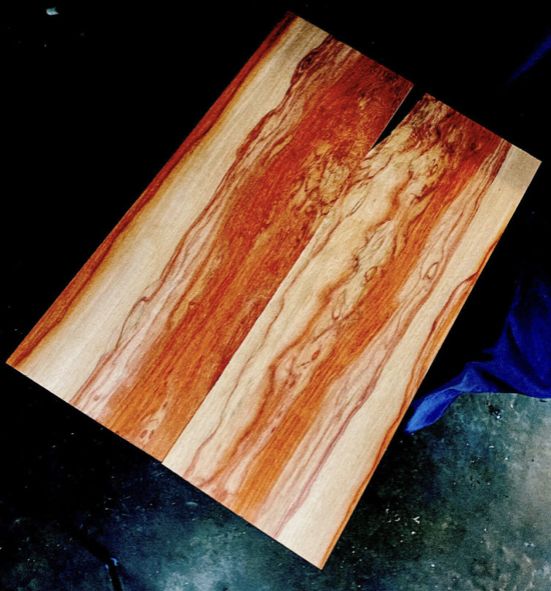

Overview
African padauk (Pterocarpus soyauxii) is vivid reddish orange when freshly cut and ages to a reddish or purplish brown. It is stable, easy to work, and popular with hobbyists for its colour and low cost. It is also called vermillion.
Pros
- Unique reddish-orange colour.
- Easy to work overall; turns and glues well.
- Excellent decay resistance, durable to very durable, and resistant to termites.
- Janka 1,710 lbf, about 745 kg/m3, with exceptional stability (3.1% radial, 5.0% tangential shrinkage).
- Relatively low cost for an exotic.
Cons
- The colour darkens substantially, and UV-inhibiting finishes slow but do not stop it.
- Large open pores need filling for a glass-smooth finish.
- Reactive oil-based finishes such as polyurethane may have curing issues unless the heartwood is sealed first.
- Reported as a sensitizer.
- Africa-wide CITES Appendix II listing.
Variants and subspecies
- Pterocarpus soyauxii: the usual African padauk.
- Burmese padauk (Pterocarpus macrocarpus): an Asian species; see Burmese padauk.
- Substitute for red-orange colour: Bloodwood (satine) is redder and not CITES-listed.
Working and finishing
Light cuts on quartersawn or interlocked grain. Fill pores before a film finish and seal the heartwood before oil-based varnish. Turns and glues well.
Staining and finishing colour
Not stained; the colour is the point and it mellows to brown with light. A UV-inhibiting clear finish slows the change.
Sustainability and handling
CITES: Pterocarpus species from African countries are in Appendix II, covering logs, lumber, veneer, plywood and transformed wood (further-processed wood), but not finished goods (APHIS CITES Timber Species Manual; checked 2026-09-30). IUCN: not evaluated per Wood Database, which is not the same as secure. FSC availability is not verified here. The US Lacey Act makes it unlawful to trade wood taken or exported in breach of the source country's laws (fws.gov/law/lacey-act), so buy from dealers who can name the country and species. If a piece will be exported to or sold in the EU, Regulation (EU) 2023/1115 (the EUDR) requires due-diligence evidence that wood products are deforestation-free and legally produced; check its current application date with your buyer.
Ethical call: acceptable with paperwork; for a red tone without the listing see Bloodwood (satine). Health: reported sensitizer. The US National Cancer Institute reports strong, consistent associations between wood-dust exposure and cancers of the nasal cavity and sinuses, so use extraction and a respirator when sanding.
Popular projects
Inlays and accents, furniture, turned objects, guitar parts, flooring and cutting boards.
Buying notes
Bell lists 4/4 at $13.75 and Woodworkers Source at $15.99 per board foot (September 2026). Sold fresh-cut orange, so expect it to age toward brown.
Typical projects
- accents and inlays
- furniture
- turned objects
- flooring
- guitar parts
- cutting boards
Sources
- www.wood-database.com/african-padauk
- www.bellforestproducts.com/exotic-lumber/prices
- www.woodworkerssource.com/lumber/exotic/Padauk-African.html
- www.aphis.usda.gov/sites/default/files/cites.pdf
- www.fws.gov/sites/default/files/documents/CoP19%20timber%20outcomes...
- www.fws.gov/sites/default/files/documents/2026-01/ole-public-bullet...
- www.fws.gov/law/lacey-act
- eur-lex.europa.eu/eli/reg/2023/1115/oj
Researched 2026-09-30. Prices, conservation status and CITES listings on this page are indicative and were checked on that date. They change: confirm them with your supplier, and with the relevant authority before importing or exporting.