


Overview
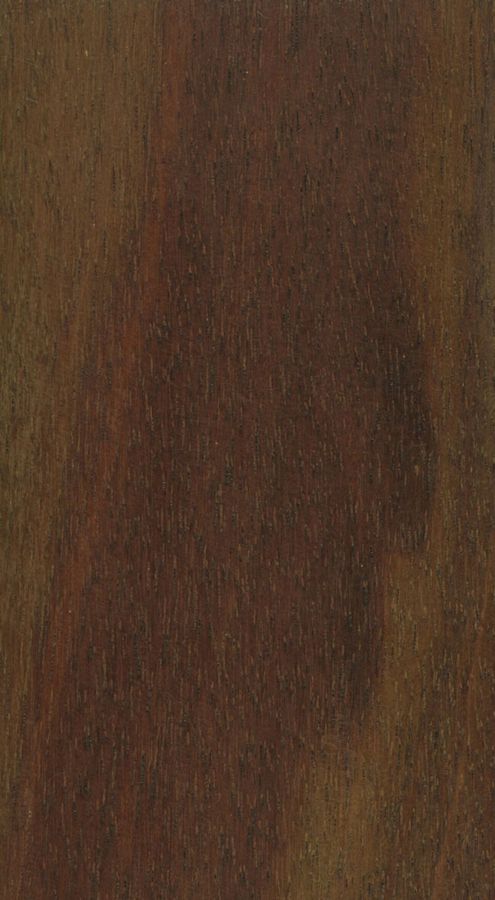
Bloodwood (Brosimum rubescens), traditionally called satine, is the reddest commercial timber: a vivid, almost crimson heartwood with a lustrous finish. It is extremely dense and brittle. People pick it for knife handles, inlays and turned work where colour is the point.
Pros
- Vivid red colour that finishes to a lustrous surface.
- Very hard (Janka 2,900 lbf, about 1,050 kg/m3) and strong.
- Rated very durable and resistant to most insects.
- Widely available as boards, turning squares and blanks.
- Not on the CITES Appendices or the IUCN Red List, per Wood Database.
Cons
- Brittle and splinters when worked; a pronounced blunting effect on cutters.
- Many boards are only a dull reddish brown; truly blood-red stock is the ideal and costs more.
- Colour darkens to brownish red with light exposure.
- Dust can cause thirst, salivation, nausea and skin irritation.
- Moderate to moderately high price.
Variants and subspecies
- Brosimum rubescens: the usual species, sold as bloodwood or satine.
- Quality grades: bright red stock versus dull brown-red, priced differently by dealers.
- Look-alikes: padauk (African padauk) is a brighter orange-red and easier to work, and Purpleheart offers the other end of the colour range.
Working and finishing
Treat it like an extremely hard, brittle wood: carbide tools, light cuts, back up edges against splintering, and expect to sharpen often. It sands and polishes to a high lustre. Apply a thick protective finish and keep it out of direct sun to slow colour change.
Staining and finishing colour
No stain needed. UV exposure shifts the colour to a darker brownish red; a thick clear finish and indoor placement slow it, per Wood Database.
Sustainability and handling
CITES and IUCN: Wood Database reports it in neither the CITES Appendices nor the Red List (APHIS CITES Timber Manual, checked 2026-09-30); absence from the Red List means it is unassessed, not necessarily secure. FSC availability is not verified here. The US Lacey Act makes it unlawful to trade wood taken or exported in breach of the source country's laws (fws.gov/law/lacey-act), so buy from dealers who can name the country and species. If a piece will be exported to or sold in the EU, Regulation (EU) 2023/1115 (the EUDR) requires due-diligence evidence that wood products are deforestation-free and legally produced; check its current application date with your buyer.
Ethical call: a reasonable choice for small items; small quantities limit the footprint. Health: dust has been reported to cause thirst, salivation and nausea, and skin irritation. The US National Cancer Institute reports strong, consistent associations between wood-dust exposure and cancers of the nasal cavity and sinuses, so use extraction and a respirator when sanding.
Popular projects
Inlays, trim and accent strips, guitars and other instruments, knife handles, turned objects, carvings and small boxes.
Buying notes
Sold as boards, turning squares and blanks. Two retailers list 4/4 at $18.70 and $19.99 per board foot (September 2026). Buy by eye: pick brightly coloured boards, because many are dull brown.
Typical projects
- inlays and accents
- guitars
- knife handles
- turned objects
- small furniture
- carving
Sources
Researched 2026-09-30. Prices, conservation status and CITES listings on this page are indicative and were checked on that date. They change: confirm them with your supplier, and with the relevant authority before importing or exporting.