


Overview
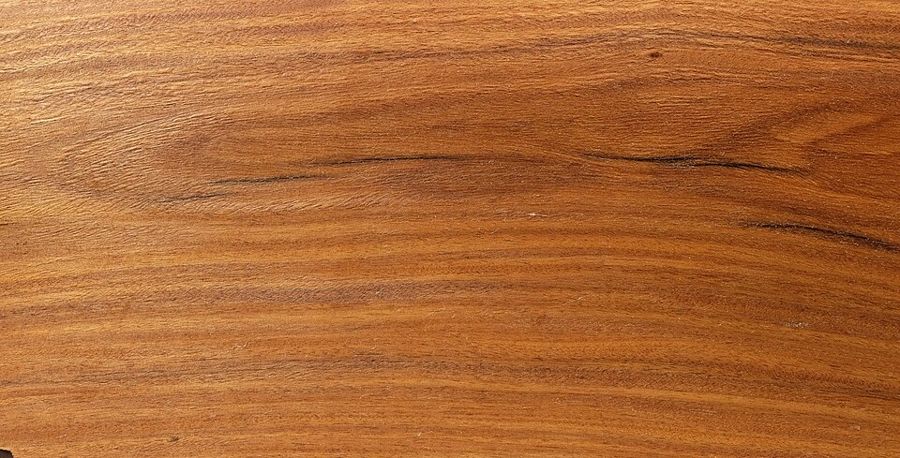
Bolivian rosewood (Machaerium scleroxylon), sold as pau ferro, morado or santos rosewood, ranges from reddish orange to dark violet-brown with black streaks. It looks much like true rosewood and is used as an alternative to it, but it is a different genus and has no CITES listing. Pick it when you want a rosewood look without the paperwork.
Pros
- Rosewood-like colour with black streaking, at a lower price than scarce true rosewoods.
- Janka 1,960 lbf, about 865 kg/m3; hard and durable.
- Rated very durable for decay; turns and finishes well.
- Not in the CITES Appendices; many Machaerium species are Least Concern, per Wood Database.
- Widely used as a substitute for Brazilian rosewood in instruments.
Cons
- Fair workability: blunts cutters, tears out on irregular grain, and shares the gluing difficulties of rosewoods.
- Susceptible to insect attack and not recommended in direct ground contact.
- Reported as a sensitizer; Wood Database also cites anecdotal evidence of a high reaction rate.
- Highly variable colour from board to board.
- Pricey at about $30 a board foot.
Variants and subspecies
- Machaerium scleroxylon: the usual source of pau ferro and Bolivian rosewood.
- Machaerium villosum: a Brazilian species that is Vulnerable from deforestation.
- Names: morado, santos rosewood, caviuna. Do not confuse with granadillo (Granadillo (macacauba)), a different group of woods.
- True rosewoods: East Indian rosewood and Cocobolo are Dalbergia, and under CITES Appendix II.
Working and finishing
Sharp, carbide tools help. Take light cuts across irregular grain. Wipe oily surfaces with solvent before gluing and test the glue. Turns and finishes well; oil or wax shows the grain. Wear a respirator.
Staining and finishing colour
Not usually stained. The natural colour range runs from reddish orange to dark violet-brown, so match boards by eye and finish clear.
Sustainability and handling
CITES: not listed in the Appendices (Wood Database; APHIS CITES Timber Manual, checked 2026-09-30); Machaerium is a separate genus from Dalbergia, so the genus-wide Dalbergia listing does not apply. IUCN: many species Least Concern; M. villosum Vulnerable. FSC availability is not verified here. The US Lacey Act makes it unlawful to trade wood taken or exported in breach of the source country's laws (fws.gov/law/lacey-act), so buy from dealers who can name the country and species. If a piece will be exported to or sold in the EU, Regulation (EU) 2023/1115 (the EUDR) requires due-diligence evidence that wood products are deforestation-free and legally produced; check its current application date with your buyer.
Ethical call: among the better true-rosewood alternatives; still ask for the botanical name, since 'rosewood' is a loose label. Health: reported as a sensitizer, with eye and skin irritation. The US National Cancer Institute reports strong, consistent associations between wood-dust exposure and cancers of the nasal cavity and sinuses, so use extraction and a respirator when sanding.
Popular projects
Guitar fingerboards and bridges, cabinetry, veneer, turned objects, interior trim and small boxes.
Buying notes
Bell lists 4/4 at $30.00 per board foot (September 2026). Check the label: Bolivian rosewood is sold under several names, and some 'rosewoods' on offer are Dalbergia species under CITES.
Typical projects
- guitar fingerboards
- cabinetry
- veneer
- turned objects
- interior trim
- flooring
Sources
- www.wood-database.com/granadillo
- www.bellforestproducts.com/exotic-lumber/prices
- www.aphis.usda.gov/sites/default/files/cites.pdf
- www.fws.gov/sites/default/files/documents/CoP19%20timber%20outcomes...
- www.fws.gov/sites/default/files/documents/2026-01/ole-public-bullet...
- www.fws.gov/law/lacey-act
- eur-lex.europa.eu/eli/reg/2023/1115/oj
- www.aphis.usda.gov/sites/default/files/cites.pdf
Researched 2026-09-30. Prices, conservation status and CITES listings on this page are indicative and were checked on that date. They change: confirm them with your supplier, and with the relevant authority before importing or exporting.