

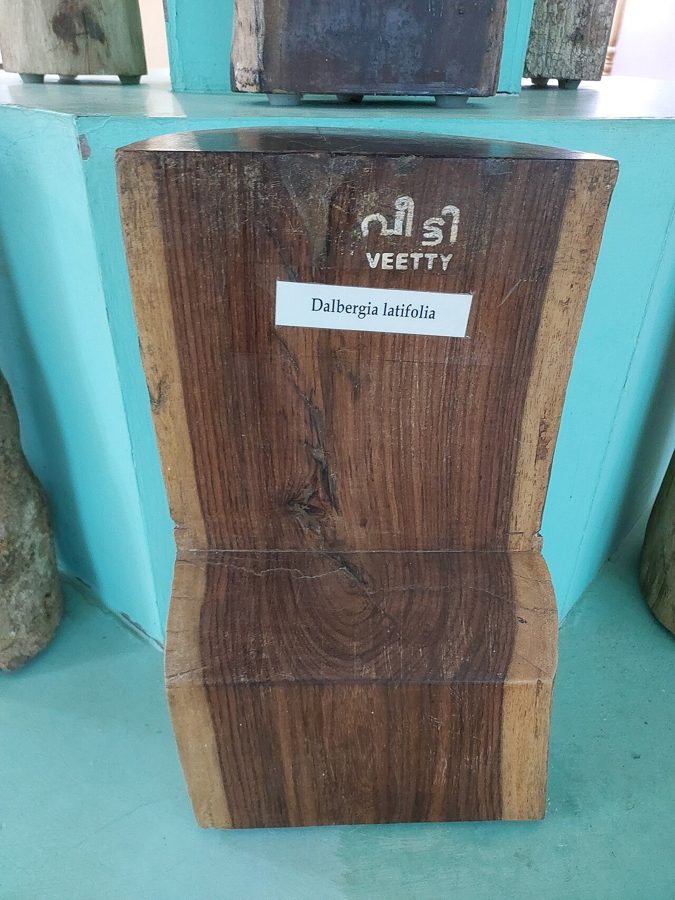

Overview
East Indian rosewood is the classic "other" rosewood: dense, dark, with purplish-brown colour and black streaks, and the stock wood for fine furniture and guitars after Brazilian rosewood was restricted. The Wood Database says it has been used extensively on acoustic guitars since the mid 1960s as a substitute for Brazilian rosewood. Supply is now shrinking and legally tangled. For a furniture project it is an expensive wood with extra paperwork.
Pros
- Hard and dense: Janka 2,350 lbf, 855 kg/m3 (Wood Database).
- Rated very durable with good termite resistance.
- Rich colour that darkens with age, with good natural lustre.
- Radial shrinkage 2.6%, tangential 5.9% (Wood Database).
- Turns and glues well.
Cons
- Somewhat difficult to machine because of interlocked grain and density; occasional chalk-like deposits dull cutting edges quickly.
- Finishing can be problematic, like most rosewoods.
- Reported sensitizer; skin irritation is the commonest reaction.
- Increasingly limited availability and high price, and it is a CITES-listed, Vulnerable species.
Variants and subspecies
- Indonesian sonokeling: the same species, D. latifolia, as grown in Java, where it is a plantation tree; see Sonokeling. The Wood Database notes some believe it was introduced rather than native. Wikipedia says it is grown on plantations in India and Java, and that Indian law makes exporting lumber from wild-harvested trees illegal.
- Sissoo or sheesham (D. sissoo) is sometimes sold as "Indian rosewood" but is a different, lighter species; see Sheesham.
- Bombay blackwood is an old trade name for this species (Wood Database).
Working and finishing
Sharp carbide and light passes help; expect tear-out across interlocked grain. The Wood Database reports a rose-like scent when worked, which some find less pleasant than other Dalbergia. The Wood Database says it generally turns and glues well.
Staining and finishing colour
Staining is rarely done: the wood is already deep purple-brown with black streaking, and it darkens further with age. Because finishing can be problematic, test any film finish on offcuts first.
Sustainability and handling
IUCN Red List: Vulnerable (2020), caused by population decline from range loss and exploitation (Wood Database). All Dalbergia except Appendix I species are in CITES Appendix II under annotation #15 (CITES Appendices text valid from 5 March 2026; checked 2026-09). The annotation covers logs, sawn wood and veneer. Finished products up to 10 kg of wood weight per shipment, and finished musical instruments, are excluded. The US Lacey Act (16 U.S.C. 3372) bars trade in plants taken in violation of foreign law, and Indian law prohibits exporting lumber from wild-harvested trees (Wikipedia), so wild Indian lumber offered abroad is a red flag. EU deforestation rules cover wood and furniture from 30 December 2026 for large and medium operators (EC, checked 2026-09). Buy only with CITES paperwork and a plantation origin. If you cannot get it, Sheesham is the lower-risk Dalbergia (IUCN Least Concern). Wear a mask: reported sensitizer.
Popular projects
Fine furniture, musical instruments, veneer and turned objects (Wood Database). Acoustic guitars are the best-known use.
Buying notes
Sold as boards and turning blanks. Bell Forest lists 4/4 stock at $52.50 to $70.00 per board foot depending on quantity, in 4 to 6.5 inch widths. Confirm the botanical name: "Indian rosewood" is also applied to sissoo, and "sonokeling" to the Indonesian-grown form of this same species. Ask for CITES documentation, particularly for anything crossing borders.
Typical projects
- fine furniture
- acoustic guitars
- veneer
- turned objects
Finishes that suit this
Finishes to avoid
Sources
Researched 2026-09-30. Prices, conservation status and CITES listings on this page are indicative and were checked on that date. They change: confirm them with your supplier, and with the relevant authority before importing or exporting.