



Overview
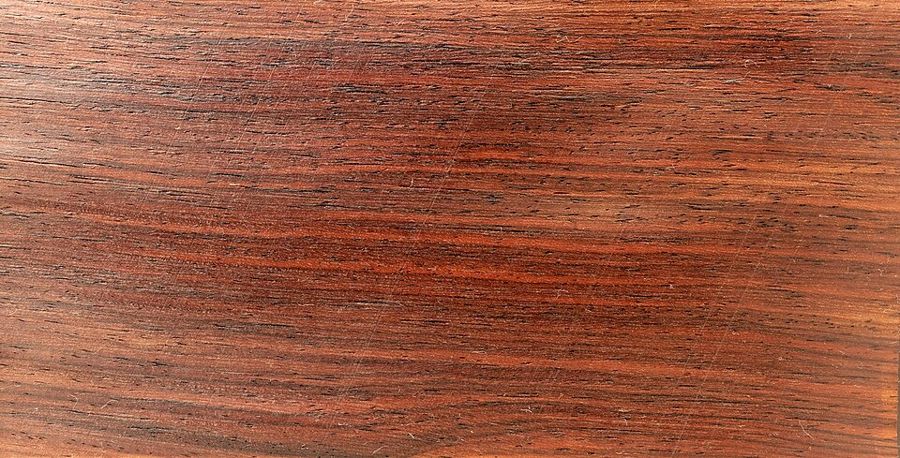
Cocobolo (Dalbergia retusa) is one of the most prized and most notorious woods: a swirl of orange, red, brown and violet with black streaks, oily, dense and brilliant when polished. It is also infamous for gluing problems and allergic reactions. People pick it for handles, instruments and turned work.
Pros
- Outstanding colour and figure, polished straight from the sander.
- Janka 2,960 lbf and about 1,095 kg/m3; hard and fine-textured.
- Rated very durable and insect-resistant, helped by natural oils.
- A top choice for instruments and small turned objects.
Cons
- Wood Database calls it notoriously allergenic: a reported sensitizer causing skin, eye and respiratory irritation, nausea, pink-eye and asthma-like symptoms.
- Oil makes gluing difficult, and colour can bleed into surrounding wood during finishing.
- Very expensive, and supply is limited.
- Vulnerable on the IUCN Red List and in CITES Appendix II.
- Tear-out where grain is interlocked, and a moderate blunting effect on cutters.
Variants and subspecies
- Dalbergia retusa: the usual cocobolo.
- Colour grades: bright orange-red or vividly marked stock commands the premium; paler wood is cheaper.
- Sapwood: very pale yellow, often removed.
- Substitutes: for dark, oily rosewood character, Bolivian rosewood (pau ferro) is not CITES-listed; for Asian options, see East Indian rosewood and Sonokeling, though both are Dalbergia and share the Appendix II listing.
Working and finishing
Wear a respirator and gloves and use dust extraction, always. Wipe glue surfaces with acetone just before gluing and test the glue. Seal early so the colour does not smear into pale neighbours. Turn and sand to a high polish; it takes a lustrous finish with little more than wax or oil.
Staining and finishing colour
Colours are lighter when freshly cut and darken with age, per Wood Database. Do not stain; a clear oil or wax shows it best. Film finishes can be affected by the surface oils, so seal and test.
Sustainability and handling
CITES: Dalbergia spp. (other than D. nigra) have been in CITES Appendix II since 2 January 2017, covering all parts and derivatives except leaves, flowers, pollen, fruits, seeds and finished musical instruments, accessories and parts; non-commercial finished items under 10 kg per shipment are exempt (APHIS CITES Timber Manual; checked 2026-09-30). Cocobolo is covered. IUCN: Vulnerable, with a population decline above 20% over three generations. Wood Database reports limited supply and high demand. FSC availability is not verified here. The US Lacey Act makes it unlawful to trade wood taken or exported in breach of the source country's laws (fws.gov/law/lacey-act), so buy from dealers who can name the country and species. If a piece will be exported to or sold in the EU, Regulation (EU) 2023/1115 (the EUDR) requires due-diligence evidence that wood products are deforestation-free and legally produced; check its current application date with your buyer.
Ethical call: avoid new, undocumented material. If you need an oily dark rosewood-like wood, Bolivian rosewood (pau ferro) has no CITES listing, and Katalox (Mexican ebony) is a dark, dense option. Health: one of the worst sensitizers; use full precautions. The US National Cancer Institute reports strong, consistent associations between wood-dust exposure and cancers of the nasal cavity and sinuses, so use extraction and a respirator when sanding.
Popular projects
Knife scales and tool handles, guitars and other instruments, pens and turned objects, inlays, jewellery boxes and fine small furniture.
Buying notes
Sold as short boards, squares and blanks, rarely as wide lumber. Bell lists 4/4 shorts at $82.00 per board foot, and blanks come out around $96-103 (September 2026). Ask for documentation of origin and legality, and be wary of bargain pieces.
Typical projects
- knife and tool handles
- guitars and instruments
- turned objects
- pens
- inlays
- small boxes
More pictures

Sources
- www.wood-database.com/cocobolo
- www.bellforestproducts.com/exotic-lumber/prices
- www.aphis.usda.gov/sites/default/files/cites.pdf
- www.fws.gov/sites/default/files/documents/CoP19%20timber%20outcomes...
- www.fws.gov/sites/default/files/documents/2026-01/ole-public-bullet...
- www.fws.gov/law/lacey-act
- eur-lex.europa.eu/eli/reg/2023/1115/oj
Researched 2026-09-30. Prices, conservation status and CITES listings on this page are indicative and were checked on that date. They change: confirm them with your supplier, and with the relevant authority before importing or exporting.