


Overview
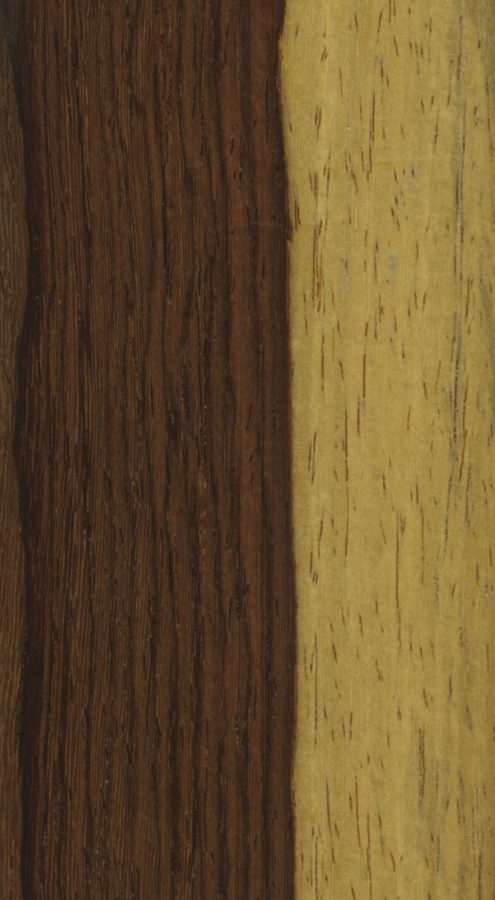
Burmese rosewood (Dalbergia oliveri, tamalan in Myanmar) is an orange to reddish-brown rosewood with black streaks and a medium-fine texture. The Wood Database calls it one of the lesser-known rosewoods, though a well-known tonewood in its home range, where it is used for the bars of the Thai ranad ek xylophone. It is hard and handsome. It is also an Endangered species, and the honest advice for most furniture projects is to choose something else.
Pros
- Very hard and dense: Janka 2,710 lbf, 940 kg/m3 (Wood Database).
- Rated very durable for decay resistance.
- Generally easy to work with hand and machine tools; turns and polishes well.
- Colour holds better than most colourful exotics, though it darkens with age (Wood Database).
Cons
- IUCN Endangered and CITES Appendix II; legal supply is hard to prove.
- Natural oils can disrupt gluing, finishing and drying.
- Blunts cutting edges rapidly.
- Reported sensitizer; eye, skin and respiratory irritation are the usual reactions.
- Mixed resistance to insect attack.
Variants and subspecies
- Burmese rosewood vs Burmese padauk: different genera with confusingly similar names and origins. Padauk is Pterocarpus macrocarpus, see Burmese padauk.
- Burmese blackwood (D. cultrata) is a different species altogether and should not be used to price this one.
- Close relative Siamese rosewood (D. cochinchinensis) is Critically Endangered; for a documented alternative, see Sheesham or East Indian rosewood.
Working and finishing
The Wood Database reports it is generally easy to work, but it dulls edges quickly. Oils in the wood can interfere with glue and finish, so take care with both; test a joint and a finish sample. It turns and polishes well.
Staining and finishing colour
Normally finished clear to show the orange-to-red colour and black streaks. The Wood Database says the colour darkens with age, but tends to hold better than many colourful exotics. Because oils affect finishing, test on offcuts.
Sustainability and handling
IUCN Red List: Endangered; the Wood Database cites a population reduction of over 50% in three generations from range decline and exploitation (checked 2026-09). All Dalbergia outside Appendix I are CITES Appendix II under annotation #15 (CITES Appendices text valid from 5 March 2026; checked 2026-09), covering logs, sawn wood and veneer, with finished products up to 10 kg of wood per shipment excluded. The US Lacey Act (16 U.S.C. 3372) makes trade in illegally taken plants unlawful. The US, EU, UK, Canada and Switzerland sanctioned the Myanmar state timber company in April 2021 (Wikipedia, "Myanma Timber Enterprise"), so ask a seller of Myanmar-origin wood where it passed. EU rules on deforestation cover wood from 30 December 2026 for large and medium operators (EC, checked 2026-09). This is a poor ethical choice for ordinary furniture: choose Sheesham with documentation instead. Wear a mask; reported sensitizer.
Popular projects
Furniture, flooring, percussion instruments and turned items (Wood Database). The ranad ek xylophone uses it for its bars.
Buying notes
Availability is "somewhat limited" and the Wood Database puts price mid to upper range, with no verified US lumber price (the Bell Forest East Indian rosewood figure is only a proxy). Insist on the botanical name Dalbergia oliveri, a CITES permit and a documented origin; walk away if the seller cannot supply them.
Typical projects
- furniture
- flooring
- percussion instruments
- turned objects
- xylophone bars
Sources
- www.wood-database.com/burmese-rosewood
- en.wikipedia.org/wiki/Dalbergia_oliveri
- cites.org/eng/app/appendices.php
- www.law.cornell.edu/uscode/text/16/3372
- environment.ec.europa.eu/topics/forests/deforestation/regulation-de...
- en.wikipedia.org/wiki/Myanma_Timber_Enterprise
- www.bellforestproducts.com/exotic-lumber/prices
Researched 2026-09-30. Prices, conservation status and CITES listings on this page are indicative and were checked on that date. They change: confirm them with your supplier, and with the relevant authority before importing or exporting.