


Overview
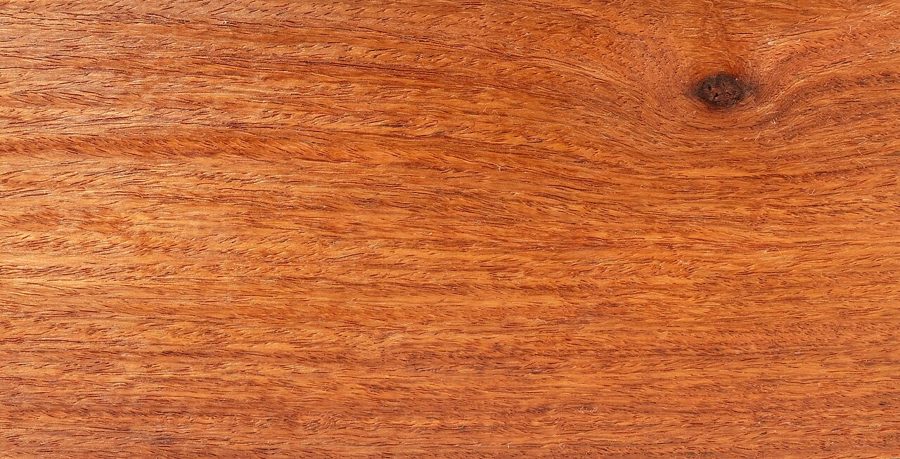
Burmese padauk is the heavier, harder and more subdued cousin of the bright orange African padauk. Colour ranges from pale golden yellow to reddish brown, darkening to golden brown with age, and the grain is interlocked with a coarse texture and open pores. The Wood Database calls it the heaviest and hardest commercially available padauk. It is used for turnings, instruments and furniture, but availability is limited, and the tree is now assessed as Endangered.
Pros
- Janka 2,150 lbf at 865 kg/m3; the hardest and heaviest of the commercial padauks (Wood Database).
- Rated very durable, with good resistance to termites and other insects.
- Turns, glues and finishes well.
- A more muted look than African padauk, if the bright red-orange is too much.
Cons
- Interlocked grain and density can make it difficult to work (Wood Database).
- Reported sensitizer; eye, skin and respiratory irritation are the usual reactions.
- Available much less often than African padauk, and likely mid to upper price range.
- Endangered (IUCN) and sourced from Myanmar and Thailand, which brings legal-origin risk even without a CITES listing.
Variants and subspecies
- Burma padauk vs African padauk: different species (Pterocarpus macrocarpus vs P. soyauxii). African padauk is brighter red-orange and less dense (Wood Database).
- Burmese rosewood (Dalbergia oliveri) is unrelated in genus, and is covered in Burmese rosewood.
- Other padauks in the genus are P. dalbergioides (Andaman padauk), P. indicus (narra) and P. angolensis (muninga).
Working and finishing
Because of its density and interlocked grain, expect tear-out when surfacing; sharp tools and light cuts help. The Wood Database says it turns, glues and finishes well, and notes a faint aromatic scent. Wear a mask.
Staining and finishing colour
Typically finished clear. The Wood Database notes that colour darkens to golden brown with age, and that it is generally less red than African padauk. Since sources were not found on its response to stain or dye, test on offcuts.
Sustainability and handling
IUCN Red List: Endangered (2019 assessment; the Wood Database page, which says it is not on the Red List, is out of date). Not listed in the CITES Appendices: the Pterocarpus annotation #17 applies only to African populations, and only P. santalinus is listed separately (CITES Appendices text valid from 5 March 2026; checked 2026-09). That means no CITES permit is needed, but not that the wood is risk-free. The US Lacey Act (16 U.S.C. 3372) makes trade in illegally taken plants unlawful. The US, EU, UK, Canada and Switzerland sanctioned the Myanmar state timber enterprise in April 2021 (Wikipedia), so Myanmar-origin wood needs a documented chain. EU deforestation rules cover wood and furniture from 30 December 2026 for large and medium operators (EC, checked 2026-09). Treat as a caution rather than a ban: buy only with a documented origin, or choose a better-supplied padauk. Reported sensitizer.
Popular projects
Veneer, flooring, turned objects, musical instruments, furniture and tool handles, per the Wood Database.
Buying notes
Rare in US yards. No Burmese padauk price was found, so the price shown is a proxy from the African padauk lists. African padauk is often what a yard means when it says "padauk": check the botanical name, since the two differ in density, colour and price.
Typical projects
- turned objects
- veneer
- musical instruments
- furniture
- tool handles
- flooring
Finishes that suit this
Sources
- www.wood-database.com/burma-padauk
- en.wikipedia.org/wiki/Pterocarpus_macrocarpus
- cites.org/eng/app/appendices.php
- en.wikipedia.org/wiki/Myanma_Timber_Enterprise
- www.law.cornell.edu/uscode/text/16/3372
- environment.ec.europa.eu/topics/forests/deforestation/regulation-de...
- www.bellforestproducts.com/exotic-lumber/prices
- goosebaylumber.net/wood/padauk
Researched 2026-09-30. Prices, conservation status and CITES listings on this page are indicative and were checked on that date. They change: confirm them with your supplier, and with the relevant authority before importing or exporting.