

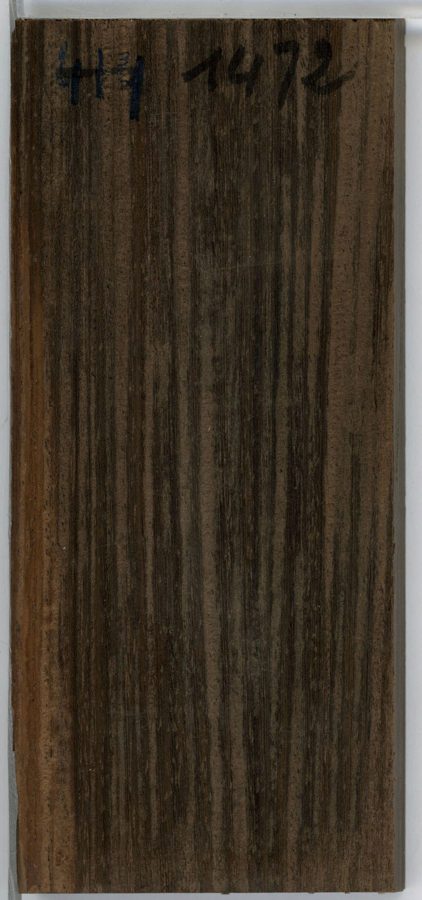

Overview
Siamese rosewood is a dense, fine-textured, reddish-brown rosewood from mainland Southeast Asia, prized in China as a "hongmu" timber. It is also one of the most endangered commercial woods in the world. The Wood Database says it has been central to illegal logging in Asia, and that as of 2013 the largest remaining tree in Thailand was guarded day and night by a platoon of soldiers. This entry is here so you can recognise the name and avoid it, not as a recommendation.
Pros
- Very hard and dense: Janka 2,430 lbf and about 1,035 kg/m3, with MOR 24,800 lbf/in2 (Wood Database).
- Fine, even texture with good natural lustre; workability is fairly good despite the density.
- Reported to be very durable.
- Turns well.
Cons
- Critically Endangered (IUCN, 2022 re-evaluation). Wikipedia reports conservationists projecting possible extinction within ten years, and that seven Thai rangers were killed in 2015 in clashes with loggers. Demand is chiefly from China.
- Increasingly scarce under CITES restrictions, and no finished-product exemption applies (see below).
- Like all rosewoods, difficult to glue or finish.
- Reported sensitizer; skin irritation, rashes and hives are listed.
Variants and subspecies
None sold as separate products. The Wood Database notes that its scent is mild and not like other Dalbergia. Do not confuse it with Burmese rosewood (D. oliveri, also Endangered), or with East Indian rosewood and Sheesham, which are different species.
Working and finishing
Despite its density and occasionally interlocked grain, the Wood Database rates workability as fairly good. Gluing and finishing can be difficult, as with all rosewoods. It turns well.
Staining and finishing colour
Finished clear: the medium to dark reddish brown with black streaking is the appeal. Test on offcuts since rosewoods are difficult to finish.
Sustainability and handling
IUCN Red List: Critically Endangered (2022 re-evaluation, per Wikipedia). The Wood Database still lists Vulnerable, so its page is out of date. Dalbergia is in CITES Appendix II under annotation #15, but parts and derivatives of D. cochinchinensis are covered by annotation #4 instead, so the 10 kg finished-product exemption does not apply to this species (CITES Appendices text valid from 5 March 2026; checked 2026-09). The US Lacey Act (16 U.S.C. 3372) makes trade in illegally taken plants unlawful, and EU deforestation rules cover wood and furniture from 30 December 2026 for large and medium operators (EC, checked 2026-09). Treat this as a poor ethical choice: do not buy newly cut timber. If a project needs a rosewood, choose Sheesham. Reported sensitizer.
Popular projects
Fine furniture, turned objects and musical instruments (Wood Database).
Buying notes
Almost nothing is legally in the market. Only one US listing was found (West Wind Hardwood, $28.00 per bf, $25.20 on sale), out of stock. Be sceptical of any seller. The Wood Database says turning blanks and burls are occasionally available, but they are subject to the same restrictions.
Typical projects
- fine furniture
- turned objects
- musical instruments
- small specialty wood items
Sources
Researched 2026-09-30. Prices, conservation status and CITES listings on this page are indicative and were checked on that date. They change: confirm them with your supplier, and with the relevant authority before importing or exporting.