


Overview
Black ash (Fraxinus nigra) is a northern, wetland ash: lighter and less dense than White ash, with closer growth rings. It is a minor furniture lumber but the main wood of traditional splint basketry, where thin strips are pounded off the log along the annual rings. Pick it for a pale, oak-like but softer ash, or when you want to work with a traditional basket-making material.
Pros
- Straight, regular grain and oak-like texture; it machines well and steam-bends well.
- Glues, stains and finishes well.
- Lighter and softer than white ash (850 lbf and about 545 kg/m3 dried, against 1,320 lbf and 675 kg/m3), so easier on tools.
- Tight, closely spaced growth rings help distinguish it, and make it pleasing on a plain face.
- Traditionally the preferred wood for pounded ash splint baskets.
Cons
- Not as strong or dense as white ash; the Wood Database attributes this to slower growth and a higher proportion of weaker earlywood.
- Heartwood is perishable and not insect-resistant: indoor use only.
- Dust: Fraxinus has been reported to cause skin irritation and decreased lung function.
- Distinct, moderately unpleasant odour while working.
- Black ash is one of the ash species the emerald ash borer attacks first, so supply is falling.
- Shrinkage is relatively high, 5.0% radial and 7.8% tangential.
Variants and subspecies
- Black ash is the only species in this entry; it is a handful of ash species used as commercial lumber.
- It is often mixed with white ash and other ashes in the yard. For the main lumber species, see White ash.
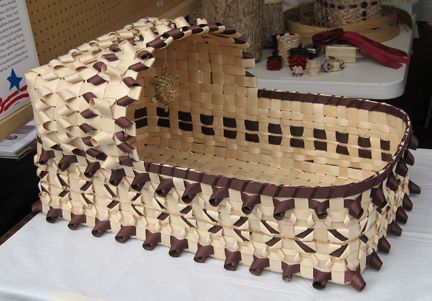
- Basket stock: for weaving, black ash logs are pounded to loosen annual-ring strips, a use the Wood Database mentions for the species and which the sample image shows in a finished basket.
- Colour is a little darker than white ash.
- Ring spacing is closer than white ash, which the Wood Database says helps tell them apart.
Working and finishing
The Wood Database says black ash produces good results with hand or machine tools, steam-bends well and glues, stains and finishes well. The grain is almost always straight and regular, and curly pieces are occasional. Pores are open, so use filler for a smooth film. Expect a distinct, unpleasant smell when cutting.
Staining and finishing colour
Black ash tends to be a bit darker than white ash: light to medium brown heartwood with wide beige sapwood. It takes stains and finishes well, and with an oak-like texture it can take the same stain schedule as White ash or oak. Test on scraps because pore absorption varies between boards.
Sustainability and handling
The Wood Database reports black ash as not in the CITES Appendices (checked 2026-09-30) but as Critically Endangered on the IUCN Red List, from a projected decline of over 80% in three generations caused by an introduced pest, the emerald ash borer; Wikipedia's page for Fraxinus nigra also gives Critically Endangered (2017). The Wood Database says green and black ash are the trees the beetle preferentially attacks. US-grown timber is still covered by the Lacey Act, which as amended in 2008 prohibits trade in plants and timber taken, possessed, transported or sold in violation of law (Wikipedia's summary of the Act); buy from dealers who can name the source. The Wood Database's wood-dust article treats wood dust in general as an irritant or sensitizer and notes that fine dust can cause cumulative lung damage, so extract at the source and wear a respirator when sanding or machining.
Popular projects
Woven and splint baskets, interior furniture, millwork, boxes and crates, and tool handles; the Wood Database lists flooring, millwork, boxes, baseball bats and turned objects for ash generally and notes black ash is one of a handful of ash species used as commercial lumber.
Buying notes
Black ash lumber is not commonly stocked. Ask local sawmills in the northern US and Canada, and ask yards whether "ash" means black or white. No verified list price was found; expect ash-like prices (see White ash, about $3.50 to $6.25 per board foot).
Typical projects
- woven baskets
- interior furniture
- millwork
- boxes
- tool handles
Sources
Researched 2026-09-30. Prices, conservation status and CITES listings on this page are indicative and were checked on that date. They change: confirm them with your supplier, and with the relevant authority before importing or exporting.