

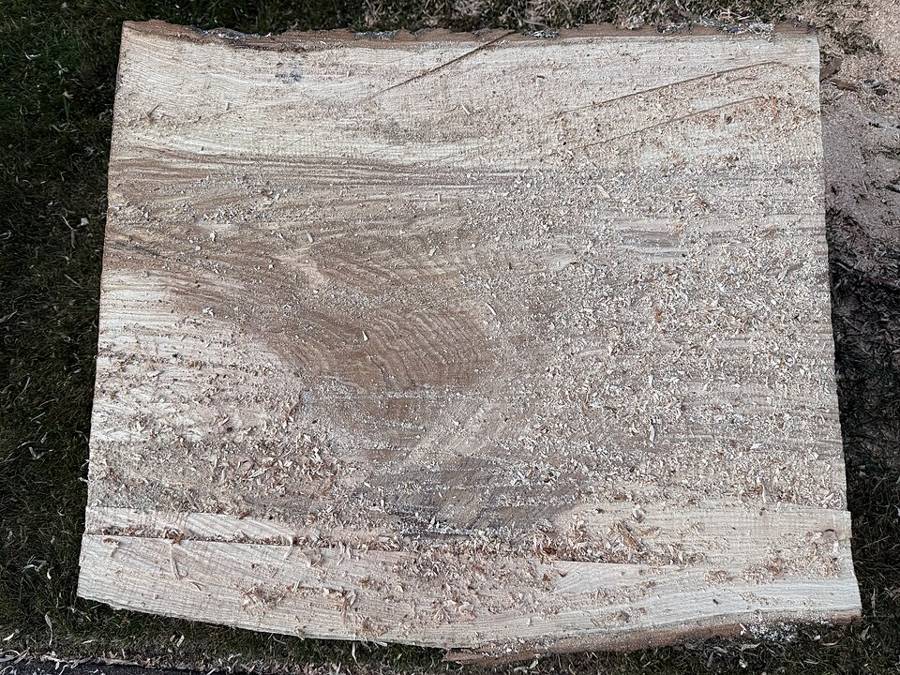

Overview
White ash (Fraxinus americana) is a pale, ring-porous hardwood with a grain like oak and the toughness of hickory. It is strong, steam-bends well and is priced like a utility wood, which is why it turns up in tool handles, baseball bats, chairs and plain, honest furniture. Pick it for a light, clean-grained piece, or for bent or impact-loaded parts.
Pros
- Strong and tough: the Wood Database says white ash has excellent shock resistance and, along with hickory, is one of the most common North American tool-handle woods.
- Janka hardness is 1,320 lbf at about 675 kg/m3 dried.
- Good results with hand and machine tools, and it steam-bends well.
- Glues, stains and finishes well; stained ash can look much like oak.
- Among the least expensive utility hardwoods, comparable to oak.
Cons
- Heartwood is perishable or only slightly durable, and ash is not insect-resistant: keep it indoors.
- Open, oak-like pores need filling for a glass-smooth finish.
- Gives off a distinct, moderately unpleasant smell when worked.
- Fraxinus dust has been reported to cause skin irritation and decreased lung function.
- Native ash is under heavy threat from the emerald ash borer, so supply and provenance are changing.
- Shrinkage is fairly high: 4.9% radial and 7.8% tangential.
Variants and subspecies
- White ash (F. americana) is the main lumber species.
- Black ash (F. nigra) is lighter, less dense and a different wood; see Black ash.
- Green and blue ash: the Wood Database notes the emerald ash borer attacks green and black ash first, then white and blue; the lumber trade also uses these related species.
- Oak look-alike: ash has much narrower rays than oak, visible as thin lines on surfaces in oak but not ash. Compare with White oak or Red oak. For a heat-treated option see Thermally modified wood.
Working and finishing
The Wood Database reports good results with hand or machine tools; ash steam-bends well and glues, stains and finishes well. The pores are open and large, so fill them if you want a smooth film finish. The grain is almost always straight and regular, and occasionally moderately curly. Expect a moderately unpleasant smell when cutting.
Staining and finishing colour
Heartwood is light to medium brown, with wide beige sapwood. It takes stain and clear finishes well; the Wood Database notes that stained ash can look very similar to oak. Open earlywood pores soak up pigment, so test the stain on offcuts. Clear finishes leave a pale, creamy surface.
Sustainability and handling
The Wood Database reports white ash as not listed in the CITES Appendices (checked 2026-09-30) but as Critically Endangered on the IUCN Red List, from a projected population decline of over 80% in three generations caused by an introduced pest, the emerald ash borer (Agrilus planipennis). It was first detected in Michigan in 2002 and, per the Wood Database, has killed hundreds of millions of ash trees in the United States and Canada; Wikipedia's page for the species also gives Critically Endangered (2017). US-grown timber is still covered by the Lacey Act, which as amended in 2008 prohibits trade in plants and timber taken, possessed, transported or sold in violation of law (Wikipedia's summary of the Act); buy from dealers who can name the source. The Wood Database says Fraxinus has been reported to cause skin irritation and a decrease in lung function. The Wood Database's wood-dust article treats wood dust in general as an irritant or sensitizer and notes that fine dust can cause cumulative lung damage, so extract at the source and wear a respirator when sanding or machining.
Popular projects
Dining chairs, tables, benches, bent-wood parts, tool handles, baseball bats and flooring, as well as millwork and boxes; the Wood Database lists flooring, millwork, boxes and crates, baseball bats and turned items as typical uses. The Wood Database singles out shovel and hammer handles, where toughness and impact resistance matter.
Buying notes
Widely available as rough and surfaced lumber at roughly $3.50 to $6.25 per board foot (various grades and thicknesses). Ask where the stock came from and whether it is white ash specifically, since "ash" can cover several species. Keep it dry and indoors.
Typical projects
- tool handles
- baseball bats
- dining chairs
- tables
- steam-bent parts
- flooring
Finishes that suit this
Sources
- www.wood-database.com/white-ash
- en.wikipedia.org/wiki/Fraxinus_americana
- www.wood-database.com/wood-articles/wood-dust-safety
- en.wikipedia.org/wiki/Lacey_Act_of_1900
- www.johnsoncreekhardwoods.com/price-list-1
- dougwhitehardwoods.com/hardwoods
- crlumber.com/price-list
- www.thewoodyard.com/current-pricing-list
- countryconcepts.com/hardwood-softwood-prices
Researched 2026-09-30. Prices, conservation status and CITES listings on this page are indicative and were checked on that date. They change: confirm them with your supplier, and with the relevant authority before importing or exporting.