

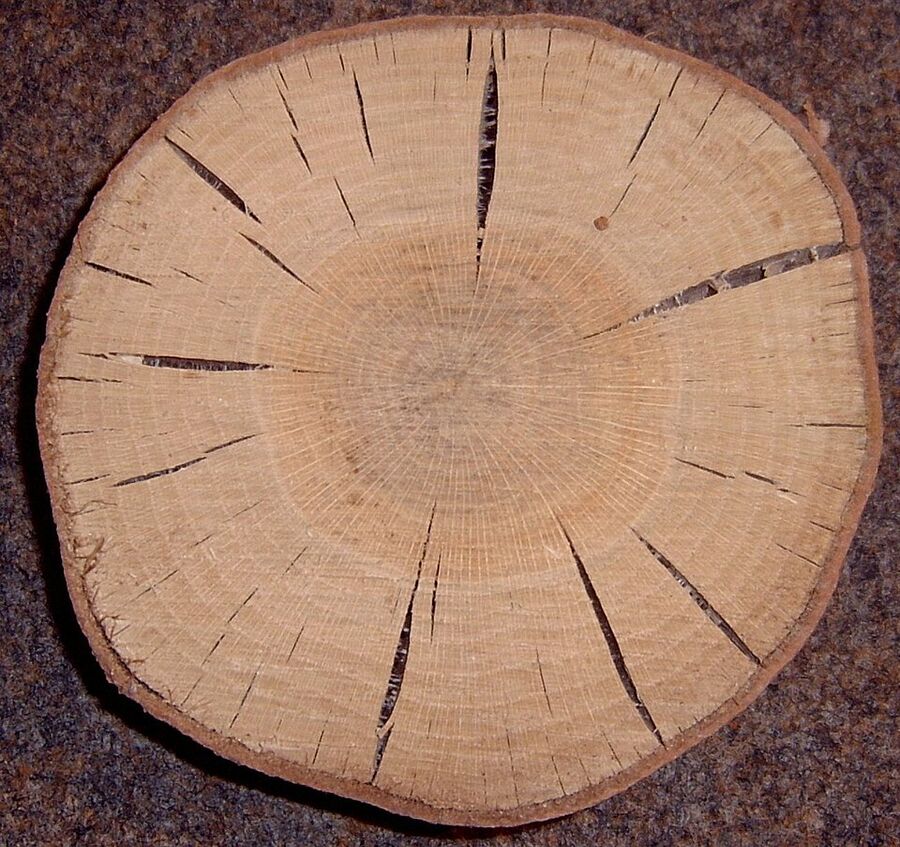

Overview
Red oak is the everyday American hardwood: strong, coarse-grained, pinkish-brown and cheap. Wood Database calls it arguably the most popular hardwood in the United States, and it is the oak behind most stock kitchen cabinets, trim and flooring. It is a good teaching wood and a good paint-grade or stained shop wood. It is a poor choice outdoors or anywhere damp.
Pros
- Inexpensive and easy to find, in every common thickness and in wide boards.
- Machines well; with white oak it scored near the top in an assessment of domestic hardwood machinability.
- Strong and moderately hard (Janka 1,220 lbf), a step softer than White oak and lighter at about 700 kg/m3.
- Glues, stains and finishes well, and the open pores make it easy to colour.
Cons
- Rated non-durable to perishable with poor insect resistance. Do not use it for exterior work or in ground contact.
- High shrinkage (4.0% radial, 8.6% tangential), so plain-sawn boards move; mediocre dimensional stability.
- Stains and discolours when in contact with water, particularly in the porous growth rings, and reacts with iron.
- Very open grain: the pores are large enough that air can be blown along a straight-grained piece end to end, which makes it a poor choice for finishes that must seal, such as a table surface for liquids, without grain filling.
Variants and subspecies
- Northern red oak (Quercus rubra) is the wood described here. Wood Database notes other red-group species (southern red oak, Q. falcata, and others) are sold under the same name, with similar appearance and properties.
- Plain-sawn, quartersawn, rift: as with white oak, quartersawn shows ray fleck and moves less but costs more; red oak quartersawn is less sought-after than white.
- Sap vs heart: pale sapwood is mixed in with the heartwood in most boards.
- For the other oak group see White oak; for the Southern evergreen oak see Live oak.
Working and finishing
Good results with hand and machine tools. It is easier on tool edges than white oak. Because of its density and ray structure, tear-out is moderate rather than severe; sharp cutters matter on interlocked grain. Glues reliably. Sands quickly but the open pores will need grain filler if you want a smooth film finish. Odour while cutting is typical oak and generally welcome.
Staining and finishing colour
Stains easily and evenly; because pores soak up pigment, the grain looks bolder under a stain than on a denser wood. A reddish cast carries through clear and pale finishes, which is why red oak is often toned toward brown or grey to avoid a pink look. Do not rely on colour alone to separate red from white oak, as Wood Database cautions.
Sustainability and handling
The IUCN assessment of Quercus rubra is Least Concern, and Wood Database reports it is not listed in the CITES Appendices (checked 2026-09-30). Supply is abundant. US-grown timber is covered by the Lacey Act's ban on trade in unlawfully taken plants, so keep your dealer's paperwork. Wood Database reports oak as a sensitizer, usually causing eye and skin irritation and asthma-like symptoms. The US National Cancer Institute reports strong associations between wood-dust exposure and cancers of the nasal cavity and paranasal sinuses; extract dust at the machine and wear a respirator to sand.
Popular projects
Kitchen cabinets and face frames, flooring, stair parts, trim, bookcases, hall tables, desks, shop furniture and jigs, and paint-grade work where the open grain is not an issue.
Buying notes
Available at nearly every hardwood dealer and big-box store, usually 4/4 to 8/4, in FAS and Select or 1 Common. Cheaper than white oak, which Wood Database also reports, and the sensible default for budget projects. To tell it from white oak, look at end grain: red oak has open pores and no tyloses (bubble-like plugs in the pores), so on a straight-grained piece you can blow air through it. Avoid it for anything outdoors.
Typical projects
- kitchen cabinets
- flooring
- trim and millwork
- face frames
- bookcases
- shop furniture
Finishes that suit this
- Catalyzed polyurethane (2K)
- Conversion varnish
- Nitrocellulose lacquer
- Pre-catalyzed and post-catalyzed lacquer
- Shellac
- Alkyd varnish
- Oil-based polyurethane
- Wipe-on polyurethane
- Boiled and raw linseed oil
- Ebonizing
- Liming wax and cerusing
- Water-soluble dye stain
- Oil-based pigment stain
- Finishing resinous and blotchy woods
- Grain filler (pore filler)
- Finishing schedules by species
Hardware to avoid
Sources
Researched 2026-09-30. Prices, conservation status and CITES listings on this page are indicative and were checked on that date. They change: confirm them with your supplier, and with the relevant authority before importing or exporting.