

Overview
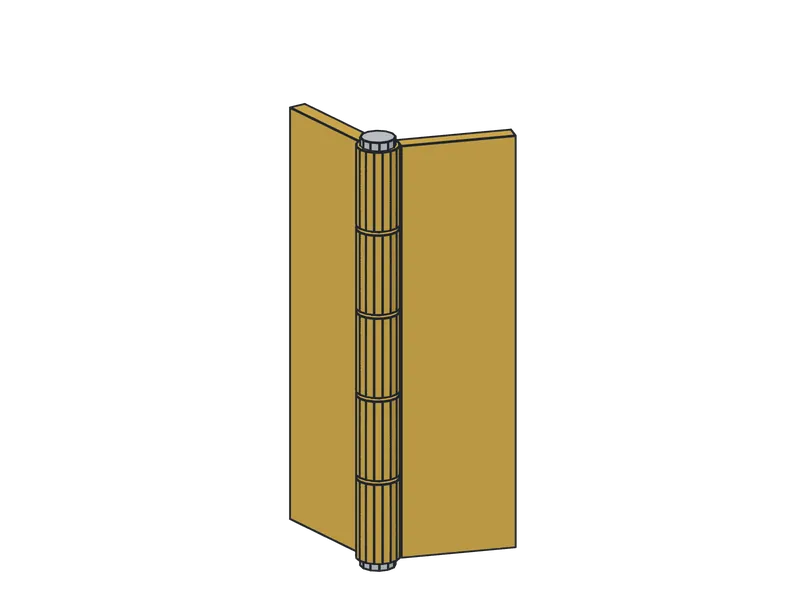
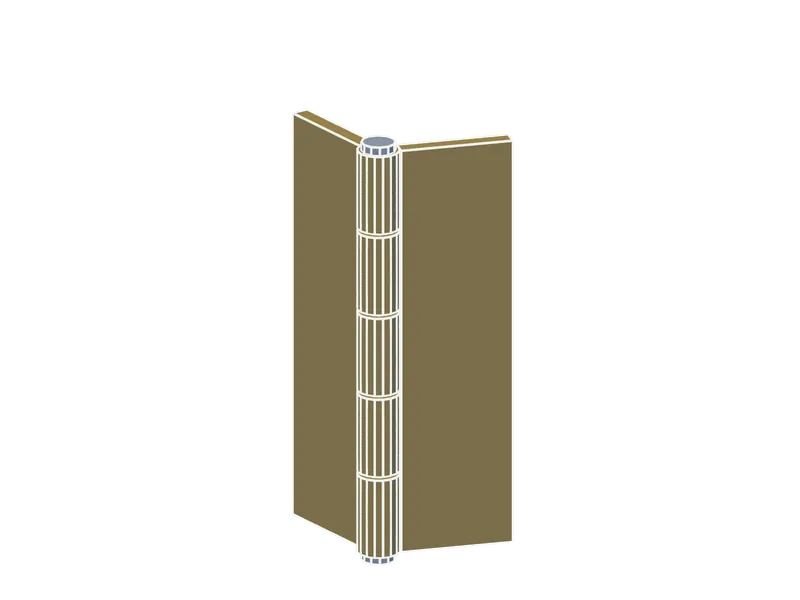
A butt hinge is a pair of flat leaves joined by knuckles and a pin. Both leaves are let into shallow recesses (mortises) cut into the edges that meet, so the closed hinge is flush with the wood and only the knuckle shows. It is the default hinge for a framed door that sits inside its opening, for a chest lid and for any box. A "half-mortise" version is let into one part only.
Types and sizes
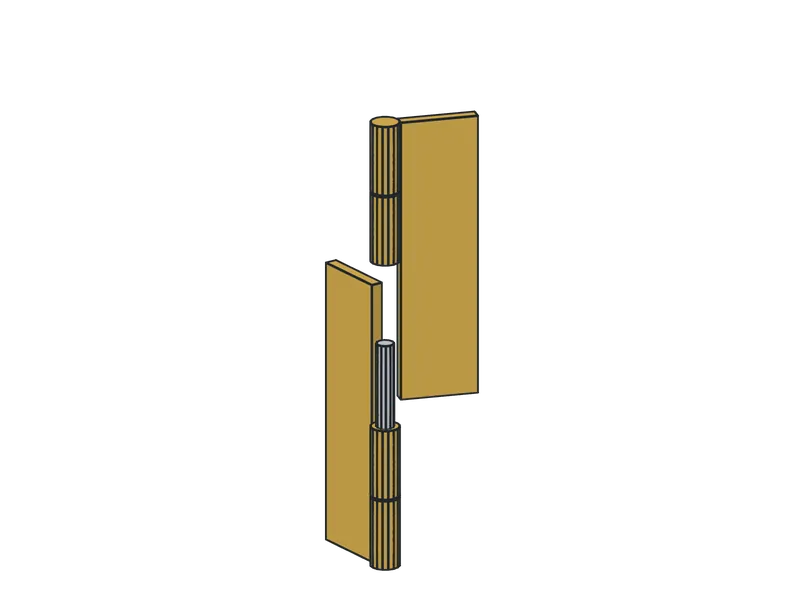
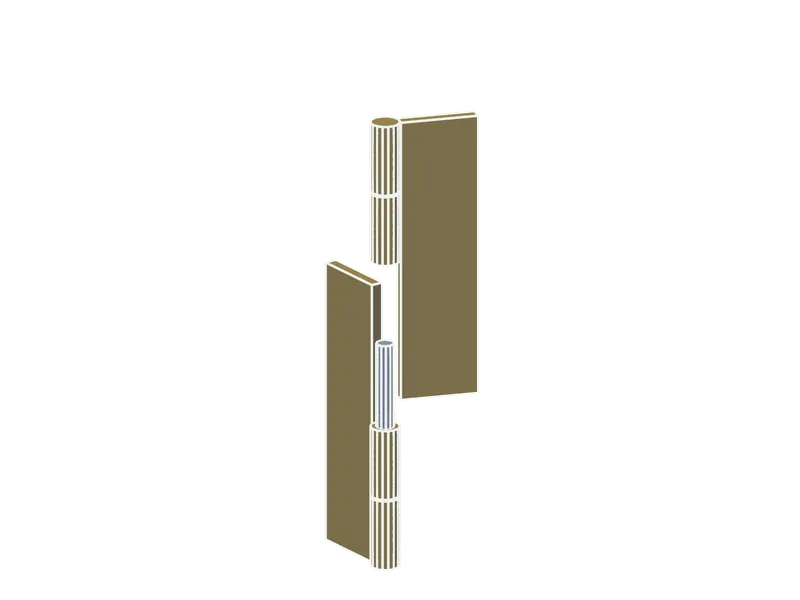
- Fixed pin is the cheap form; loose pin (lift-off) lets you remove a door without unscrewing.
- Rising butt lifts a door as it opens so it clears a carpet or a door above.
- Leaf length is the hinge's "size", quoted with the open width: 2 in x 1-1/4 in (50 x 32 mm) is a common small cabinet size; 3 in x 1-3/4 in (75 x 45 mm) hangs a full-height door.
- Brass (polished or antique) is the choice for period furniture; steel is cheaper and strong and comes bare, zinc-plated or black-oxide.
- Screws are normally countersunk wood screws in a matching metal (see Wood screw).
Where it is used
Federal and Sheraton case pieces use small brass butts on inset doors and lids; Shaker and neo-Shaker cupboards hang plain doors on plain butts; Arts and Crafts and Mission work often chooses a dark or hammered finish to match the pulls. Country work uses butts, often steel, on chests and cupboards alongside Strap hinge for heavier doors.
Choosing and sizing
Use two hinges up to about 1 m (40 in) of door height and 5 kg (11 lb), three above that or for a heavy solid door. As a rule of thumb, the hinge's leaf length is about one-sixth to one-eighth of the door height, and a door 18 to 20 mm (3/4 in) thick takes a hinge about 32 to 45 mm (1-1/4 to 1-3/4 in) open. A brass hinge is soft: a heavy door on brass wants a thicker leaf or a steel hinge. Hinges are always bought in pairs, and screws should match the metal.
Installation
- Mark the hinge positions about 1/5 of the door height from top and bottom (a hinge at about 75 to 100 mm, 3 to 4 in, from each end is usual).
- Scribe the leaf outline with a marking knife; with the hinge closed on the door edge, the knuckle centre should stand just proud of the door face by the gap you want (about 1.5 mm, 1/16 in).
- Chop or rout the mortise to exactly the leaf thickness (for example 2 mm, 5/64 in). Too deep sets the door back and binds; too shallow props the door open at the hinge side.
- Drill pilot holes with a self-centring bit; a hole for a No. 6 screw is about 2.5 mm (3/32 in) in hardwood.
- Fit the leaves to the door first, set the door with shims for an even gap, mark the carcass leaf positions from the door and repeat.
Wood movement and species
A door's width changes seasonally across the grain, so leave a hairline gap on the knuckle side and let the door shrink away from the hinge, not into it. Hinge mortises cut on the end grain of a stile cut cleanly but the screws hold poorly there; place screws in side grain wherever possible. Steel screws and steel butts corrode in the tannin-rich oaks (White oak, Red oak), leaving blue-black stains in damp air; use brass hinges with brass screws, or plated screws, and seal the mortise (see Dewaxed shellac).
Common mistakes
- Door binds on the hinge side: mortises too deep, or door set without a gap.
- Screws strip in softwood: too large a pilot, or end-grain screws; use a longer, thinner screw.
- Soft brass screws shear: drive a steel screw of the same thread first, then the brass one.
- Hinge pins out of line: the mortises were marked with different knuckle centres; mark both from one block.
Related
- Strap hinge and Piano hinge: alternatives for heavy doors or long edges.
- Knife hinge: a nearly invisible alternative for small inset doors.
- Magnetic catch and Roller catch: usually paired with butt-hung doors.
- Wood screw: the fixing that matters most to hinge life.
Styles it suits
Suitable for
Fixes into: hardwood, softwood.
Poor choice in
The reasons are in the wood movement and species section above.
In our designs
Our example designs model this as ButtHinge_75mm, ButtHinge_50mm, LeafHinge_Plain, LeafHinge_Brass, drawn with the leaf shape, placed with a hardware_mount join.
More pictures
Sources
Updated 2026-10-03. Sizes and ratings are typical trade figures drawn from the sources above. A load rating is the maker's rating for one product, not a property of the type: check the maker's own sheet, and test a fit on scrap before cutting good wood.