

Overview
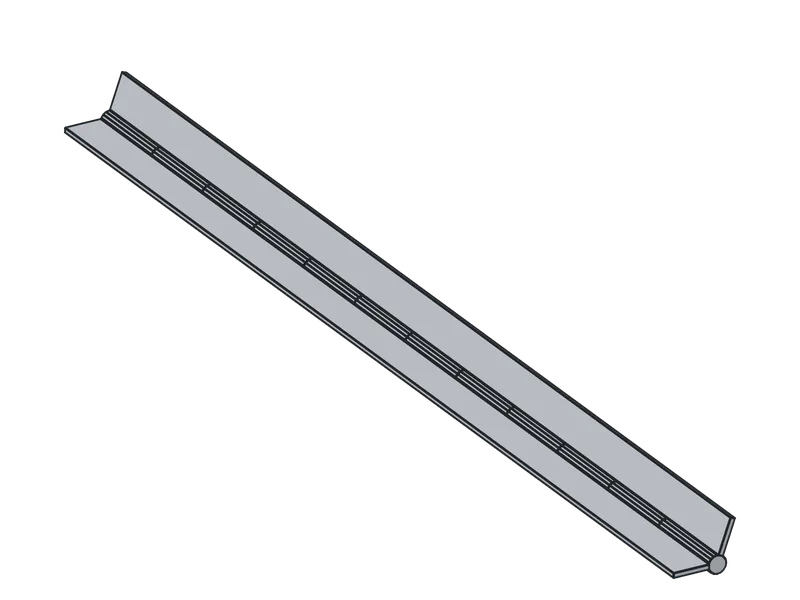
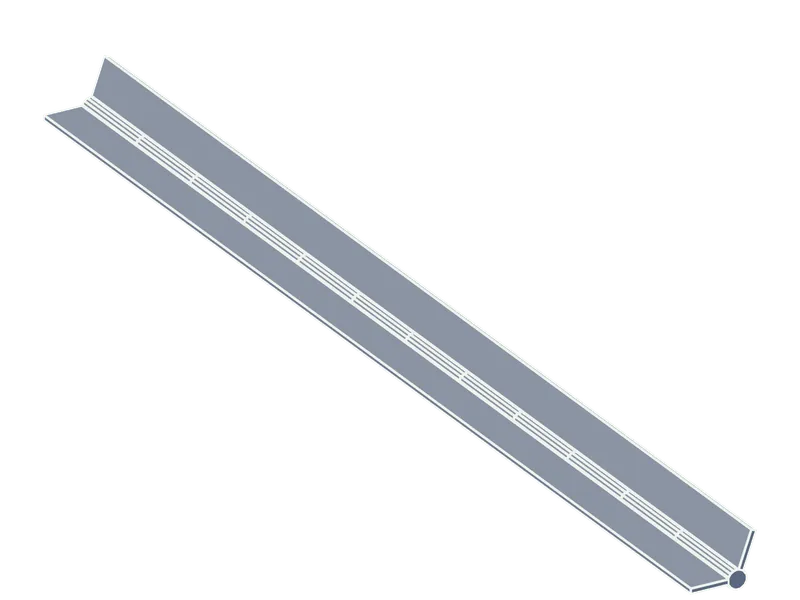
A piano (continuous) hinge is a barrel hinge that runs the whole length of the door, lid or panel it supports. It is made from long strips of two leaves with many knuckles and a single pin, usually pre-drilled with screw holes. It suits fall-fronts, long lids, tool-chest flaps, workbench lids and anything where a pair of butt hinges would concentrate load on two points.
Types and sizes
- Open width: 1 in (25 mm), 1-1/2 in (38 mm) and 2 in (50 mm) are the usual steps.
- Leaf thickness is the strength: thin leaves for light boxes, thicker for heavy lids.
- Hole patterns: pre-drilled on a pitch of about 2 to 3 in (50 to 75 mm), with countersunk holes.
- Materials: zinc-plated steel is the cheap everyday one; brass for visible furniture; stainless for damp or outdoor use.
- A pin that can be withdrawn lets the lid come off; a rivetted pin does not.
Where it is used
Not tied to a style: it is a workshop and utility hinge. It appears on tool chests, fall-front desks, sewing boxes and cabinet lids. It is not used in period case furniture, which hung lids on butts or back-flap hinges instead.
Choosing and sizing
Cut the hinge a few millimetres shorter than the edge so the ends do not catch. Use a width so the leaves leave at least 3 mm (1/8 in) of wood around the screws. For a lid heavier than 10 kg (22 lb), choose a thicker leaf and add a lid stay. Match the metal to the screws.
Installation
- Cut with a hacksaw or a metal-cutting blade; file the cut end, and tap the pin back in or fit a new short pin.
- Surface mount: drill pilot holes in the centre of each slot, 2.5 mm (3/32 in) for a No. 4 or 6 screw in hardwood, and drive each screw by hand to avoid burring the brass or stripping the plating.
- Mortised: rout or chisel a recess to exactly the leaf thickness so the knuckle sits on the box edge and the lid closes with a hairline gap.
- Fit the hinge to the lid first and clamp the lid in place before fitting the box leaf, using a spacer for an even gap.
- Leave out every other screw until you are sure the alignment is right.
Wood movement and species
A long continuous hinge cannot follow a long board's seasonal change across its width: a wide solid lid fixed along its whole length with the grain running across the hinge will pull on the screws as it moves. Run the grain of a solid lid parallel to the hinge, or use plywood or a framed panel. Steel hinges and screws stain white and red oaks (White oak, Red oak); use brass or stainless there.
Common mistakes
- Hinge cut too long and ends rubbing: trim the length, not the gap.
- Binding because the box and lid mortises are not both exactly the leaf thickness.
- Screws too long for a 12 mm (1/2 in) box wall and poking through.
- Left with sharp cut ends: file or dress them.
Related
- Butt hinge: two-point alternative for a door or lid.
- Back-flap hinge: for table leaves.
- Wood screw: sizing and pilot holes.
Suitable for
Fixes into: hardwood, softwood, sheet, engineered.
Poor choice in
The reasons are in the wood movement and species section above.
Sources
Updated 2026-10-03. Sizes and ratings are typical trade figures drawn from the sources above. A load rating is the maker's rating for one product, not a property of the type: check the maker's own sheet, and test a fit on scrap before cutting good wood.