


Overview
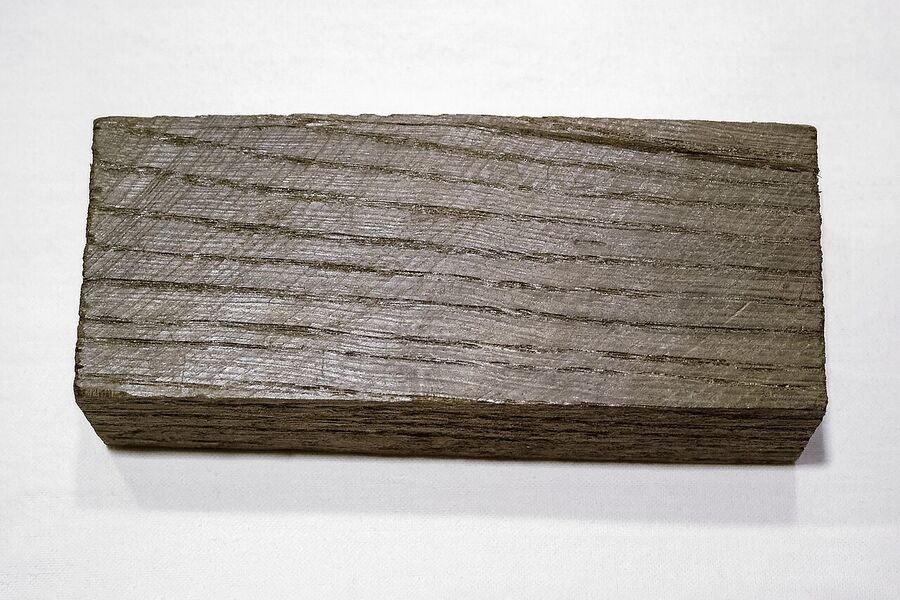
Bog oak is oak that has lain in a peat bog for hundreds, sometimes thousands, of years. The Wood Database says the very low oxygen protects it from normal decay, while the acidic peat lets iron salts and other minerals react with the oak's tannins and turn the wood dark brown to almost black. It is not a species. English oak (Quercus robur) is the one most often recovered. Wikipedia calls bog-wood the early stages of fossilisation. It is chosen for its rare dark colour and its age, not for its machining properties.
Pros
- A natural black that no stain gives. The colour runs through the wood, so carving and turning reveal more of it.
- Age and story: one 5,000-year-old oak was unearthed in the BBC report that Wikipedia cites, and bog-wood is important in archaeology.
- Wikipedia says a claim exists that bog-wood is comparable to some of the world's most expensive tropical hardwoods (an unverified comparison).
- Has a long craft history: carved decorative items, jewellery, and pieces in historic interiors (Wikipedia).
Cons
- Very scarce and very dear. The Wood Database says prices are very high because of the limited supply, and Rare Woods USA lists 8/4 at $35 per board foot.
- Hard to cut. Wikipedia says maturation turns the wood from golden-brown to black while increasing its hardness to the point that only specialist cutting tools can carve it.
- May crack or split as it dries (Wikipedia), and not every piece is sound; stock arrives in odd sizes and shapes.
- No reliable Janka or density: the Rare Woods USA page carries empty hardness fields, and the Wood Database gives none.
Variants and subspecies
- Bog oak proper: English oak from peat bogs. Colour ranges from golden-brown to black depending on how long and in what water it lay (Wikipedia).
- Other bog-wood: Wikipedia lists pine, yew, swamp cypress and kauri as species that also occur as bog-wood.
- Swamp kauri (ancient kauri): Wood Database says this is wood from fallen kauri trees preserved in New Zealand swamps and bogs, and that extraction difficulty makes it expensive. Living kauri is soft, at 730 lbf Janka (Wood Database), so that figure does not describe bog oak.
- River oak: I did not find a source covering river-recovered oak, so I do not describe it here.
- For the broader topic see Reclaimed lumber and Urban wood.
Working and finishing
Treat every piece as an individual. Wikipedia reports the wood becomes very hard and needs specialist cutting tools; sharp carbide tooling and slow feeds are my suggestion, not a sourced rule. Dry slowly, since it can crack or split as it dries (Wikipedia). Wikipedia notes the cracks do not necessarily detract from the look, which is why it is popular for decorative carving.
Staining and finishing colour
The colour is natural and runs through the wood. I found no sourced guidance on how it takes stain or whether the dark colour lightens on planing; test a scrap.
Sustainability and handling
Bog oak is recovered, not felled, which is a plus, but it comes from peatlands. I did not verify legality or conservation constraints for any bog, so ask the seller for provenance and permission. I did not check CITES or IUCN for it as a product. Use dust extraction and a respirator as for any hardwood; I did not find a bog-oak-specific safety source.
Popular projects
Carved decorative items and jewellery were popular in the nineteenth century (Wikipedia). Prized in the Tudor period for its dark hue, it was used for a throne, Venetian palaces and a bedroom suite, per Wikipedia. Wikipedia also lists furniture and joinery, carved dirk handles and tobacco pipes.
Buying notes
Sold by specialist dealers in small pieces or boards, often by the board foot or per piece. Rare Woods USA lists 8/4 standard lumber at $35 per bf. Ask how it was dried, whether it is cracked, and the origin. Expect odd sizes and voids; buy the piece, not the board footage.
Typical projects
- carved decorative items
- jewellery
- knife and dirk handles
- tobacco pipes
- furniture and joinery
Sources
Researched 2026-09-30. Prices, conservation status and CITES listings on this page are indicative and were checked on that date. They change: confirm them with your supplier, and with the relevant authority before importing or exporting.