

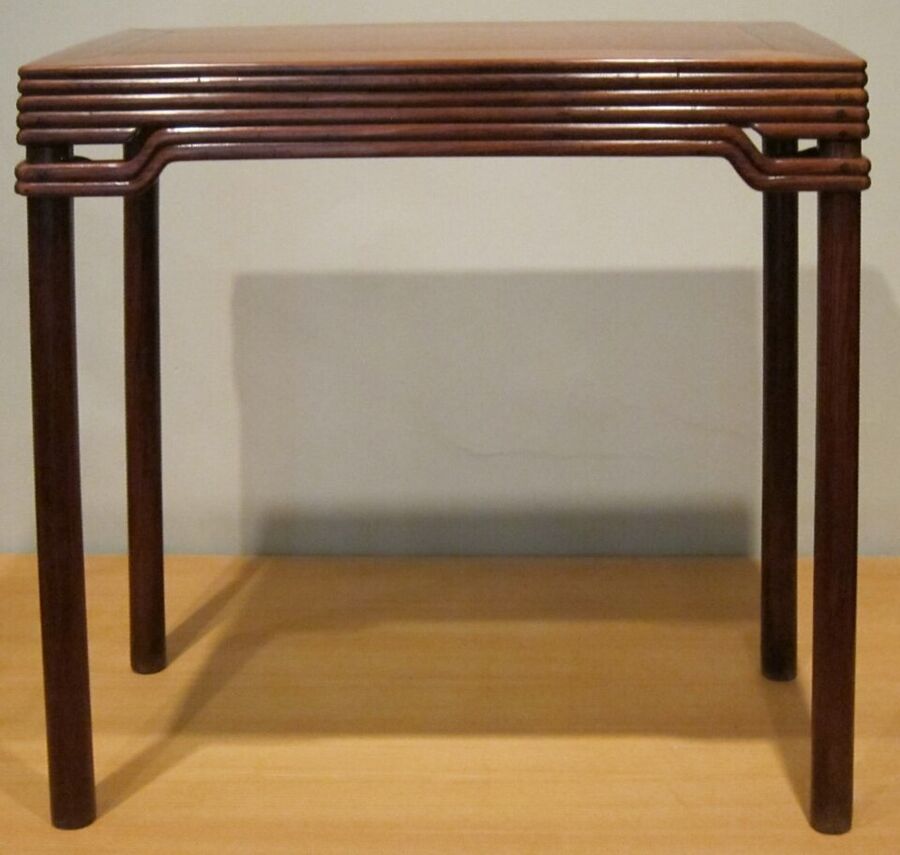

Overview
Huanghuali is Dalbergia odorifera, the classic wood of late Ming and early Qing Chinese furniture. Wikipedia's Chinese furniture article places it as the "xiangzhi" class of the hongmu timber standard, equating xiangzhi, D. odorifera and huanghuali. It is a CITES Appendix II rosewood, endemic to southern China, and one of the most expensive furniture timbers. I found no Janka or density from a source I could open. Realistically it is a wood to study and to restore with, not one to casually buy.
Pros
- The defining wood of classical Chinese furniture, with a clear tradition of joinery and form.
- Its value and prestige are well documented: Wikipedia cites Chinese huali prices of 8 to 12 million RMB per ton in 2004 and 18 million per ton in 2020.
- A single named species, so identification and the CITES position are well defined.
Cons
- Extremely expensive and scarce; no verified US lumber price.
- Legally restricted: CITES Appendix II, and protected as a Vulnerable endemic.
- No hardness, density or machining data from a source I could open.
- Several hongmu woods are sold under overlapping names, so identification needs care (the classes are distinct in the standard).
Variants and subspecies
- Dalbergia odorifera is huanghuali proper.
- Under the Chinese hongmu standard (GB/T 18107, as summarised by Wikipedia) there are eight classes, including huali (Pterocarpus), zitan, hong and hei suanzhi (Dalbergia), xiangzhi, wu/yinchen (Diospyros), striped ebony and jichimu. The classes are not interchangeable; see Zitan (red sandalwood) and Jichimu (chicken-wing wood).
- Other Dalbergia rosewoods are different woods and may be listed differently.
Working and finishing
No source I opened gives machining or finishing data for huanghuali. Test cuts, glue and finish on offcuts.
Staining and finishing colour
No stain tests found. Classical pieces are valued for the natural wood, so stain is rarely the goal. If you are restoring, match the existing finish on offcuts.
Sustainability and handling
On 2026-09-30 the Species+ database lists Dalbergia odorifera in CITES Appendix II, effective 26 November 2019 (CoP18, annotation #15). All parts and derivatives are covered, except leaves, flowers, pollen, fruits and seeds; finished products up to 10 kg per shipment; finished musical instruments, parts and accessories; and certain Dalbergia species under other annotations (D. cochinchinensis under #4, Mexican Dalbergia under #6). An earlier India-specific Appendix II listing dates from 2 January 2017. Wikipedia reports that all Dalbergia species are in Appendix II except D. nigra (Brazilian rosewood), which is in Appendix I. Wikipedia also lists D. odorifera as Vulnerable (1998). The Lacey Act bars US trade in plants taken in violation of law, with timber covered since 2008, and the EU deforestation regulation covers wood and furniture from 30 December 2026 for large and medium operators. I found no sourced toxicity data for this species, so extract the dust and wear a respirator.
Popular projects
Ming and early Qing furniture such as tables, chairs and cabinets, as in the photographed Kangxi-period side table, and modern reproductions.
Buying notes
Treat any offer of huanghuali as legally complex. Insist on CITES documents for trade across borders, a Latin name, and an expert identification. For other Chinese classical woods, see Zitan (red sandalwood), Jichimu (chicken-wing wood) and Nanmu.
Typical projects
- Ming and early Qing classical furniture
- tables
- chairs
- cabinets
- reproductions
Sources
- en.wikipedia.org/wiki/Dalbergia_odorifera
- en.wikipedia.org/wiki/Chinese_furniture
- en.wikipedia.org/wiki/Dalbergia
- speciesplus.net/api/v1/taxon_concepts/68032
- commons.wikimedia.org/wiki/File:Chinese_side_table,_Qing_dynasty,_K...
- en.wikipedia.org/wiki/Lacey_Act_of_1900
- environment.ec.europa.eu/topics/forests/deforestation/regulation-de...
Researched 2026-09-30. Prices, conservation status and CITES listings on this page are indicative and were checked on that date. They change: confirm them with your supplier, and with the relevant authority before importing or exporting.