


Overview
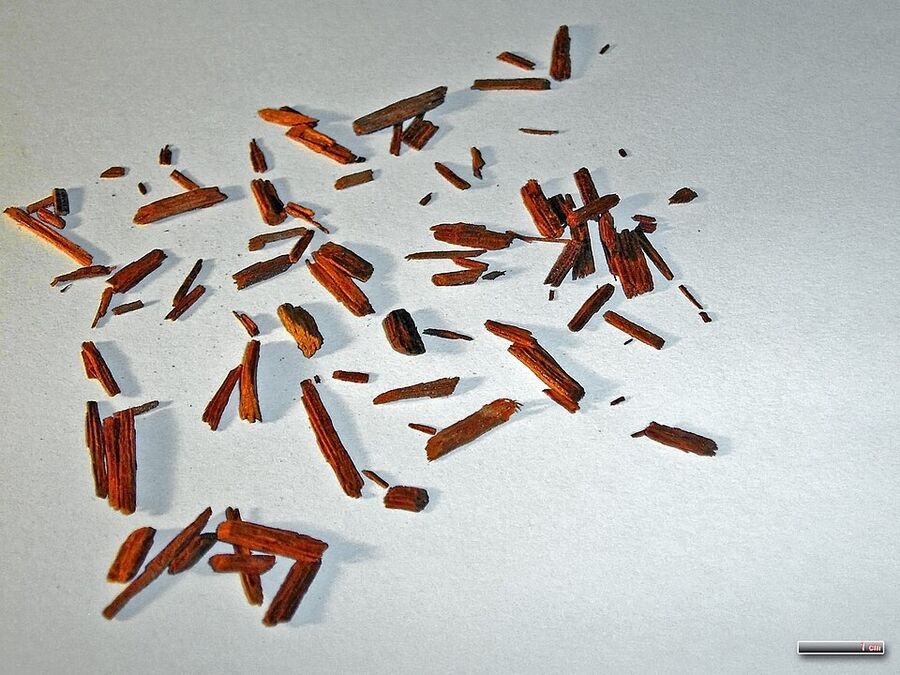
Zitan ("purple sandalwood") is the dense, dark, reddish-purple wood of Pterocarpus santalinus, known in English as red sandalwood or red sanders. Wikipedia says it was prized in the Qing dynasty, and in Chinese furniture it is a distinct class of the hongmu standard. At about 2,940 lbf Janka and about 1,010 kg/m3 (Wood Database) it is a very hard, very dense wood. It is also controlled and expensive, so treat it as a restoration and collector's wood.
Pros
- Extremely hard and dense: 2,940 lbf Janka, about 1,010 kg/m3, with a specific gravity of 0.88 to 1.01 (Wood Database).
- A rich dark orange to reddish-purple colour (Wood Database).
- Historic prestige as a Qing-dynasty court wood (Wikipedia).
- One clearly named species, with a well-documented CITES entry.
Cons
- Exorbitant prices and common counterfeits (Wood Database).
- CITES Appendix II, so international trade needs permits.
- Wood Database lists the wood as an irritant, and at this density it will be hard on tools.
- Sources conflict on the species' IUCN status (Endangered or Near Threatened).
- Wikipedia reports smuggling of the wood from India to China.
Variants and subspecies
- Pterocarpus santalinus, the species covered here.
- Wikipedia's Chinese furniture article says the zitan class under the hongmu standard covers more than this one species, and names other zitan sources including Dalbergia louvelii and D. maritima; those are different woods with different CITES treatment.
- For the other hongmu classes see Huanghuali and Jichimu (chicken-wing wood).
Working and finishing
I could not source machining or glue tests for this species. At 2,940 lbf expect heavy tool wear and pilot holes for every fastener; test everything on offcuts.
Staining and finishing colour
The colour is the point: dark orange to reddish purple. Stain is rarely used. I found no tests.
Sustainability and handling
CITES check, 2026-09-30, via the Species+ database: Pterocarpus santalinus is in Appendix II. The current listing took effect 13 September 2007 (CoP14, annotation #7) and covers logs, wood-chips, powder and extracts; earlier listings from 1995, 1997 and 2003 are superseded. It is also on the EU's Annex B. Wood Database says IUCN lists it as Endangered, but Wikipedia's text says it was reclassified Near Threatened in 2018 while its status box shows Endangered, so I give EN with that caveat. Wikipedia reports smuggling from India to China. The Lacey Act bars US trade in plants taken in violation of law, with timber covered since 2008, and the EU deforestation regulation covers wood and furniture from 30 December 2026 for large and medium operators. Wood Database reports the wood as an irritant: extract the dust and wear a respirator.
Popular projects
Qing court furniture and other Chinese classical pieces (Wikipedia). I found no sourced list of modern uses.
Buying notes
Insist on a Latin name, a CITES permit, and expert identification, since Wood Database says counterfeits are common. If the wood is offered as "zitan", check which species it is: the hongmu zitan class includes several.
Typical projects
- Qing dynasty court furniture
- Chinese classical furniture
Sources
- www.wood-database.com/red-sandalwood
- en.wikipedia.org/wiki/Pterocarpus_santalinus
- en.wikipedia.org/wiki/Chinese_furniture
- speciesplus.net/api/v1/taxon_concepts/28106
- commons.wikimedia.org/wiki/File:Santali_rubri_lignum_050258.jpg
- en.wikipedia.org/wiki/Lacey_Act_of_1900
- environment.ec.europa.eu/topics/forests/deforestation/regulation-de...
Researched 2026-09-30. Prices, conservation status and CITES listings on this page are indicative and were checked on that date. They change: confirm them with your supplier, and with the relevant authority before importing or exporting.