


Overview
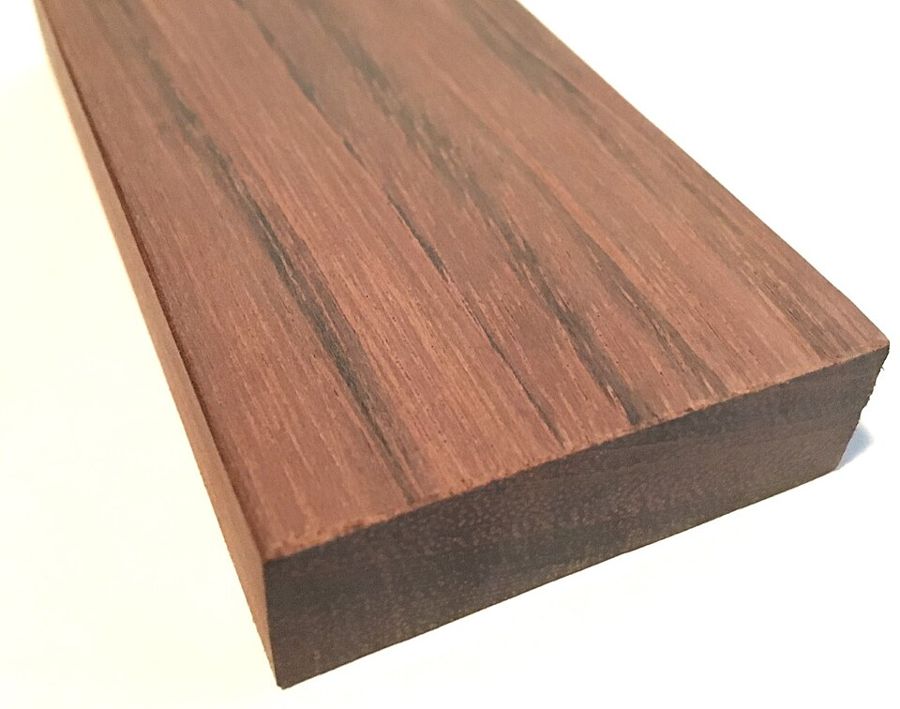
Jatoba (Hymenaea courbaril), sold as Brazilian cherry, is an orangish to reddish brown wood that deepens with light, hard and strong and common as flooring. It turns richly red over time. It is chosen for hard-wearing furniture, floors and treads where a warm tone is wanted.
Pros
- Janka 2,690 lbf and about 910 kg/m3: very hard, stiff and strong.
- Very durable and termite-resistant, according to Wood Database.
- IUCN Least Concern and not CITES-listed.
- Glues, stains, turns and finishes well, and steam-bends well.
- Reasonably priced for a tropical hardwood.
Cons
- Hard to work: interlocked grain tears out in planing and it blunts tools moderately.
- Reported to cause skin irritation.
- Colour shifts with light, so a freshly cut board will not match an aged one.
- Shrinks about 4.2% radially and 8.0% tangentially, so it moves seasonally.
- The pale grey-yellow sapwood is clearly demarcated from the heartwood.
Variants and subspecies
- Hymenaea courbaril: the principal species.
- Brazilian cherry is the flooring-trade name. Wood Database stresses that it is unrelated to American cherry (Black cherry), though its aged colour resembles stained cherry.
- Look-alikes: Santos mahogany (cabreuva) is a similar warm brown but a different wood; see its entry.
Working and finishing
Use sharp, high-quality blades and take light passes to limit tear-out on interlocking grain. Pre-drill for screws. It glues and finishes well, turns well and bends well under steam. Expect to sharpen sooner than with oak.
Staining and finishing colour
Takes stain, though the natural orange-to-red brown already resembles a cherry stain. It darkens on exposure to light, so many makers apply clear finishes and let it deepen, or use a UV-inhibiting finish to slow the change.
Sustainability and handling
CITES: not listed in the Appendices (Wood Database; APHIS CITES Timber Manual, checked 2026-09-30). IUCN: Least Concern. FSC availability is not verified here, so ask the supplier. The US Lacey Act makes it unlawful to trade wood taken or exported in breach of the source country's laws (fws.gov/law/lacey-act), so buy from dealers who can name the country and species. If a piece will be exported to or sold in the EU, Regulation (EU) 2023/1115 (the EUDR) requires due-diligence evidence that wood products are deforestation-free and legally produced; check its current application date with your buyer.
Ethical call: among the lower-risk imported hardwoods; a sensible alternative to Ipe for hard-wearing indoor uses. Health: reported to cause skin irritation, per Wood Database. The US National Cancer Institute reports strong, consistent associations between wood-dust exposure and cancers of the nasal cavity and sinuses, so use extraction and a respirator when sanding.
Popular projects
Flooring and stair treads, benches and hard-wearing tables, cabinetry, tool handles, turned items, and anywhere a rich red-brown with high wear resistance is wanted.
Buying notes
Sold as flooring and as 4/4 to 8/4 lumber. A specialist dealer lists 4/4 at $11.60 per board foot (September 2026). Check that 'Brazilian cherry' flooring is Hymenaea, and note that it is a halo name, not a cherry.
Typical projects
- flooring
- furniture
- cabinetry
- tool handles
- stair treads
- turned objects
More pictures

Sources
Researched 2026-09-30. Prices, conservation status and CITES listings on this page are indicative and were checked on that date. They change: confirm them with your supplier, and with the relevant authority before importing or exporting.