


Overview
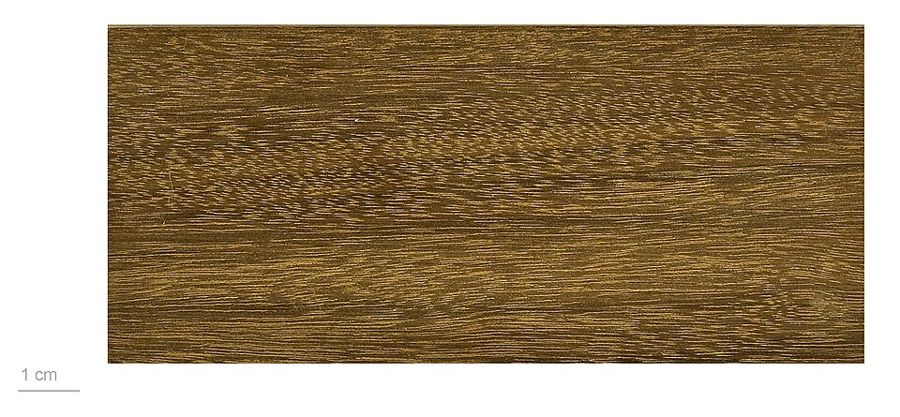
Ipe (pronounced ee-pay; Handroanthus spp., formerly Tabebuia) is the extreme-duty tropical hardwood: olive to reddish or blackish brown, very hard, very durable, and very hard to work. It is mainly sold as decking and flooring, with boards for furniture sold less often. Pick it for outdoor surfaces that must last decades with little care.
Pros
- Janka hardness around 3,490 lbf and density about 1,050 kg/m3, so it resists wear, dents and abuse.
- Rated very durable, with excellent insect resistance, per Wood Database; it is susceptible to marine borers.
- Wears and weathers well outdoors; left unfinished it greys at the surface.
- Strong and stiff, so outdoor furniture can use light sections.
Cons
- Difficult to saw, plane and drill; it blunts cutters badly, tears out on interlocked grain and needs pre-drilled screw holes.
- Hard to glue, so designs usually rely on mechanical fasteners; surface preparation is needed first.
- Contains lapachol, which Wood Database says produces pronounced skin irritation.
- Heavy, and shrinks about 5.5% radially and 7.1% tangentially, so allow for movement.
- CITES Appendix II since November 2024; Wood Database expects availability to shrink and prices to rise.
- Trees grow at very low density, so harvest is hard to sustain.
Variants and subspecies
- Handroanthus serratifolius (the species most often assessed), H. guayacan and H. impetiginosus are sold together as ipe, lapacho or 'Brazilian walnut'.
- Roseodendron and remaining Tabebuia species fall in the same CITES listing.
- Cumaru (Cumaru) is similar in colour, and Wood Database says the two can be very hard to tell apart.
- Brazilian walnut is a flooring-trade halo name only; it is not related to true walnut (Black walnut if you want the real thing).
Working and finishing
Use carbide tooling, slow feeds and sharp, light passes. Pre-drill and countersink every fastener. Plane with the grain; interlocked areas tear. Wipe gluing surfaces with solvent first, and for any glued joint use an epoxy or similar type recommended for oily woods, tested on scraps. Exterior oil keeps the colour; unfinished ipe weathers to silver-grey.
Staining and finishing colour
Takes oil-based penetrating finishes; film finishes and stains adhere poorly because of the density and oils. The colour ranges from reddish brown to yellowish olive or blackish brown, sometimes with darker stripes. UV oils slow the greying.
Sustainability and handling
CITES: Handroanthus, Tabebuia and Roseodendron are in Appendix II with annotation #17 (logs, sawn wood, veneer, plywood and transformed wood), effective 25 November 2024 (FWS CoP19 timber letter; APHIS CITES Timber Manual; checked 2026-09-30). IUCN: H. serratifolius is Endangered on a projected 100-year decline of over 50%, which Wood Database cautions is a forecast rather than an observed decline; mature trees occur only about once per 3 to 10 hectares. FSC availability is not verified here, so ask for chain-of-custody documents. The US Lacey Act makes it unlawful to trade wood taken or exported in breach of the source country's laws (fws.gov/law/lacey-act), so buy from dealers who can name the country and species. If a piece will be exported to or sold in the EU, Regulation (EU) 2023/1115 (the EUDR) requires due-diligence evidence that wood products are deforestation-free and legally produced; check its current application date with your buyer.
Ethical call: defensible only with documented, legally sourced stock. Substitutes: White oak or Thermally modified wood for decking, or Cumaru, which is now also Appendix II. Health: lapachol is a skin irritant; wear gloves and a respirator. The US National Cancer Institute reports strong, consistent associations between wood-dust exposure and cancers of the nasal cavity and sinuses, so use extraction and a respirator when sanding.
Popular projects
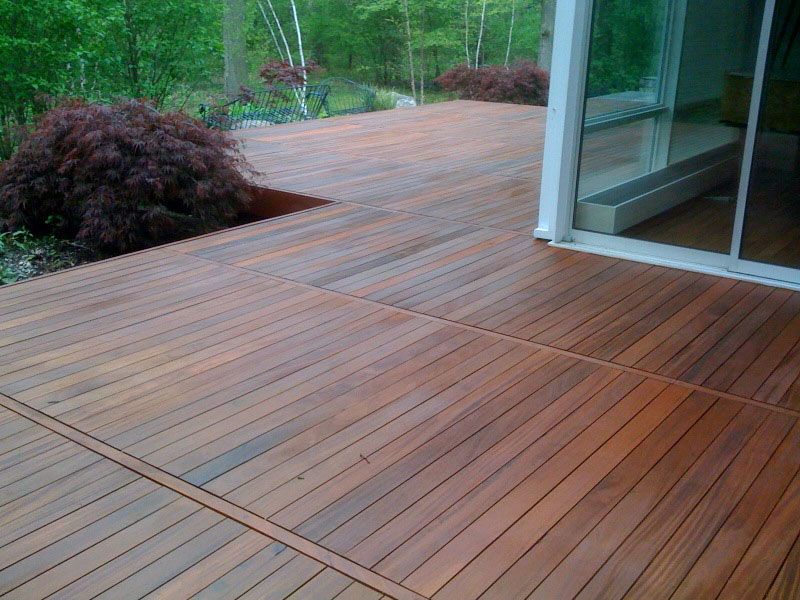
Decking, boardwalks, outdoor benches and tables, pergola and handrail parts, flooring, and tool handles or mallet heads where weight and hardness help.
Buying notes
Sold mostly as 5/4 decking and flooring, and as 4/4 to 8/4 lumber from specialist exotic dealers (one lists 4/4 at $16.99 per board foot, September 2026). Buy kiln-dried, surfaced stock, and ask for the CITES documentation that came with it. Avoid anything sold only as 'Brazilian walnut' without a botanical name.
Typical projects
- decking
- outdoor furniture
- boardwalks and docks
- flooring
- tool handles
- benches
Finishes that suit this
More pictures

Sources
- www.wood-database.com/ipe
- www.woodworkerssource.com/lumber/exotic/Ipe.html
- www.aphis.usda.gov/sites/default/files/cites.pdf
- www.fws.gov/sites/default/files/documents/CoP19%20timber%20outcomes...
- www.fws.gov/sites/default/files/documents/2026-01/ole-public-bullet...
- www.fws.gov/law/lacey-act
- eur-lex.europa.eu/eli/reg/2023/1115/oj
Researched 2026-09-30. Prices, conservation status and CITES listings on this page are indicative and were checked on that date. They change: confirm them with your supplier, and with the relevant authority before importing or exporting.