


Overview
Kiri is the Japanese name for Paulownia tomentosa, one of the lightest commercial hardwoods. This file covers kiri and paulownia together: they are the same tree, called kiri in Japan and paulownia elsewhere. The wood is pale grayish brown and very soft. Japan has used it for the koto soundboard and for storage chests whose light weight and interior lining suit clothing and swords. Choose it for lightweight casework, boxes and carved or acoustic parts.
Pros
- Extremely light and soft: Wood Database gives 300 lbf Janka and about 280 kg/m3.
- Wood Database calls it extremely easy to work, and it stains and glues well.
- Fast-growing plantation timber, so supply from Asian plantations is practical.
- Deep Japanese tradition: Wikipedia credits it as the koto soundboard wood, and its tansu article describes kiri katana-dansu and kusuri-dansu (apothecary chests). A wedding tansu was traditionally made from a tree planted at a daughter's birth.
Cons
- At 300 lbf Janka it is far too soft for tabletops or anything that takes wear.
- Wood Database warns it can blunt tools because of silica content.
- Wood Database says it is seldom sold in the US, and that prices are likely high for a domestic species.
- Invasive in North America (Wikipedia), so do not plant it.
Variants and subspecies
- Paulownia tomentosa is the species covered here; "kiri" is its Japanese name.
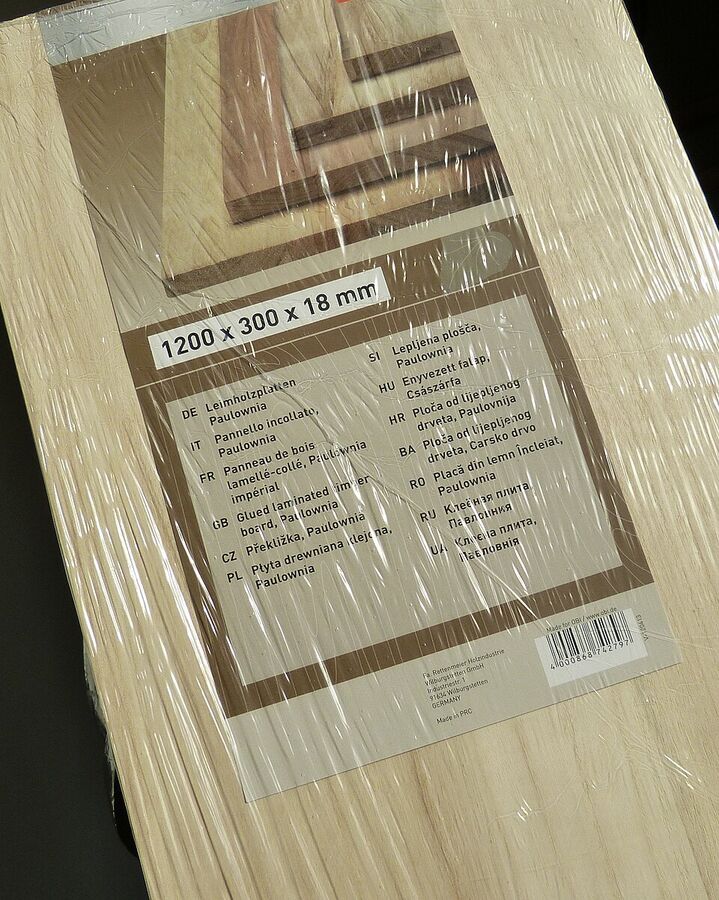
- Plantation boards sold as "paulownia" (like the edge-glued panel in the photo, made in China) may not be P. tomentosa: I did not verify the species behind any retail listing, so check the label.
- Some Japanese tansu use a different, harder face wood on a kiri carcass: see Keyaki and Sugi.
Working and finishing
Extremely easy to cut, plane and carve (Wood Database). Use sharp, hard-edged tools because of the silica. Wood Database says it glues well. Because it is so soft, expect it to crush under heavy clamp pressure; I found no finish data beyond staining, so test on offcuts.
Staining and finishing colour
Wood Database reports that it takes stain well. Test on offcuts to check evenness.
Sustainability and handling
Wikipedia lists P. tomentosa as Least Concern, and Wood Database does not list an IUCN rating; both agree it is not a conservation concern, and it is invasive in North America. I searched Species+ on 2026-09-30 and found no CITES listing. The Lacey Act covers imports into the US (timber since 2008, including violations of foreign law). EU buyers fall under the EU deforestation regulation for wood and furniture from 30 December 2026 for large and medium operators. I found no specific toxicity data; treat dust as an irritant and extract it.
Popular projects
Koto and other soundboards, katana-dansu and apothecary chests, wedding chests, drawer boxes and linings, lightweight cabinets, and carved decoration.
Buying notes
Look for plantation boards from Asian suppliers, either solid or edge-glued. Check moisture and flatness on arrival. Wood Database expects prices to be high for a species that is not domestic stock; I found no per-board-foot listing to quote.
Typical projects
- koto soundboards
- katana-dansu
- kusuri-dansu (apothecary chests)
- wedding tansu
- drawer linings
- edge-glued panels
Sources
- www.wood-database.com/paulownia
- en.wikipedia.org/wiki/Paulownia_tomentosa
- en.wikipedia.org/wiki/Tansu
- en.wikipedia.org/wiki/Koto_(musical_instrument)
- commons.wikimedia.org/wiki/File:Leimholzplatte_Paulownia.jpg
- speciesplus.net
- en.wikipedia.org/wiki/Lacey_Act_of_1900
- environment.ec.europa.eu/topics/forests/deforestation/regulation-de...
Researched 2026-09-30. Prices, conservation status and CITES listings on this page are indicative and were checked on that date. They change: confirm them with your supplier, and with the relevant authority before importing or exporting.