


Overview
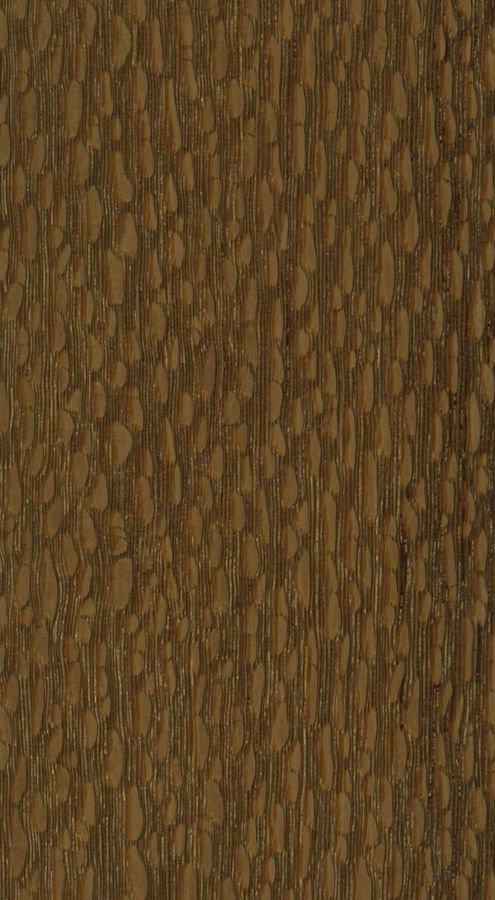
Leopardwood (Roupala montana) is a medium to dark reddish brown wood with conspicuous grey or light-brown ray flecks that look like leopard spots, strongest on quartersawn faces. It is used for veneer, guitars and show furniture. It is easily confused with lacewood.
Pros
- Dramatic ray fleck, best on quartersawn stock.
- Janka 2,150 lbf, about 885 kg/m3; hard and durable.
- Most species rated very durable.
- Glues and finishes well.
- Not CITES-listed and not on the IUCN Red List.
Cons
- Fairly difficult to work: dense, and it tears out when planed.
- Shrinkage is high tangentially (3.5% radial, 8.8% tangential), so quartersawn is the stable cut.
- Medium-to-high price for an imported wood.
- Easily mixed up with lacewood and silky oaks, so labelling is unreliable.
- Related Proteaceae genera have been reported to irritate eyes and skin.
Variants and subspecies
- Roupala montana: leopardwood proper.
- Lacewood: Wood Database notes the term is used loosely for any wood with lace-like figure, including leopardwood. Bell Forest sells lacewood as Panopsis, and the Australian silky oaks (Cardwellia sublimis and Grevillea robusta, see Silky oak) can look very similar.
- Quartersawn shows the strongest figure and is stabler.
Working and finishing
Plane quartersawn faces with a sharp, high-angle blade or use a scraper to avoid tear-out. It glues and finishes well. Sand carefully so the contrasting rays stay crisp.
Staining and finishing colour
Stain is rarely used. A clear oil or lacquer deepens the red-brown background and sharpens the fleck contrast; dye can flatten the figure.
Sustainability and handling
CITES and IUCN: not listed in the CITES Appendices or on the IUCN Red List (Wood Database; APHIS CITES Timber Manual, checked 2026-09-30). FSC availability is not verified here. The US Lacey Act makes it unlawful to trade wood taken or exported in breach of the source country's laws (fws.gov/law/lacey-act), so buy from dealers who can name the country and species. If a piece will be exported to or sold in the EU, Regulation (EU) 2023/1115 (the EUDR) requires due-diligence evidence that wood products are deforestation-free and legally produced; check its current application date with your buyer.
Ethical call: reasonable; ask the dealer for the species name because lacewood and leopardwood are mixed up. Health: no adverse effects are reported for Roupala lacewood, though other Proteaceae have caused eye and skin irritation. The US National Cancer Institute reports strong, consistent associations between wood-dust exposure and cancers of the nasal cavity and sinuses, so use extraction and a respirator when sanding.
Popular projects
Guitar backs and tops, cabinet doors and panels, show furniture, veneered boxes and turned pieces.
Buying notes
Two retailers list 4/4 at $19.99 (quartersawn) and $20.75 a board foot (September 2026). Quartersawn is the stock to look for. Check the label: 'lacewood' may be a different tree.
Typical projects
- guitars
- cabinetry
- fine furniture
- veneer
- turned objects
Sources
Researched 2026-09-30. Prices, conservation status and CITES listings on this page are indicative and were checked on that date. They change: confirm them with your supplier, and with the relevant authority before importing or exporting.