


Overview
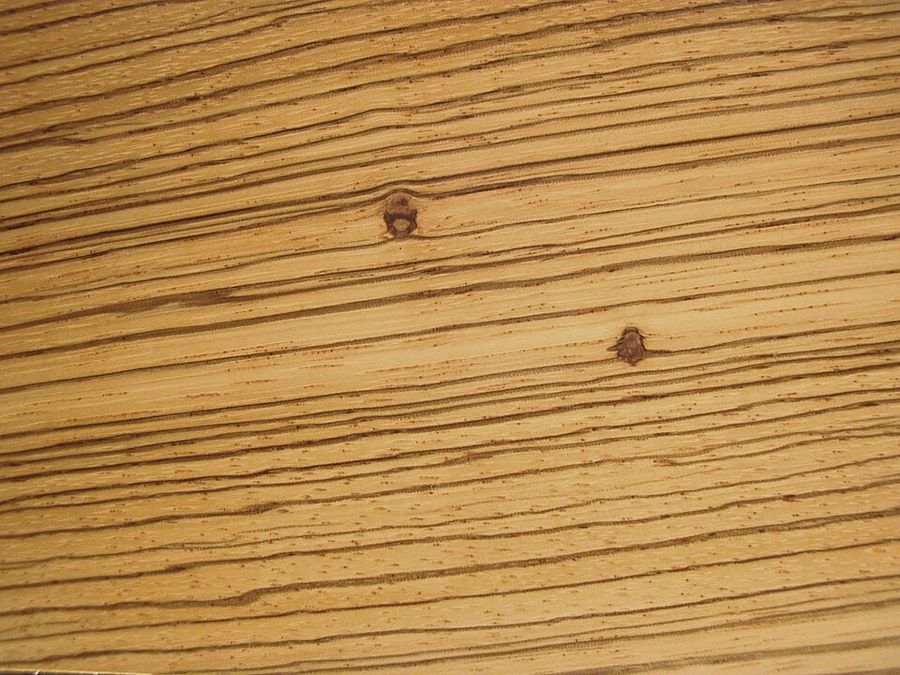
Zebrawood (Microberlinia brazzavillensis) has cream to light-brown wood with dark blackish-brown stripes, wide and erratic on flatsawn faces and narrower and more uniform on quartersawn ones. It is chosen for the stripes, not for easy work. It is expensive.
Pros
- Unmistakable stripes that vary by sawing method.
- Janka 1,830 lbf, about 805 kg/m3; strong and stiff.
- Durable and insect-resistant.
- Saws, glues and finishes well.
- Both lumber and veneer are available in good sizes.
Cons
- Planing is very difficult because of interlocking grain, and tear-out is common.
- Large open pores usually need a transparent pore filler.
- High shrinkage (7.6% radial, 10.8% tangential, 17.8% volumetric).
- Reported as a sensitizer, with eye and skin irritation the usual reactions.
- Prices are high, about $30 to $33 a board foot.
Variants and subspecies
- Microberlinia brazzavillensis: the principal species.
- Microberlinia bisulcata: Wood Database says this Cameroon endemic is sold interchangeably and is Endangered.
- Zebrano, zingana: alternative names.
- Look-alike: Tigerwood (goncalo alves) has a looser dark striping at lower cost.
Working and finishing
Saw readily; surface with a high-angle blade or scraper. Use pore filler for a smooth finish. It glues and finishes well, so the real work is in surfacing.
Staining and finishing colour
The stripes are the point, so finish clear. Strong stains can flatten the contrast, and the open pores soak up stain irregularly.
Sustainability and handling
CITES: not listed (Wood Database; APHIS CITES Timber Species Manual, checked 2026-09-30). IUCN: M. brazzavillensis is Vulnerable on a population reduction of over 20% in three generations; M. bisulcata, sold interchangeably, is Endangered. FSC availability is not verified here. The US Lacey Act makes it unlawful to trade wood taken or exported in breach of the source country's laws (fws.gov/law/lacey-act), so buy from dealers who can name the country and species. If a piece will be exported to or sold in the EU, Regulation (EU) 2023/1115 (the EUDR) requires due-diligence evidence that wood products are deforestation-free and legally produced; check its current application date with your buyer.
Ethical call: a caution; use it for accents or veneer rather than whole pieces. Tigerwood (goncalo alves) gives a bold stripe at lower risk. Health: reported sensitizer. The US National Cancer Institute reports strong, consistent associations between wood-dust exposure and cancers of the nasal cavity and sinuses, so use extraction and a respirator when sanding.
Popular projects
Veneered panels, drawer fronts and accents, furniture, instrument trim, inlay and turned objects.
Buying notes
Woodworkers Source lists quartersawn 4/4 at $29.99; Bell lists 8/4 at $33.00 per board foot, with 4/4 out of stock (September 2026). Quartersawn gives narrower, more regular stripes.
Typical projects
- veneered panels
- accent parts
- furniture
- guitar and instrument trim
- inlay
- turned objects
Sources
Researched 2026-09-30. Prices, conservation status and CITES listings on this page are indicative and were checked on that date. They change: confirm them with your supplier, and with the relevant authority before importing or exporting.